
A poem from Call and Response II
Streets keep turning up
where they shouldn’t—unless
my map’s the wrong way ‘round.
It’s useless, anyway; streets here
are unlabeled. (Well,
why should they be laden with names?)
Back somewhere, the canals misplaced me.
Behind them, I’d lost myself in Roman ruins.
I’m six time zones off
from my internal map,
with no time to re-center,
following my viewfinder wherever
it leads, snatching quaint anonymity
from scenes that will not
tell their stories
until one nondescript building
shouts, “LITTLE PETER STREET!”
places me back on the map
and I wind toward Victorian railroad arches,
red bricks blackened and green
with lichen and moss.
They recount
lifetimes of industry, ruin, reuse, whatever
my lens can read into them.
DISCUSSION
This poem began as a blog post. Well, technically, it began as me writing my stream-of-conscious reflection on the day into a journal I wasn’t really keeping (I never keep journals well) while on a trip in January, 2015. I had had a paper accepted in a conference at the University of Manchester – a city I’d always wanted to visit. OK, yes, I’m a Joy Division & Factory Records fan, but I know that particular music scene is well past. But I’ve long been intrigued by the city’s industrial history and post-industrial experience, and the aesthetic developed from that. (Sometimes, I’ve wondered if Joy Division was in fact to blame for my own ruin aesthetic, but I think JD just sounds like my internal landscape–one forged from growing up on a disused farm with bipolar disorder type 2.)
A few years later, I was invited to participate in Call and Response II (i.e., the second iteration of it), and I brought in this poem, along with my pantoum, to offer one or the other for an artist to select. The artist’s choice was “City Centre,” although he told me at the gallery show that he wanted to paint them both.
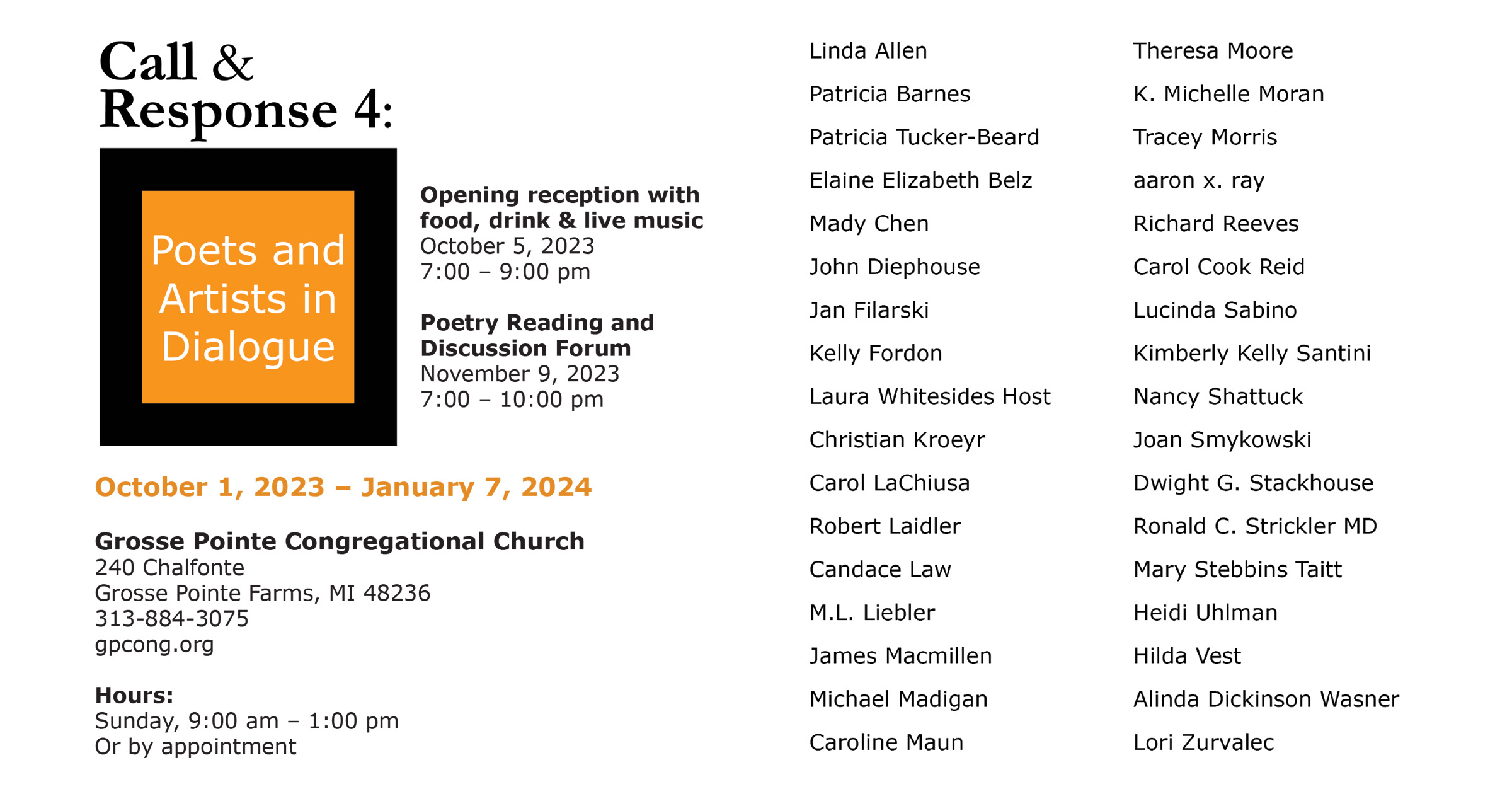
Call and Response is a program offered through the Arts Ministry of Grosse Pointe Congregational Church. This program invites visual artists and poets to respond to each other’s work. We would get together on a Saturday, with a small selection of our work. We’d draw numbers, and each poet could select an artwork and each artist could select a poem to respond to in our respective art forms. The resulting works were featured in a gallery show at the church, as well as in a book published by the Arts Ministry. Every contributor had two works in the gallery and book: the one they brought for someone to respond to, and the one they created in response to someone else’s work. There was an opening reception for the gallery show, and, near the end of the show’s run, an evening of talks and performances, where each poet read both of their poems, perhaps with commentary; and each artist showed slides of their works while discussing them. Creativity really abounded at all these events. The year I participated, the reading of one of my poems (“Kintsugi”) was accompanied by an interpretive dance!
I keep toying with the idea of fleshing this poem out more. I still might. A poem doesn’t have to be finished just because it’s appeared on the page (or the screen).
Astute readers will have noticed the two spellings of “centre/re-center” used, the first in the title, and the second in the poem itself. “City Centre” is the name of that part of the city of Manchester, and it would be wrong for me to Americanize its spelling. However, it would be equally inappropriate, I think, for me, a US American, to use the British spelling when it’s just me talking, basically.
During my visit to Manchester, I attended and presented at the two-day conference (a Friday and Saturday), and had three more days to enjoy the city. An online friend I’d never met before picked me up from the airport, and told me a bit about places we were passing as he drove me to the bed & breakfast where I was staying. On Sunday, after I’d attended the church he recommended based on my general churchmanship, he picked me up in his car and showed me around town. It was a delight. I enjoyed seeing the city from his perspective, and he left me with clues of places I’d want to check out for myself the next day. He took me to the Roman ruins and canals mentioned in the poem, so in reality I wasn’t there alone getting myself misplaced. I had a guide.
So on Monday, I spent the day walking around City Centre (give or take) by myself, spending a fair amount of time at the cathedral (where I also attended a mid-day Eucharist), and also visited the John Rylands Library, since my friend commented that they have a fragment of the oldest known canonical Gospel manuscript, which of course I had to see. I also remember fondly the clotted cream fudge I bought in the gift shop there. And I made a point to get to the People’s History Museum, which saw me making a wrong term and winding up in Salford. At the museum, I bought a mug which reads, “There have always been ideas worth fighting for.” It was practically all I had time to do there, although I did see an exhibit or two.
On top of all that, I wandered – really wandered, following the smaller canals running through the city or the large, brick railway arches that cut through it. Many of the archways have shops built into them now, which is quite charming. Others are as described in the poem: mossy, darkened, a little damp. Also charming.
All of that, plus statues, civic buildings, and miles and miles of pavement, all of which I over-documented (as I do) with snapshots to get the visuals down to go with the memories. It was exhilarating and also exhausting. It was primarily in moments where I realized I was lost – there really were few street signs that I could see – that my feet really made their displeasure known. Luckily, the weather was only a little bit rainy during my five days there, and the temperature was a balmy 12 degrees Celsius. It had been 12 degrees Fahrenheit when I left Detroit! Really the weather reminded me of Northern California at the same time of year. Californians also think it’s cold then.
2015 was well into the age of the smart phone, and I had used GPS before (a Garmin I purchased along the way to help me get home when I moved back from grad school in California) but in this case, I had neither. I had an iPad, which doubled as a camera when my digital camera’s batteries died, and a paper map, as I recall. With no access to the internet (who can afford the roaming charges?) I was reading a map, whether on paper or saved on my iPad.
The key difference between “reading” a map and using GPS, of course, is that the map can’t really tell you where you are; you must discern that from your surroundings. The map, then, can place you in context so you can then figure out how to get from there to somewhere else.
So this poem includes a few now-antiquated elements, which were already antiquated in 2015, but I’m always in a budget-driven lag behind new technology. My old digital camera still had a viewfinder, even though it also had a screen on the back. I often preferred to use the viewfinder, but I think by this point I was using the screen in real life but opting for the more poetic “viewfinder” in a poem about, well, finding my way (and enjoying the view).
I really was rescued by a building with “LITTLE PETER STREET” on it. As a bonus, I recalled that the old Factory Records headquarters was in that vicinity, so of course I paused there before heading through the railway arch described in the poem on my way to the now-familiar road back to my bed & breakfast.
–Elaine
PS – I am participating in Call and Response IV this year! I’ve finished and submitted my poetic response to the artwork I selected. I can’t wait to see and read all the works, and mingle again with such amazing, creative people at the gallery opening reception and the performance later in the year.

 The Sound
Leave a comment