
In 2019 I was invited to participate in the second Call & Response at Grosse Pointe Congregational Church. I brought my poem (which is at this post), and I selected this image from photographer Danny Rebb. (Seriously, go check out his work – he’s quite good.)
I had written my dissertation (ProQuest link) – well, at this time, I was wrapping up my dissertation (Academia.edu link) – on urbex photography (also called “ruin porn,” but I was examining when it might be taken seriously as art). So naturally, when I saw Danny’s photo, I made a beeline to claim it. Danny generously let me have the print he’d brought in that day; I have it framed in my spare room alongside the broadsheet of my poem, as they were hung together at the exhibition.
“Urbex” is a short-hand for the term “urban exploration,” coined by the late Ninjalicious (Jeff Chapman). Urbexers generally live by the Sierra Club maxim, “Take nothing but pictures; leave nothing but footprints” – although there are, of course exceptions. Ninjalicious brilliantly pointed out that if you take someone urbexing with you, they shouldn’t be a rule-follower – not just because urbex is precisely going into places you’re not supposed to go (sometimes, illegally), but because, he observed:
…a lot of people who usually behave well do so because they’re mindlessly obeying rules and laws, not because they’re carefully considering which actions are helpful and right and which are harmful and wrong. People who think laws are more important than ethics are exactly the sorts who will wander into an abandoned area and be so confused by their sudden freedom and lack of supervision that they’ll start breaking windows and urinating on the floor. Law-free zone, right? That means they can do anything they feel like, right?
Ninjalicious, Access All Areas: A User’s Guide to the Art of Urban Exploration (Infiltration, 2009) p. 19.
That quote really doesn’t have much to do with my poem; I just like it a lot. It sheds some clarity on the difference that sometimes exists between what is lawful vs. unlawful and what is right vs. wrong. And it doesn’t surprise me that someone who spent time wandering through spaces people normally don’t go, making observations and photographs, would think deeply on a subject like this. He probably also had a bad experience, perhaps with the specific examples of bad behavior he lists.
However, the ethical behavior of leaving nothing and taking nothing does relate to the structure of this poem. You’ll notice italicized phrases scattered throughout. This was a conscious choice to quote the exquisite reflections of photographer Harry Skrdla. Urban explorers often find scraps of documents or other materials in sites; I used these “found” pieces of Skrdla’s poetic language to mimic those found objects.
Skrdla’s photography is as revelatory as his observations. His book is among a surprising number of urbexers’ photography books that include remarkable philosophical and poetic musings on the very nature of dereliction, abandonment, and decay – and the causes thereof. Skrdla’s photographs are in black and white. He told me in his email that the book is out of prrint, but it is available for a reasonable price on Amazon.
Using Skrdla’s words, especially with the citation, does constitute fair use. Because I’m me, though, it took a while for me to get up the courage to contact him and send him the poem. Thankfully, he enjoyed it and approved.
And now the poem. (Yes, it has footnotes, but they are only to define the term kintsugi, and to cite the Skrdla book – at least here. I’ve moved one footnote into the text you just read above.)
Elaine Elizabeth Belz
KINTSUGI[1]
We construct buildings not just as shelter,
but as frameworks for life.
—Harry Skrdla, Ghostly Ruins[2]
Who built these ruins?
Vanished industrialists,
scavengers, scrappers
have all fled the scene, leaving
structure open to wind –
Once-grand edifice
now hackneyed desolation,
a record of what
we have wasted, crushed to dust.
Concrete crumbles to humus.
What terrible fate
left behind such detritus?
Sunlight attempts
to sort through rubble, unravel
prose into poetry,
its warm light
planting hope in new dirt:
a living being
possessed of a soul,
broken but not abandoned.
What does it know, this tree,
of market collapses and greed?
Sacred bush aflame –
riotous theophany
where few would trespass to find it.
Viewed from the inside,
ruins harbor all the world
open to new life.
Nature mends fissures with gold,
flaunts wrinkles without regrets.
[1] Kintsugi is a Japanese art of mending broken objects with gold.
[2] Harry Skrdla. Ghostly Ruins: America’s Forgotten Architecture. New York: Princeton Architectural Press, 2006. All italicized words in the poem are taken from this book.
I was pleased to finally be able to use the line about prose unravelling into poetry. That was something I tried to use in a poem maybe 25 years ago, but it didn’t work. I held onto it, though!
For anyone who has the book from Call & Response II, there was an error, and the last 3 lines of my poem were omitted. I luckily found out before it was my turn to get up & read it at the performance near the conclusion of the gallery show. Before the program began, I was surprised with the information that a dancer had selected my poem as one of two she would interpret in dance. She wanted to rehearse it with me reading it, so I sat in the back of the room where she had space to move, and read through it from the book…and...hey, wait, there’s more to it than this… Quickly, I went to the gallery (we were in another room, one with a stage) and the broadsheet was also missing the last 3 lines. Sometimes I actually can think on my feet, though, and I pulled out my phone, went to my Gmail app, and searched for the email where I’d sent the poem in. I copied the last three lines down into my copy of the book so I wouldn’t be squinting at my phone, and all was well. (I was since given a corrected broadsheet, which is the one I have hanging with Danny’s photo.)
In case you were wondering, I have been urbexing – but only a few times. Most recently, I’ve gone with Danny a couple times; but my first experience in urban exploration – before I knew it was called anything – was in 1998. In my memory, I was awakened by my then-roommate Paula while I was trying to sleep in on a Saturday, but I think that was actually the time she asked me if I wanted to go out in the rain to help our mutual friend Jim pick up a door someone had put to the curb so he could make art out of it. (He made a table top with photographs of churches and dirt, and words from the Tao Te Ching about the interrelation of beauty and ugliness on it. The work was about Detroit being a city of churches & trash – a line he got from a fellow art student who’d had his car stolen.) I honestly don’t remember if I went along…so I probably didn’t. You’d remember that, right?
Instead, I might have been perfectly awake when Paula had Jim on the phone and was asking on his behalf, did I want to come along with him, Paula, and Jim’s friend Len (all three photographers) to explore the Michigan Central Station? Um, of course! The only non-photographer, who also didn’t have any kind of camera at the time, I took along an unlined notepad to make rubbings if I felt so inspired, and/or to make notes for later poetry. In either case, I expected what I later read in Elaine Scarry’s On Beauty and Being Just – that beauty compels us to copy it. Record it somehow. [Paula and Len both took pictures of me, though, so Scarry might need to rethink what really motivates art-making. But they also took lots of photos of the building.] And I did write a poem, “Omen,” in which I simplified the three photographers into one. In the poem, I ask that friend, as I asked Paula in real life, to photograph a bird’s skeleton that was in the rubble on the floor in the main waiting room:
“A small bird’s dusty skeleton
lies, fetal, in the new dirt floor.”
Some years later I learned that my great-great grandfather, a carpenter, had been one of many, many laborers who worked on that building.
Not even knowing what “urbex” was, I also didn’t know the ethic, but I don’t think I seriously violated it. People around this time (when you could just walk right into the train station) were pulling marble off the walls & taking fixtures. I did take some souvenirs, but nothing that could ever have been used in restoration. While we were on the tracks out back, I collected some decent-sized fragments of the glass ceiling that now was shattered all over the tracks. It was glass with hexagonal chicken wire embedded inside, with one relatively smooth side and one ridged side. I brought them home, filed down the sharp edges, & use them as coasters. I’ve recently dabbled (poorly) in doing some pseudo-kintsugi using gold-colored powder in epoxy to repair highlight the cracks in some of them. I’m actually contemplating cracking them all so I can add the gold in. Here’s a blurry photo of one, plus a close-up (yikes, I did a terrible job – but it was my first attempt), and a picture of the coaster in use:
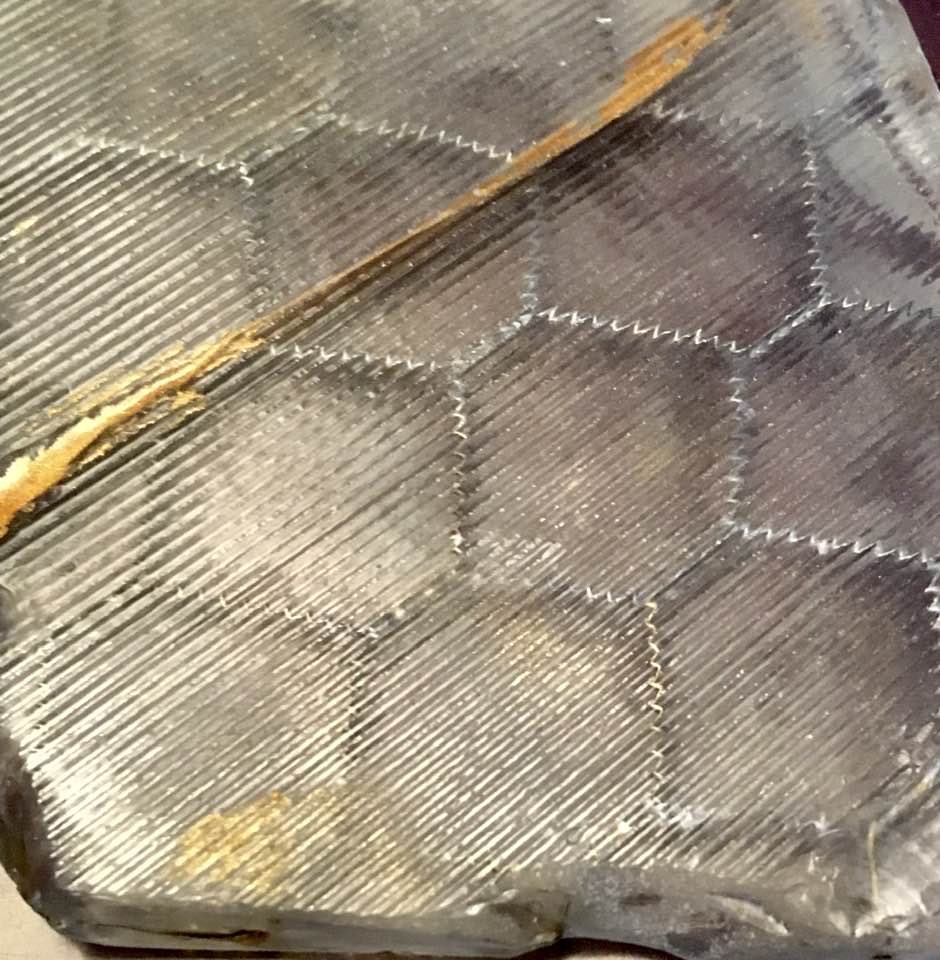


The difficulty for me, other than declining eyesight & a less-steady hand than I had earlier in life, is that the cracks don’t actually break the glass. The chicken wire inside holds them together, but with a gap. So I was trying to close up the gap, and to a certain degree, just ended up putting too much glue on it. Plus I smudged it.
I’ve also had the thought to somehow get a dusting of the gold in spots along the edges, rather than cracking them all. What do you think?

 The Sound
Leave a comment