
Year A – November 30, 2025
Note: I am beginning a series of blogging on the Sunday Eucharistic lectionary—the Revised Common Lectionary as used in the Episcopal Church—paired with artwork. This project has its origins in bulletins I used to make for St. Andrew’s Church, Livonia, although I wrote much shorter reflections.
Lectionary readings:
Isaiah 2:1-5
Romans 13:11-14
Matthew 24:36-44
Psalm 122
You can read them online here: https://lectionarypage.net/YearA_RCL/Advent/AAdv1_RCL.html
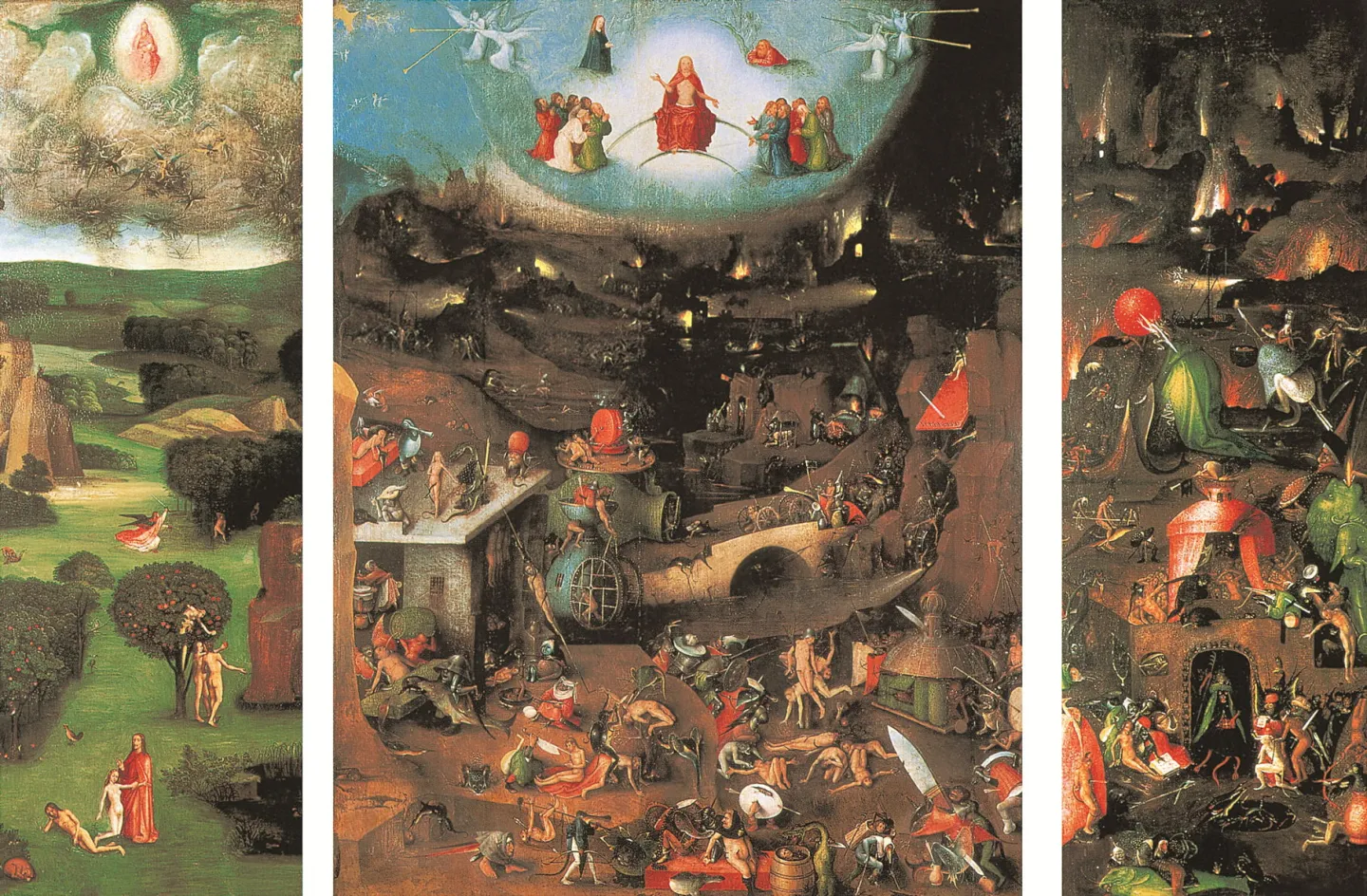
Advent comes with so many clichés: It’s the “now and not yet” season, where the annual cycle spins around from Christ the King Sunday and aims us toward Bethlehem. The first Sunday in Advent transitions us into the season of expectation and preparation for Christmas by focusing first on Jesus’ second coming.
I’ll admit, it’s daunting to blog about the return of Christ, as there are so many different understandings of it across Christian traditions. I grew up in a tradition that interprets the book of Revelation and all the other apocalyptic literature in the Bible as prophetic prediction of something that is in our future. As a child, I had nightmares about the surreal imagery, such as the sun falling from the sky and the moon turning into blood.
Now as an Episcopalian, I get to reckon with our peculiar cliché of singing Charles Wesley’s “Lo, He Comes with Clouds Descending.”1 That hymn builds on Revelation 1:7, which states that all the nations of the world will weep on account of Jesus when they see him. When I juxtapose Revelation’s emphasis on economics and the oppressive economic systems of our own time, I can certainly imagine what Jesus’ return would do to stock exchanges everywhere, and can easily picture the weeping and wailing of all who wrest profit from others’ labor and pain. “Every eye will see him,” John of Patmos writes, “even those that pierced him.” Jesus was brutally killed by the powers of empire that still commit brutality against the poor and marginalized, and against all who oppose the powerful. And Jesus told us that what we do to the least of these, we do to him. “Even those that pierced him” isn’t necessarily a reference to ancient history.
In Bosch’s Last Judgment, pictured above, we see what looks like an apocalyptic nightmare. On Christ’s right hand is a depiction of paradise. In traditional form, he gestures, palm up, to invite the blessed into that paradise. But we also see there a depiction of the creation of Adam and Eve and their expulsion from the garden. Hell lies on Jesus’ left hand, and his palm faces down to indicate damnation. But hell also stretches out before him, as if to show us our own world as it is revealed in the light of God’s glory. Even paradise in this scene is a reminder to the viewer of how far we are from God’s design for our world. In this sense, perhaps Christ’s judgment is of the sort described in the fourth Gospel—a light present among us that shines in the darkness and reveals the truth about the hellscape we so often find ourselves in right here on earth.
Today’s lectionary readings, however, strike a different, perhaps more hopeful, tone.
The Gospel passage has Jesus using apocalyptic imagery to warn his disciples that the “coming of the Son of Man” will happen suddenly and unexpectedly, and so they must be prepared. He doesn’t specify for what, exactly. He alludes to the Genesis flood, which “swept away” all the world’s inhabitants (apart from Noah’s family), and compares that to workers being suddenly taken (although in each case one worker is left). Whatever is happening, it is happening quickly.
In the Epistle, Paul2 gives us some more hints. He’s writing before the Gospels were written, so it’s not commentary on Matthew. But he encourages us to be prepared because our salvation is approaching. “The night is far gone; the day is near.” We’re so used to hearing of doom in both religious and secular predictions about the future, but however dreadful that day may be, Paul reminds us that it is about salvation. Yes, we should prepare ourselves for it—but it’s a good thing!
You may have noticed I’m moving backwards through our lectionary readings. But we’re in a season now that starts with Christ’s second coming and moves to his first, so I’m not without precedent.
The Psalm, famously set as a coronation anthem,3 begins, “I was glad when they said to me, ‘Let us go to the house of the Lord.’” Like the Romans passage, this is good news. The house of the Lord is the seat of judgment, and the people of God stream there to praise the Lord—the people of God here being, of course, the tribes of Israel. But the prophetic words of Isaiah announce God’s intention to draw “all the nations” to that house as well:
In days to come
the mountain of the Lord’s house
shall be established as the highest of the mountains,
and shall be raised above the hills;
all the nations shall stream to it.
Many peoples shall come and say,
‘Come, let us go up to the mountain of the Lord,
to the house of the God of Jacob;
that he may teach us his ways
and that we may walk in his paths.’
For out of Zion shall go forth instruction,
and the word of the Lord from Jerusalem.
He shall judge between the nations,
and shall arbitrate for many peoples;
they shall beat their swords into ploughshares,
and their spears into pruning-hooks;
nation shall not lift up sword against nation,
neither shall they learn war any more.
Isaiah 2:1-4, NRSV
I think the picture that these lectionary readings draw together is one where judgment really is “already and not yet,” as Christ present among us reveals our actions, our lives, our world to us in light of God’s glory. This kind of judgment doesn’t damn persons, though; it moves them to change. When we truly see by the light of God Christ brings, we want to go up to the house of the Lord, and beat our swords into plowshares. We want to, in Paul’s words, “live honorably in the day” and “put on the Lord Jesus Christ.” We want to learn wisdom and instruction from God. We want to walk in God’s paths.
On to Bethlehem, then.
- I won’t go into the full tangent here, but I am on the side of the debate that finds the second verse antisemitic, and I just might be prepared to die on that hill, but not here and not now. ↩︎
- Romans is generally held as one of the undisputed letters of Paul. ↩︎
- C. Hubert Parry (1848-1914) as performed at the coronation of Charles III: https://youtu.be/oh4EeA2IylQ?si=fZ7oXQ-0_ecCPjKY ↩︎
 The Sound
Leave a comment