
Years A—January 4, 2026
Happy New Year! And Merry Christmas. The readings for this Sunday are:
- Jeremiah 31:7-14
- Ephesians 1:3-6,15-19a
- Matthew 2:13-15,19-23
- or Luke 2:41-52
- or Matthew 2:1-12
- Psalm 84 or 84:1-8
Since these are the same readings assigned to all three years of the lectionary cycle, I will use the first Gospel listed for today. (Additional note: I will cover the Feast of the Holy Name in a subsequent year.)
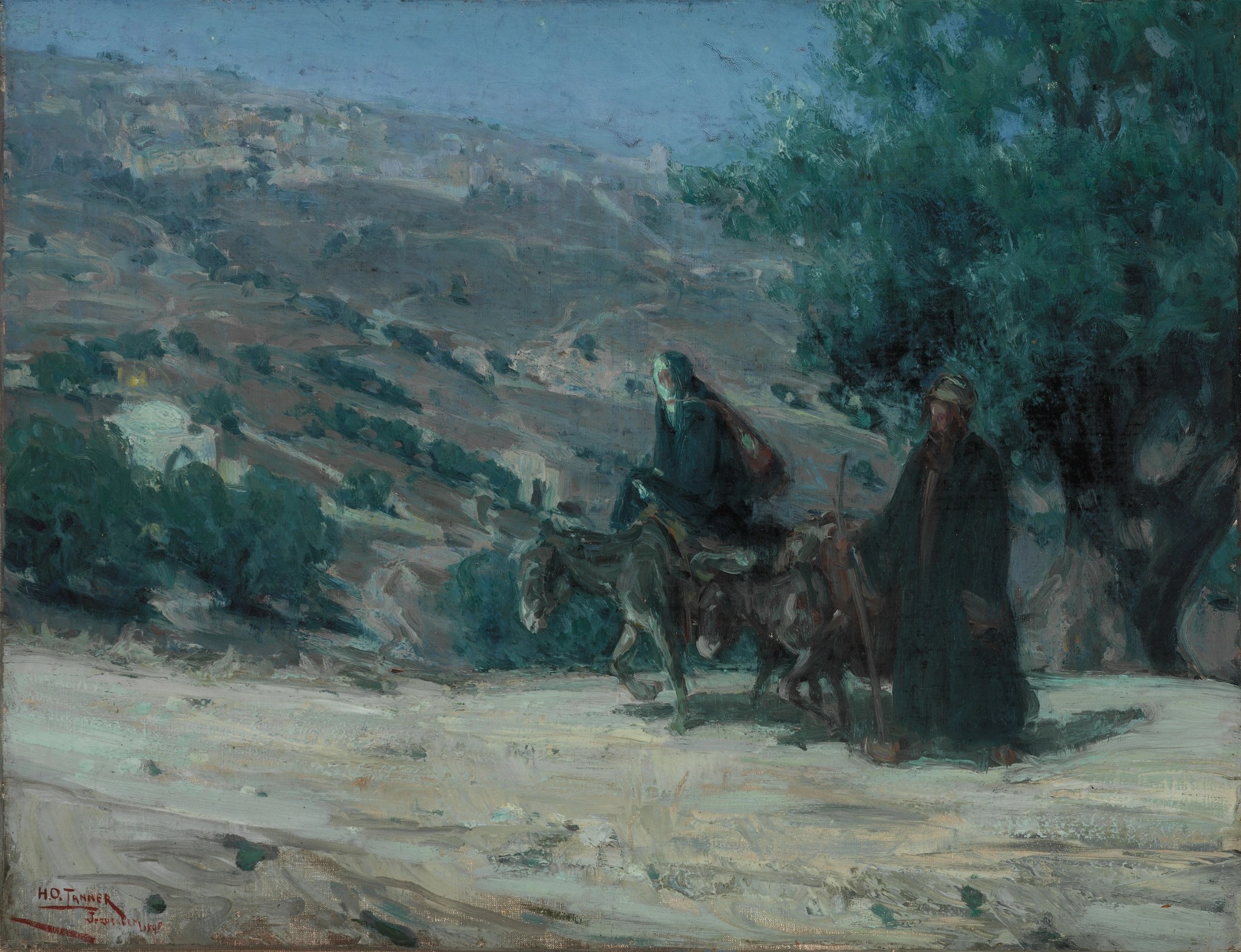
The artwork above, Henry Ossawa Tanner’s Flight into Egypt (1899), is one of many religious works by the painter—others include the famous genre paintings, The Thankful Poor (1894) and The Banjo Lesson (1893). In his genre work, Tanner focused on the African American experience, seeking to share with wider audiences more genuine scenes of family life, tradition, and, in his own words, “the warm big heart”1 he recognized in his African-American Appalachian subjects.
Tanner was born in Pittsburgh. His father was an AME bishop, and both his parents were educated; they ensured that all their children received an education (including a younger sister who practiced medicine.) Having decided at thirteen that he wanted to be a painter, Tanner studied at the Pennsylvania Academy of the Fine Arts in Philadelphia. Over the years, his work took a variety of styles as well as subjects, including landscapes, religious themes, and daily life. He is famous as the first internationally renowned African-American artist. He lived in Paris2 from 1891 until his death in 1937, returning to the US from time to time for professional activities, and of course, to visit family. His 1894 watercolor, Crossing the Atlantic (Return Home) (below) may have been a way to pass time on a long ocean trip, or a study in the colors, shadows, and textures of clouds and sea water; but it gives us a sense of the vastness of the ocean and isolation of the ship that no doubt would have been dwarfed by its setting.
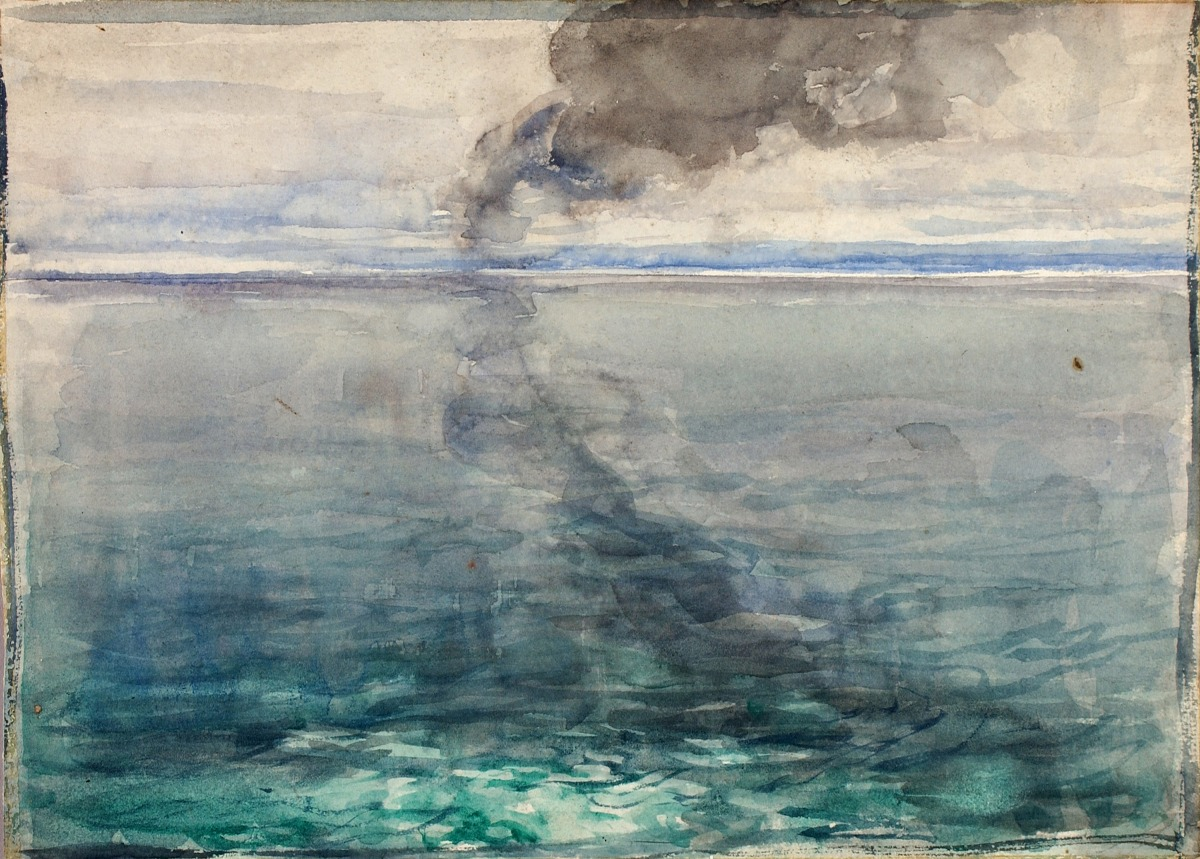
I can’t help but compare it with the Flight into Egypt, both images awash in blues and depicting not the journey ahead, but the ground (or water) that has been covered. In both compositions, we cannot know how far along in the journey we are. As such, these scenes depict the journey as journey, with all the uncertainties intact.
Not all of Tanner’s work is blue, though, and the Flight into Egypt cradles its subjects in warmer hues. I’m no expert on his work, but many of the religious paintings of his that I’ve seen often use warmer colors, which convey to me both the light and intimacy of the divine. His painting, The Annunciation (1897) is brightly lit by the angel Gabriel, set in predominately yellows and reds, and much more detailed than the Flight. In fact, in the Flight into Egypt, we can’t really see the Christ child. Presumably, he is wrapped up for safety and warmth somewhere in Mary’s garments. Tanner painted other scenes from the Holy Family’s journey to Egypt,3 and in some of these, we can make out the baby Jesus more or less on Mary’s lap.
In our Gospel story for today, the Magi have come and gone. Joseph is warned in a dream that Herod wants to kill little Jesus. Famously, the author of Matthew (let’s go ahead and call them “Matthew”) wants Jesus’ life to recapitulate Israel’s history, and spending some formative time in Egypt is an important piece of that. It allows Matthew to apply to Jesus the words of Hosea 11:1: “When Israel was a child, I loved him, and out of Egypt I called my son.”
For Christians, this recapitulation of sacred history ties in with Paul’s assertion in the Ephesians passage for today, that God has “destined us for adoption as his children through Jesus Christ.” Hosea calls Israel (the ancestor Jacob and his descendents) God’s son; and while Jesus would be included in Hosea’s use of “Israel,” Matthew seems to want all that “son”-ness to focus itself onto Jesus. Paul, then, has Jesus extending his sonship—or better, childship (since gendering everyone as male is not the point)—to us.4
Our passage from the Hebrew Scriptures (Jeremiah 31:7-14) is not about the exodus from Egypt but rather the return from exile in Babylon. It continues the theme we’ve been reading this season, of joyful return and God’s provision of all the necessities of life. Included in those making the journey are “the blind and the lame, those with child and those in labor, together.” They will begin the journey with weeping, but God will change all that. Echoing the Hosea passage Matthew alludes to, Jeremiah reports God’s declaration, “I have become a father to Israel, and Ephraim is my firstborn.”
While this passage belongs first and foremost to the historical setting in which it was written and the people to whom it was written, and to the Jewish people whose sacred Scripture this is, we Christians who also claim it as sacred Scripture might read into it some familiar themes. Importing Paul’s adoption metaphor, we might see ourselves as among those being called into covenant with God. Or we might see Jesus included in the holy people returning home, or at least foreshadowed there, as he is for Matthew. In any case, we can recognize a pattern here, familiar from so much of Scripture: that it is always God’s intention to restore, to heal, to comfort, to deliver, to renew, to refresh, to redeem, to provide. Despite appearances, God is always acting in our world to move us from brokenness to restoration, from weeping to rejoicing.
Having thus returned (vicariously, through these texts), we find our home in God’s house. The Psalmist describes the Temple in such tender and devoted terms.
The sparrow has found her a house
and the swallow a nest where she may lay her young;
by the side of your altars, O Lord of hosts,
my King and my God.Psalm 84:2, BCP Psalter
The Psalm reads like an ecstatic outburst. I picture the Psalmist weeping for joy and sometimes nearly giddy with laughter. And if I may take more liberties, verses 4 and 5 transform the journey of return (whether from exile or from Egypt) into a pilgrimmage—no doubt, to the Temple, a pilgrimmage ancient Israelites would have made, when able, for various feasts. Here, as in Jeremiah, dry places are flooded with drinkable water as God provides what is needed to complete the journey and arrive home.
So it’s not the vast, engulfing, undrinkable floods of the ocean in Turner’s Crossing the Atlantic (Return Home), but we can certainly see God’s hand in the Flight Into Egypt, as the way is bathed with clear light, warmth exudes from within the scene, and the baby is safe and warm, wrapped in his mother’s clothing, and held securely in her arms.
Post-script: Matthew uses the flight to Egypt to relocate Jesus to Nazareth from Bethlehem. Biblical scholar Dan McClellan has a quick explainer video about Matthew’s and Luke’s birth narratives and how their handling of having Jesus born in Bethlehem contradict. There’s a lot of scholarship backing this up, but this short video sums up a lot of the details.
In short, Matthew seems to have Mary and Joseph already living in Bethlehem all along; returning from Egypt, they relocate to Nazareth because Joseph is vaguely warned in a dream about Herod’s son who is now ruling in Jerusalem. Luke had Mary and Joseph living in Nazareth but going to Bethlehem for a census (see McClellan’s short explainer on the census here) and then returning to Nazareth. In both cases, the authors were trying to hit a couple points: the historical fact that Jesus was known as “Jesus of Nazareth;” and the desire to have his birth fulfill what was seen as a prophecy that the Messiah would be born in Bethlehem. (It should be noted that messianic expectations were and are complicated; there has never been a single perspective on this in Judaism, but there is a long history of Christians cobbling one together that Jesus is cued up to fulfill.)
These details complicating the potential historicity of these accounts would be bad news if our primary concern were with literal accuracy, as if our salvation were bound up in the factual details of a newspaper account. Thanks be to God, it is not. However it transpired in hisotry, the Word was made flesh and dwelt among us, and we are saved.
- Boime, Albert (1993). “Henry Ossawa Tanner’s Subversion of Genre”. The Art Bulletin. 75 (3), 419. (This reference is supplied in the Wikipedia article linked for the painting. The article is available through JSTOR.) ↩︎
- He moved to Paris in large part to work without the constant hindrance of Ameican racism. Boime (1993) gives an example of a reviewer who laments his use of cool tones she deemed more proper to “Anglo-Saxon” artists: “Their work has the clean, athletic objectivity of their race. But H. O. Tanner is not an Anglo-Saxon. His work is in its essence oriental, it is subjective, almost mystical.” For this reviewer, (Eunicdee Tietjens of Evanston, IL), warm tones would have been more appropriate for an African-American (or any non-white, really) artist. Tanner, it should be noted, came from a family with ties to the civil rights movement of the late 19th century. Frederick Douglass and Booker T. Washington were both family friends, and Tanner participated in the symposium at the counter-exhibits set up under the leadership of Ida B. Wells and Frederick Douglass to protest the exclusion of African-Americans at the 1893 Chicago World’s Columbian Exposition (a.k.a. the Chicago World’s Fair). The World’s Fair in Chicago that year included extremely exploitative exhibitions of people from Africa, depicting them as savages; and with the exception of a “Jubilee” day where non-whites were permitted to enter, the fair was closed to People of Color. African-American Chicagoans set up counter-exhibits and distributed Wells’ pamphlet, Why the Colored American Is Not in the World’s Columbian Exposition. ↩︎
- See, for example, his 1923 painting here, where we can see Mary holding Jesus in her arms; and Tanner’s slightly earlier (c. 1916-1922) oil on wood version, where the child appears to be on his mother’s lap, here. ↩︎
- There currently isn’t (quite) an equivalent gender-neutral term for “sonship,” but the way to fix that is for us to use alternatives. “Childship” was one possibility I found. It jars because it is unfamiliar, but I think trying to replace it with a word that wouldn’t jar so much does nothing to move us toward a better term. ↩︎
 The Sound
Leave a comment