
The Second Sunday after the Epiphany, Year A—January 17, 2026
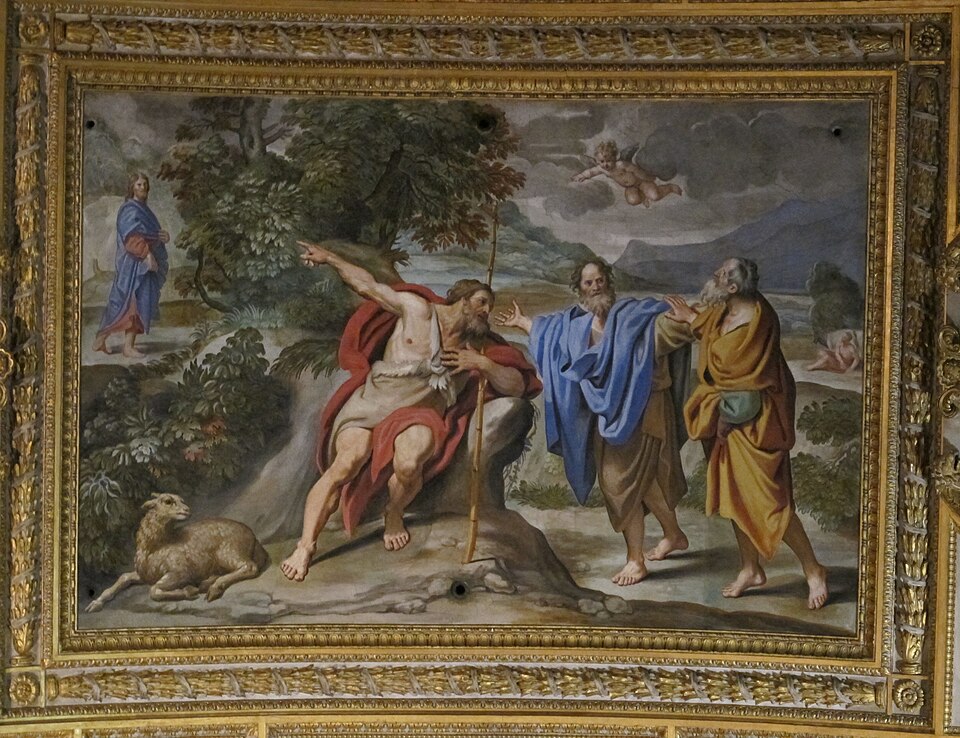
Today’s Gospel begins in the second day of a three-day sequence in the ministry of John the Baptist:
- Day 1: In conversation with some Pharisees, John dispenses with the popular suggestions that he might be the Messiah or perhaps Elijah. (Elijah was expected to return to herald Messiah’s coming.)
- Day 2: John sees Jesus approaching, and recounts an event that has already happened: when he baptized Jesus and saw a vision of a dove descending on him, which God had told him would indicate “the one who baptizes with the Holy Spirit.” We’re not told who his audience is. A crowd there to hear him preach? His disciples? We’re not told why Jesus was approaching; only that John told the crowd he was the Lamb of God and the Son of God.
- Day 3: John is with two of his disciples. He sees Jesus walking by, and shouts, “Look! The Lamb of God!” So his disciples apparently leave John standing there, and follow Jesus instead.
It seems that the author of this Gospel is taking some pains to sideline the Baptist. He has John say several times, “I myself did not know him.” And in a scene where John is drawing crowds and Jesus is milling around, Jesus starts stealing John’s disciples. Most importantly, John begins by denying he himself is the Messiah, and then, in slightly different terminology, proclaims that Jesus is.
As for John’s disciples, we learn only one of their names: Andrew. Together, these disciples catch up to Jesus, who, noticing they’re following him, ask them what they want. “Rabbi, where are you staying?” Jesus says, “Come and see.” So they followed him and stayed with him the rest of the day. Maybe they had thought if Jesus had nowhere to stay, they could invite him to wherever they were staying. But it sounds more to me like they were interested in hearing him, and possibly following him if what they heard confirmed John the Baptist’s claims about Jesus.
Andrew had a brother named Simon. The author seems to assume we already know this brother, since he introduces Andrew by name first as “Simon Peter’s brother.” Andrew sought out his brother and said to him, “We’ve found the Messiah!” [I like to picture this along the lines of that West Wing flashback of Josh running through the rain to pull his his friend Sam out of a meeting to join then-candidate Bartlet’s campaign.]
The first thing Jesus does upon meeting Simon is change his name. Our lection ends there, almost guaranteeing we’ll miss the fact that this contradicts other accounts where Jesus gives Peter that new name at his confession of Jesus as the “Christ, the Son of the Living God”—essentially what John the Baptist has already told us in this first chapter of the Fourth Gospel.
In Isaiah, we have what first appears to be simply the prophet’s reflection on his calling. Isaiah seems to see this calling as if it’s written in his DNA, placing it prior to his birth. But quickly this simple reading gives way to at least a couple other readings.
And he said to me,
‘You are my servant, Israel, in whom I will be glorified.’
OK, so this is about Israel, then.
And now the Lord says,
who formed me in the womb to be his servant,
to bring Jacob back to him,
and that Israel might be gathered to him…
‘It is too light a thing that you should be my servant
to raise up the tribes of Jacob
and to restore the survivors of Israel;
I will give you as a light to the nations,
that my salvation may reach to the end of the earth.’
Hm. Well, we know that being a light to the nations is Israel’s vocation. Who is this person that should embody Israel’s vocation and bring Israel back to God?
I don’t think there’s one right answer, even if you limit your scope to Jews or Christians. In both groups, there will be many who identify the first person in this passage as the Messiah; it’s just that Christians will identify that Messiah as Jesus and Jews will not.
The (admittedly provisional) way I try to navigate this is to assume prophecies always speak to the context in which they are written (which may be different than the context they portray). Secondarily, they derive their meaning from the Jewish interpretive tradition. Then, for Christians, they can take on significance not as predictions about Jesus, but as interpretive lenses his first followers used to read him into their own (Jewish) understanding of God and God’s actions in history. Even so, we’ll come to very different conclusions than will our Jewish siblings in faith. I think it’s important for Christians to be honest and deliberate about all this, since we’ve been coopting Jewish Scripture for two thousand years as if it were ours to begin with. When in reality, we read Jesus through the Hebrew Scriptures because it is what shaped Jesus’ own self-understanding and his disciples’ message about him.
In any case, the messianic servant in this Isaiah passage is called before birth to call God’s people back, in turn, to who they were called to be before birth: a light to the nations, for the salvation of the world. And look at the reversal at the end of the passage! Those who are despised slaves of the rulers of the world will draw the attention of kings and princes, who will prostrate themselves when they see the same people of Israel as God’s people.
The Psalm follows a similar theme. The Psalmist is lifted out from a muddy pit, and placed on solid, elevated ground. This has changed the Psalmist’s cry for help into a song of joy and praise—and “many shall see, and stand in awe, and put their trust in God.”
Beginning in verse 7, we see the portion of the Psalm that the author (who wasn’t Paul) of Hebrews (which was not a letter and probably wasn’t to any Hebrews) uses to apply to Jesus as Messiah. That anonymous writer was working from the Septuagint, though, which renders the Hebrew line, translated in the BCP psalter as the parenthetical “you have given me ears to hear you” with “you have prepared a body for me.” The Septuagint’s wording plays extremely well into the Christian reading espoused by the author of Hebrews, that this Psalm is about Jesus. There’s no reason Christians can’t read it that way, as long as we recognize that this is not the literal, historical, or in any sense plain reading of the Psalm. However, for Christians, Jesus is precisely the one who used the ears God gave him to obey God’s commandments, and so needs offer no sacrifices to atone for his own sin.
Aaaand here’s where we run into the problem with the Lamb of God John the Baptist has sent us off to follow—or, rather, our understanding of what that means.
I’m not sure what Andrew and his companion might have heard in “Lamb of God” or seen in Jesus as he was simply walking by. But centuries later, on the other side of a whole lot of theology, biblical interpretation, and history, the way we understand this passage and the appellation, “Lamb of God,” will be heavily shaped by what we were taught to hear in it.
For many Christians, Jesus is easily domesticated as a sacrificial lamb, a body God prepared in order to sacrifice it. His life, teachings, and resurrection are all relegated to the supporting role of “proving” Jesus was God and/or that his sacrifice was accepted by God. The important thing about Jesus is he died to take away your sin, if you believe in him. The right way.
And I realize this isn’t exactly an “iron man,” but it’s also not a straw man. I grew up with it. We did value Jesus’ teachings and consider it important to obey them, but they were also reinterpreted so as to be inoffensive to 20th-century middle-class American sensibilities. Good followers of Jesus were patriotic, which wasn’t a problem because after centuries of reassigning all God’s promises to Israel to Christendom, Christians were pretty good at making their own nation into a nation blessed and chosen by God to be a light to the nations, or spread democracy, or something.
And so Jesus became a silent, helpless victim of God’s wrath so you don’t have to.
Meanwhile, and unsurprisingly, the world’s sin (note it’s not plural) has not been taken away. It seems to be multiplying.
Recently, the Department of Homeland Security put out a video citing Jesus’ saying, “Blessed are the peacemakers, for they will be called the children of God” while showing military actions by heavily armed troops who fire guns, break down doors, and arrest People of Color. (I won’t link to them; here’s Dan McClellan’s response video, where you can see the original.) Here were my thoughts in the comments and when I shared Dan’s video on social media:
There is SO much wrong with that DHS video, from a theological perspective. And it goes back to questions of soteriology. When we made Jesus a passive scapegoat and victim to excuse people who intellectually assent to the “right” beliefs, we became Rome and made God Incarnate into a tool of Empire. It was Pax Romana that crucified Jesus, and we are now engaging in Pax Americana, which is as brutal, as violent, as illegitimate, and as much of a lie as when the Romans did it. Make no mistake: ICE would kill Jesus. In fact, it does kill Jesus every time someone dies at their hands.
I realize that snippet doesn’t connect all the dots, and this is a very long post. To summarize, if the moral concerns of a populace are bound up in their own personal failings and the risk of eternal punishment if they don’t believe and do what is required to appropriate a sacrifice for their sins, then it becomes really easy for the powers of Empire—whether in the state or in the church—to manipulate that populace, or at least divert their attention from all sorts of atrocities. And when the entire cosmos is built on the logic of an honor system that requires violence and torture to uphold the good, then, well, your moral compass is not going to point the right way.
So how might we understand Jesus as the Lamb of God?
For starters, we can keep in mind that the writers of the New Testament engage pretty much every metaphor they can to describe the salvation they experience in Jesus, against the backdrop of the Hebrew Scriptures as read with Greek, or Hellenistic Jewish, eyes. Such a feast of imagery actually resists being reduced to a prosaic, doctrinal rendering. Second, we can recognize that all of these interpretations are contextual, and we can rework them in our context. Third, we actually should revisit our doctrinal formulations in light of the results they produce. If our ideas about Jesus create a world Jesus would oppose, then our doctrines need to change, or else we need to admit that they are our god, and Jesus is now a sacrifice made to our dogmas.
I honestly thought I would skip the 1 Corinthians passage, but perhaps it’s a good way to wrap up. If we started with a promise of saving light going out to all nations, here we have a little picture of some small bit of that light being reflected back. Paul will have criticisms for the church in Corinthians; but he orients his letter by celebrating the spiritual gifts that church exemplifies and the promise that they will be strengthened and perfected by Jesus through the faithfulness of God.
 The Sound
Leave a comment