
“On Emerging—Strangely, Alive”
“Restoring a Sentimental Wheelbarrow with Rust”
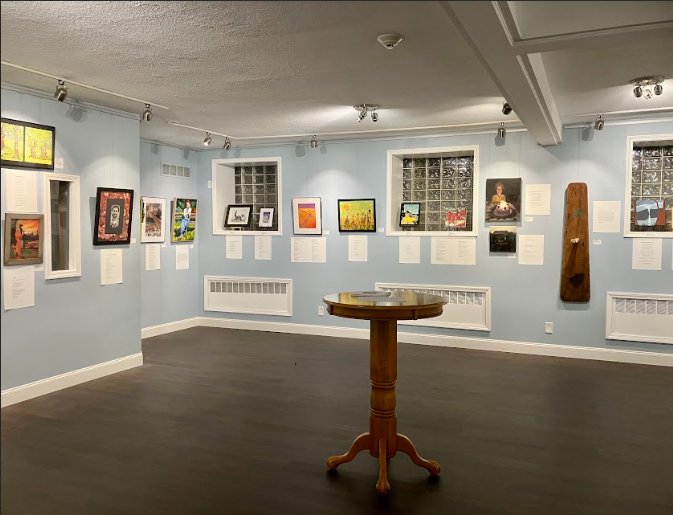
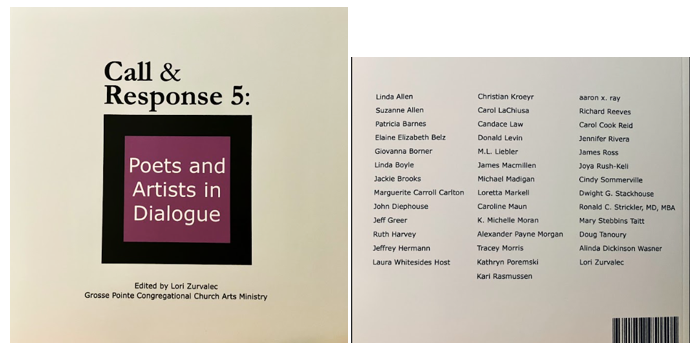
In 2025, I was invited for the third time to participate in Call & Response, a fantastic program of the Grosse Pointe Congregational Church’s Arts Ministry. The premise of the program is that poets and visual artists respond to each other’s work, and it results in a gallery show, a live poetry reading with artists’ talks, and a book. The gallery show closed on Sunday, February 1, 2026. As is my custom, I’m sharing these poems of mine that were published in the book and displayed in the gallery show.
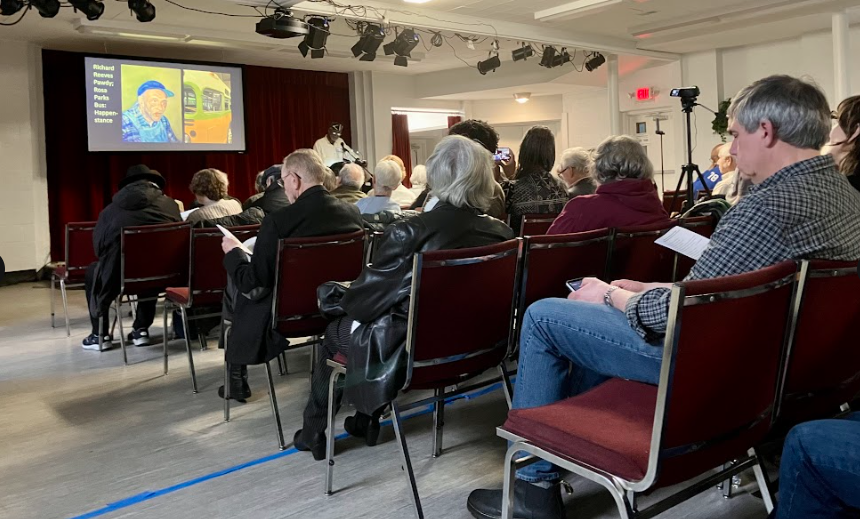
Last summer, we poets and artists converged at the church to choose the work we would respond to. Each participant submitted several of their works; once one was chosen, the rest of their work was taken out of consideration, so that everyone would have two pieces in the show: the one they brought, and their response to someone else’s work.
It just so happened that photographer Marguerite Carlton and I chose each other’s work. That happens sometimes. The poets had submitted in advance so that the artists could read them ahead of time. When I selected Marguerite’s photo, Functioning Treasures, I asked the coordinator Lori Zurvalec to point her out to me, and I went to introduce myself. She told me she was hoping to be able to choose one of my poems (the choices are made by drawing numbers). We got to know each other a bit (we’re both Episcopalian!) before her number was called and she was able to claim the poem she wanted.
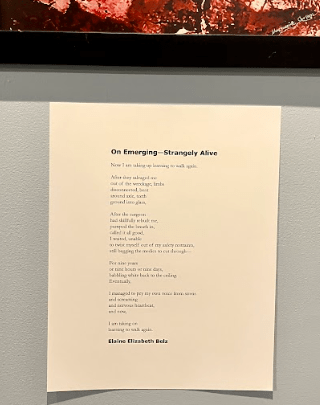
The broadsheet of my poem hanging below the photograph in the gallery show
Here it is (trigger warning: describes a serious car accident):
Elaine Elizabeth Belz
ON EMERGING—STRANGELY, ALIVE
Now I am taking up learning to walk again.
After they salvaged me
out of the wreckage, limbs
disconnected, bent
around axle, teeth
ground into glass,
After the surgeon
had skillfully rebuilt me,
pumped the breath in,
called it all good,
I waited, unable
to twist myself out of my safety restraints,
still begging the medics to cut through—
For nine years
or nine hours or nine days,
babbling white back to the ceiling.
Eventually,
I managed to pry my own voice from sirens
and screaming
and nervous heartbeat,
and now,
I am taking on
learning to walk again.
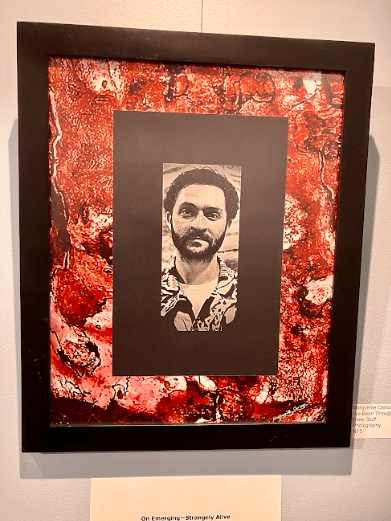
Marguerite Carlton, I’ve Been Through
Some Stuff, response to my poem, “On Emerging, Strangely Alive,” as displayed in the gallery show.
The car wreck in “On Emerging—Strangely, Alive” is fictitious. I did partly draw on my experience, at age 14, of being in an accident in which my femur was broken, but it was nowhere near this serious. Instead, the poem describes mental health crisis, something I can only describe non-literally.
I chose Marguerite’s photo, Functioning Treasures, because I am always drawn to rusty things. (My first C&R, I responded to an urbex photo by Danny Rebb.) Marguerite told me these wheelbarrows are used by her and others in a community garden space, and she is inspired by the fact that these old, beat-up wheelbarrows are simply used, functionally.
But each time I’ve participated in Call & Response, I eventually found myself gripped with anxiety that I might not be able to produce a poem. After all, I normally don’t write poetry by assignment with a deadline!
This time, I started poking around online to make sure I had the right language to describe the various parts of a wheelbarrow. (In academia, we know that research is a great way to procrastinate when you’re having trouble getting started on the writing part.)
In that process, I stumbled on a thread on a paint company’s Facebook page, which somehow had an AI-generated title: “Refinishing a sentimental wheelbarrow with rust.” I loved the ambiguity. The original post was by someone looking to restore a wheelbarrow that had belonged to…I don’t remember, maybe a grandparent. But what if you were trying to use rust to restore a wheelbarrow?
Elaine Elizabeth Belz
“REFINISHING A SENTIMENTAL WHEELBARROW WITH RUST”[1]
Mostly,
you need time,
consistent effort,
and lots and lots of lack:
lack of primer
lack of paint
lack of new hardware.
No need for sandpaper.
Ordinary use day after day
will admit the necessary elements
wind and water bear.
Just put it to use.
If the tray skews a little from the frame,
keep filling it up and pushing it around.
If the wheel wobbles a bit,
don’t fix it.
If paint flakes,
let it go.
Let the handles show their wear:
the patina of dirt, of human touch.
The rust will show up on its own,
like one grey hair, then another.
[1] The title is from an AI-generated heading for a thread in a Facebook discussion forum
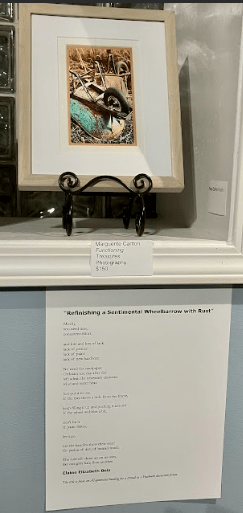
Marguerite Carlton, Functioning Treasures, displayed on a ledge in the gallery with the broadsheet of my poem posted underneath.
Much thanks to Marguerite Carlton, and to Lori Zurvalec who organized the project and edited the book.
 The Sound
Leave a comment