
The Fifth Sunday afther the Epiphany—February 8, 2026
Isaiah 58:1-9a, [9b-12]
Psalm 112:1-9, (10)
1 Corinthians 2:1-12, [13-16]
Matthew 5:13-20
Although my field is theological aesthetics, I teach church history (technically, historical theology, which makes it not so far off from theology). We recently covered the Council of Nicaea where, at the behest of the Emperor Constantine, the bishops of the Church took a first stab at crafting an official orthodoxy.
The famous story of Nicholas punching Arius while the latter was preaching that Christ was not divine is almost certainly a medieval invention meant to bolster Nicholas’ reputation as a strong defender of the faith.
Which is good, because today’s passage from the Hebrew Scriptures specifically names “strik[ing] with an evil fist” as an incorrect outcome of fasting (i.e., religious piety). That reading is about the wrong and right way to fast, but I’d like to think through it more broadly. What if, instead of fasting, we substitue “religion”?
After all, fasting is a religous practice, and both the Hebrew and Christian Scriptures point to it as a practice that can too easily be coopted by our pride and self-righteousness. I think any religious practice could be substituted here, as well as religion more broadly. “Small-o” orthodoxies, even.
Whether or not the compilers of the Revised Common Lectionary tried (and sometimes failed) to work themes together, it can be a fruitful exercise to try to find one. The theme you see any given lectionary cycle will likely be influenced by what is going on around you and what concerns you have for your own life or for your own faith community.
I’m thinking of a former student who critiqued orthodoxies in general as tools of colonialism, and the discomfort I feel in thinking about it that way. Yet I know that orthodoxy in the early Church grew out of at least two main factors: (1) a desire to preserve the “faith once delivered to the saints” in a time when printed texts were more rare, expensive, and unaccessible to most ordinary folks; and (2) Constantine’s embarrassment that, just as soon as he started promoting Christianity (likely as a way to help unify the Empire he’d just sewn back together), the Church seemed ready to fragment over doctrinal disputes.
I don’t fault any of that. But as I tell my students, had the creed been crafted in some other place and at some other time, it would be very different. Our orthodoxies reflect, at least in part, the thinking of a particular time and place, and they leave out Christians who were already present in other parts of the world, as well as Christians like us, who live in another part of history.
Today’s readings point us toward something more important than orthodoxy. In fact, the reading from Isaiah could also be read as telling us that right religious practices and doctrinal formulations are much less appealing to God than right action toward the vulnerable. What if we substitute “orthodoxy” for “fast” in the following passage?
Is not this the fast that I choose:
to loose the bonds of injustice,
to undo the thongs of the yoke,to let the oppressed go free,
and to break every yoke?Is it not to share your bread with the hungry,
and bring the homeless poor into your house;when you see the naked, to cover them,
and not to hide yourself from your own kin?
What if we think it less important to hold right beliefs about Jesus, and more important to put into practice the priorities of Jesus? In today’s Gospel, Jesus says that he has not come to abolish the law or the prophets, but to fulfill them. Like Isaiah before him, he reminds us that to be a city on a hill that draws people to God’s light in our midst, our good works must be evident. And, Jesus says, if we aren’t doing that, what’s the point? (I’m paraphrasing the bit about salt losing its saltiness—which, by the way, can’t happen.)
The excerpt from Paul’s letter to the Corinthians brings in another important point here. He reminds this church that when he first came to them,
My speech and my proclamation were not with plausible words of wisdom, but with a demonstration of the Spirit and of power, so that your faith might rest not on human wisdom but on the power of God.
His emphasis is on the Holy Spirit, who guides us to discern the mind of Christ, and to understand the gifts God has given us, and how we ought to use them. He speaks in highly spiritual language, but his emphasis seems to be on what we are called to do with those spiritual gifts.
The Psalmist celebrates a community that so delights in God’s commandments that they
- are full of mercy and compassion
- are generous in lending
- manage their affairs with justice, and
- give freely to the poor.
Without using the phrase, the Psalmist describes this community, more or less, as a city on a hill:
Their descendants will be mighty in the land;
the generation of the upright will be blessed.
Wealth and riches will be in their house,
and their righteousness will last for ever.
Light shines in the darkness for the upright […]
For they will never be shaken;
the righteous will be kept in everlasting remembrance.
They will not be afraid of any evil rumors […].
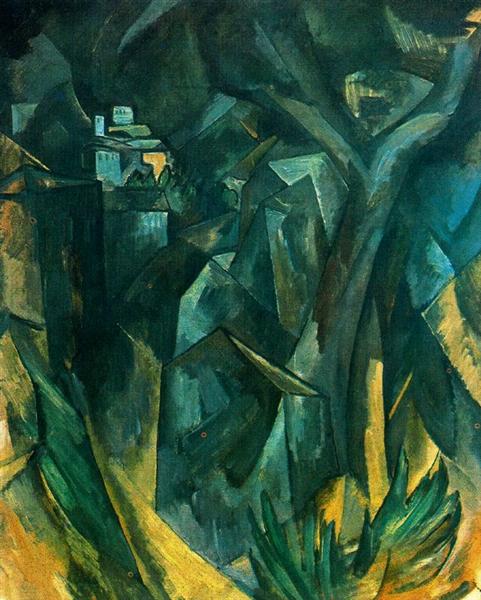
The image at the top of this post is by one of the leaders in the Cubist movement. Art historians refer to paintings like this, from the early years of cubism (c.1908-1912), as “analytical cubism.” These paintings represent a close study of their subject from every possible angle, rendering it fairly abstract. They tend to be more or less monochromatic, since their emphasis is on the form of the subject. (This is much the same reason many sculptors don’t paint their work, as that would draw the attention to the surface and not the form and mass of the sculpture.)
Braque’s The City on the Hill is not overly abstract. We can see the rocky cliff-like hill with some kind of vegetation at its foot, and the city nestled in what feels like the safety of this particular hill. But it doesn’t look terribly inviting or accessible, and the light is primarily down on the lower ground. This looks like a fortified city whose wealth and security is on display, but which does not welcome us. The close study of this subject—the cubist analysis, you might say—finds mostly rocky outcroppings and a cover of darkness. While it is a masterful and compelling work of art, I don’t think this is the kind of city on a hill Jesus calls us to be.
The Church whose religion is centered less on orthodoxies and more on its actions welcoming, empowering, and liberating the poor along with everyone else it embracies will, in fact, be the kind of city on a hill where “nations will stream to your light” (in the words of Isaiah 60:3). As we prepare for the coming season of Lent, let’s focus less on the fasts like giving up chocolate or fun activities, and more on the fasts and spiritual practices of creating more just communities, giving freely to the poor, and helping people to get up this hill we’re on.
 The Sound
Leave a comment