
The Last Sunday after the Epiphany—February 15, 2026
Exodus 24:12-18
2 Peter 1:16-21
Matthew 17:1-9
Psalm 2
or Psalm 99
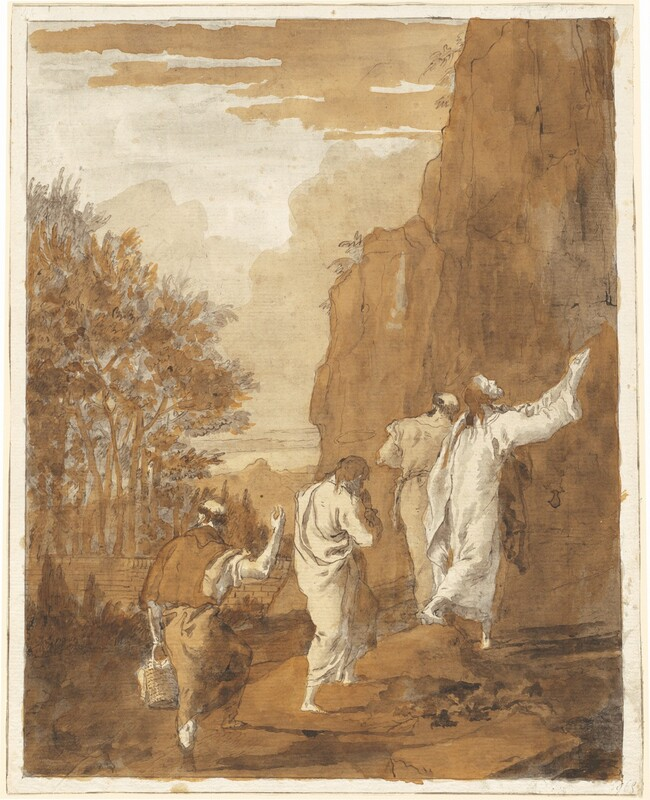
The Sunday before Lent begins, the Church invites us on a curious excursion, and in the image above by Giovanni Domenico Tiepolo, we see Christ leading three disciples on this same journey.
The Transfiguration of Christ is a curious episode, echoing both Jesus’ baptism and his ascension—perhaps recalling the one and anticipating the other. We encounter it much closer to the Theophany at Jesus’ baptism, when God the Father identified him as God’s “beloved Son” with the Holy Spirit echoing that revelation by descending and alighting on him—a kind of anointing without the oil. Scholars have pointed to a similar story in the Apocalypse of Peter, which some argue is the reference for the author of 2 Peter. In one of the versions of this text that survive, the Transfiguration is the Ascension. In this text, Jesus urges the three disciples to come with him to the “holy mountain” (as the author of 2 Peter also calls it). The apocryphal text offers some possible clarity on why Peter’s comment in the Gospel story, about building three tabernacles, was considered so improper: Jesus explains to Peter that God has made a tabernacle for Christ and all the righteous: one not made by human hands. Then, true to the apocalyptic genre, he shows Peter both this paradisical dwelling for the righteous and a hell of Dante-esque torments for the wicked. But in the end, Moses, Elijah, and Jesus are all taken up into heaven and heaven’s door closes behind them. The disciples, in this story, descend the mountain without Jesus, but nevertheless rejoicing.
That has been a bit of a detour, but I’ll come back to it.
The season of Lent can be traced to the multi-year period of catechism early would-be-Christians underwent in preparation for baptism. Eventually, Christians began joining them in their fasting and preparation during the home stretch, which is a wonderful show of solidarity. Over centuries, it seems to have turned into a season for focusing on our sinfulness and unworthiness, a time to busy ourselves with inward-focused concern for the fate of our own soul. We may not be compelled, exactly, to gaze upon the scenes of hell from Peter’s Apocalypse, but we are meant to entertain the thought that such hellscapes reflect God’s feelings toward our sinfulness and, maybe, toward us as sinners.
In our better moments, we do well to listen to the Church’s teaching, for example, in one of the proper prefaces for Lent: “You bid your people cleanse their hearts and prepare with joy for the Paschal feast.” Lent is better thought of as a time to practice our faith—as Colleen McDannell has described it, practice like a pianist playing scales: to become better at it. The long tradition of taking up spiritual disciplines during Lent—of which abstaining from chocolate, for example, is but one option—is a form of exercise. We use this focused time to act more like the Christians we are and hope to be, to live into our baptism as we approach the inauguration of that Eighth Day, the Resurrection of Christ into which we are baptized. Jesus is leading us in the arduous climb up the mountain to see precisely what we are to become: like him. As if to demonstrate that we actually can become like him, Moses and Elijah appear with him in a state of glory, having themselves become like him. It’s a vision that is there for a minute, then gone—but what a lasting impression it makes!
So this week, just before we head into Lent, let’s spend some time thinking about what we might expect out of that journey—the journey itself, and its culmination. What might we become? What might we practice, in order to get better at being what we are becoming?
In college, I had a friend who was an engineering major, and he told me his professors encouraged their students to start calling themselves engineers already, and start thinking of themselves as such. We do the same thing in theology, too: Everyone who thinks about God is a theologian. But, as I was reminded in a conversation with a local musician, there are good ones and bad ones: good and bad musicians, good and bad engineers, good and bad theologians, and good and bad Christians. Nobody starts out good. You might show promise, or have an affinity for what you’re undertaking, but in order to become a good musician, a good engineer, a good theologian, or a good Christian, practice is required. And it helps to focus on the goal. This Sunday, we get to see it, through the text, anyway: Jesus, among his friends, in glory.
What we might literally see this Sunday in church is the Body of Christ, gathered together, partaking in Communion—a sacramental practice that confects the very Body that it is. As Augustine of Hippo famously said, “Be what you see; receive what you are.” Practice will literally make perfect.
 The Sound
Leave a comment