
The First Sunday in Lent—February 22, 2026
Genesis 2:15-17; 3:1-7
Romans 5:12-19
Matthew 4:1-11
Psalm 32
This post is a bit late. No, I haven’t given up this blog for Lent. The truth is, I spent my time this weekend prepping for and leading a 10-hour workshop through the seminary where I teach. It was fantastic—the students brought so much to the table—but it wiped me out.
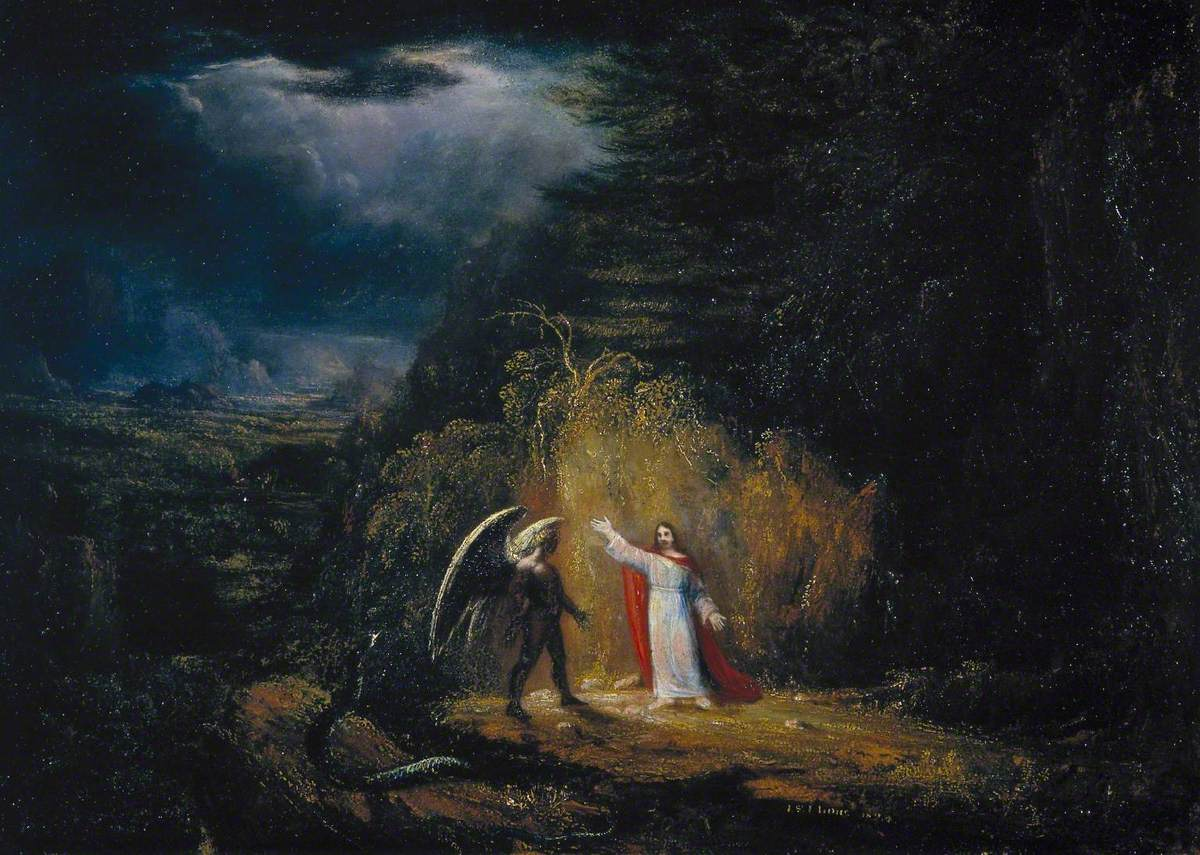
After finding the perfect image for this post, I almost didn’t use it. As I read about the artist, I learned that he gave up his painting career for one in medical quackery. He claimed to have found a cure for tuberculosis and was implicated in the deaths of some of his patients due to his “treatment” for the disease—which eventually also took his life (likely to no one’s surprise).
What I like about the image is that the wilderness is very dark (although what is presumably the more populated world in the background is lit by the moon), and so the devil, depicted as a dark angel, fits right in. Jesus, however, does not. Not only is there no darkness in or on him; he instead lights up the space around him. Even the devil is partially lit by Christ’s radiance: he is exposed for who he is. Whatever motivated the artist to turn to twisting medicine the way the devil twists Scripture in this story? In any case, it probably led to his death from the disease he pretended to cure.
Today is the first Sunday in Lent. In Lent; not of it. Every Sunday is “a little Easter,” after all. That is why people who give up something for Lent will often relax their restriction on Sunday. To me, that is also a sign that Lent is not an endurance test where breaking your fast ruins the whole season. It’s not about self-punishment, either. It’s about self-discipline, but not of the self-help variety. It’s about practicing to be a better Christian. When you practice, taking breaks can be a good thing, and failing a goal is no reason to give up.
Lent is a season of practice—and not just on the spiritual level. Fasting, for example, involves the body in the most visceral way. I don’t think it’s useful to make it about the “mortification of the flesh,” though. Our flesh is good. God chose to become flesh, after all! Splitting ourselves into body vs. mind or body vs. spirit is not only harmful, but probably untrue. It’s with our (fleshy) brains that we perceive the world around us, formulate beliefs, and make judgments and decisions—all things that have traditionally been associated with the spiritual. As practitioners of an incarnational faith, it makes so much more sense to recognize the unity of our body and mind/spirit, and to use that unity to train both in practices that make us more and more like Christ, the God who became human so that we humans might become godlike.
As such, it’s also problematic to focus too narrowly on our selves. Lent can so easily become a season of navel-gazing and breast-beating, a season of making our sinfulness and guilt out to be much more powerful than it actually is. The truth of the matter is if we follow Jesus, he’ll lead us away from all that and into the life abundant that Irenaeus famously said is the glory of God.1 Following Jesus takes practice, though, and it requires intentionality toward action. (This is where I’m preaching to myself.)
The Collect of the Day2 and the Gospel focus us on Jesus’ temptations in the desert. The author of Matthew tells us the reason Jesus was led by the Spirit into the desert was precisely to be tempted, but that doesn’t happen right away. It doesn’t happen until he has spent forty days fasting and is “famished.” The wilderness, though, is symbolic of spriritual struggle. Even today, the wilderness is inhospitible and dangerous to humans; unless you’re prepared, you’re likely to die if you spend a long time in the elements somewhere like a desert. In the ancient imaginary, the wilderness was haunted by the kinds of things humans seek to banish from their communities. We cluster together for safety and mutual support, knowing that becoming isolated from our communities can lead to our death. We feel distant from that kind of danger today, but our psychological and physical thriving really does depend on other people. Deliberatly going into the wilderness in Jesus’ day was a practice of radical reliance on God and intentional struggle with internal and external demons. It makes sense that it would involve extended fasting, as this would be part of that intentionality and that struggle. We see similar practices across cultures and religions: subjecting oneself to intense hardship to cultivate an equally intense spiritual experience.
So Jesus—again, God who chose to become one of us—chooses to go into that place of struggle and temptation that threatens to undo us, that we work hard to avoid. He encounters the demonic head-on, and answers its distorted use of Scripture with Scripture. It is instructive to notice how the devil uses Scripture. He is trying to encourage Jesus to use it instrumentally for his own benefit. Jesus counters this by pointing to how Scripture actually orients us toward God, not the other way around. To use the symbolism in the painting at the top of this post, Jesus is bringing light to a dark wilderness. Not only is his light not overcome by the darkness, but it unmasks his tempter.
And while it’s fantastic to have that kind of model to instruct us, we’re not Jesus. We don’t always manage to deflect temptation the way he seems to do so easily. The psalmist describes the way those failures can oppress us and guilt can crush us. In fact, our sense of guilt lead us to imagine an adversarial relationship with God. But the psalmist has a sudden insight: “I said, ‘I will confess my transgressions to the Lord,” then you forgave me the guilt of my sin.” How eager God is to forgive and heal us, but we think our sin is so repulsive to God that it makes us repulsive to God.
We Christians read this in(to) the Genesis story, where Eve and Adam eat fruit from the tree “of the knowledge of good and evil” that God had warned them not to eat. However we interpret the broader story, in today’s portion, we simply see the mythological first humans doing what God had said not to do, and then feeling shame3 and needing to hide.
But Christians have read the Genesis story as a story of a “fall.” Especially when we read the story literally, i.e., as telling us actual facts about events in the past, it becamed a way to explain why sin, death, and all kinds of evil wound up in a world that a good God created. This is a distortion of the text, which is more mythological in character: Myth, after all, addresses existential questions like “why is there evil in the world if God is good?”
I’m not sure whether Paul thought the story was literally true or not, but he invokes it to argue that the life Jesus brings is so much more powerful than the death that was brought into the world through the sin of one man. However we want to interpret the Genesis story, Paul’s insight, much like Matthew’s narrative, tells us that all the powers of evil in our world are no match for Jesus. By showing up in our world, Jesus disrupts the (seeming) logic of condemnation Like the Psalmist realizing that confession brings God’s immediate forgiveness, Jesus shows us that God’s will for us—to be fully alive—is so much more powerful than all the forces of death in our world. His jiu-jitsu in the desert is not just a story about him. The power by which he accomplishes that is the same power with which he overcomes whatever power our sin and guilt may have (or convince us it has) to keep us separated from the God who is actually quite radically eager to embrace us.
- What he said was that the glory of God is the human being fully alive. ↩︎
- A collect (pronounced “CALL-ect”) is a thematic prayer whose name derives from the idea that it collects or gathers up all the prayers of the worshippers present or the prayers that have preceded it. Today’s collect reads, “Almighty God, whose blessed Son was led by the Spirit to be tempted by Satan: Come quickly to help us who are assaulted by many temptations; and, as you know the weaknesses of each of us, let each one find you mighty to save; through Jesus Christ your Son our Lord, who lives and reigns with you and the Holy Spirit, one God, now and for ever. Amen.” ↩︎
- “Realiz[ing] they were naked” picks up on a trope in the Hebrew Scriptures where nakedness is a cipher for shame. ↩︎
 The Sound
Leave a comment