
The Fourth Sunday in Lent, Year A—March 15, 2026
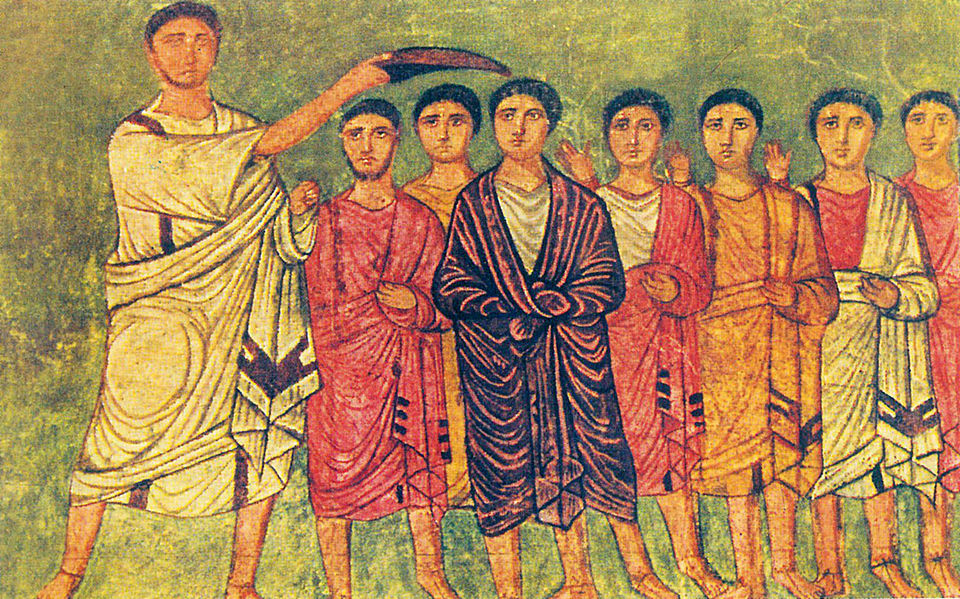
The story of David’s anointing by Samuel always amuses me. God tells Samuel not to look on the outward appearance of Jesse’s sons, because that’s not a factor in who God chooses. Unlike human beings, God isn’t distracted by looks, but sees the heart. And then, as if to openly announce that whoever wrote this story is a human being, we’re told how handsome David is: ruddy, with beautiful eyes. We don’t get to see what God sees; at least, not in this moment.
But the story is an example of one of the running themes in Scripture: the reversal. David is a shepherd, so not anyone who should have been under consideration to be the next king. Also, the current king is still quite alive and well. And David is the youngest of Jesse’s sons. Apparently, no one thought it worth the bother to go get him when Samuel told Jesse he was there to anoint one of his sons.
Psalm 23 draws from the shepherd’s imaginary to speak of God’s intimate care. It’s a Psalm many know by heart, and that is often read at funerals when we are in need of God’s comfort. Yet it does also contain a reversal: surrounded by his enemies, the Psalmist sits down to dinner at a table God has set. That his cup overflows indicates not only that there is plenty to drink, but that there is also plenty of time and safety to sit and drink.
The brief excerpt from the epistle urges the Christians in Ephesus to act like the light they are, and expose what is in the dark (i.e., what people normally aren’t meant to see). Sight is the organizing metaphor in today’s Scripture passages, and the epistle certainly bridges us into the Gospel reading.
In the Gospel, Jesus heals a blind man. This pericope is loooooooong, and rich in potential jumping off points. The setting is the healing of a blind man. Cool, another healing story. The Gospels are full of those.
This one begins with some bad theology. As Jesus and his disciples are walking, they see a blind man. The omniscient narrator drops in the detail that the man was born blind, and Jesus’ disciples seem to know that too, but we’re not told how. In any case, they choose to talk about the man, much the way we do in our politics when we make various groups—women, LGBTQIA+ persons, immigrants, impoverished or unhoused persons, and so on—a mere issue to be discussed and debated.
“So whose fault is it that he’s blind? Did his parents sin?” Bad theology, but also a very common human response when we see another person suffering. Most often, we probably look to blame victims in order to distance ourselves from the possibility of suffering in the same way. It couldn’t happen to me because I don’t do the thing that person did, right? So the disciples, who at this point are in no way at risk of being born blind, see a human being in need and reduce him to a cautionary tale.
Jesus corrects their bad theology with some more bad theology (sorry, Jesus). He tells them sin had nothing to do with this; rather, the man was born blind so that God could essentially use the man to display God’s good works. With some words about how we need to do God’s work before night comes, he spits in the dirt to make mud, and smears it on the man’s eyes.1
But I don’t actually think Jesus is spouting bad theology here. Often when people say things like that, it does arise from some bad theology that implies or outright claims that God micromanages the world, devising sources of suffering for God’s self-aggrandisement. I don’t think that’s what Jesus is saying here—or at least, I don’t think we have to read it that way. We may not be able to answer the question of why bad things happen in our world, but Jesus’ response tells us two things: (1) it’s not anyone’s fault; and (2) God can transform it. God is always working to bring good into our world, and, in any present moment, God will use whatever is at hand to do so.
OK, so the man born blind is healed, and the disciples’ misunderstanding is corrected. That’s a great place to wrap up, but the compilers of the Revised Common Lectionary compel us to keep going.
We hear the story of how no one would believe that this man who could now see was the same man who had been born blind, until his parents confirm his identity. We hear that he was brought to some Pharisees who tried to get him to agree that Jesus was a sinner, since he healed the man on the Sabbath. (“Oh, did I mention it was the Sabbath?”—John, apparently.) Curiously, they conflate the accusation with the glory of God: “Give glory to God! We know that this man is a sinner.” Without knowing it, they’re countering Jesus’ claim, that God’s glory is seen in a person made whole, with the idea that God’s glory will be seen in calling out a sinner.
[It’s worth noting here that John tends to use Pharisees as a foil to Jesus as Messiah. We should be aware that this reflects John’s historical context. Pharisees and Christians were two Jewish groups that could survive the destruction of the Temple—the Pharisees by locating God’s presence in the text, and the Christians by locating God’s presence in Jesus of Nazareth and his teachings. Eventually, through a painful split (and an inevitability, I imagine, given Chrsitans’ claims about Jesus), they ended up different religions. The Pharisees are the early rabbis in what has become modern-day Judaism. We’re seeing in John’s Gospel a reflection of the painful breakup, but we needn’t and shouldn’t import it into our present.]
This Gospel story is full of reversals centering on the metaphor of sight:
- The disciples, who notice and talk about the blind man, wind up sidelined in this particular story.
- The man’s life-long blindness is taken up as an opportunity for God to be glorified.
- The blind man is healed; he is no longer blind.
- The man’s community don’t recognize him; perhaps they, like the disciples, could only see him as a blind man—quite possibly because as a blind beggar, he was simply a trope, a point in the landscape; and they had never actually really seen him.
- The no-longer-blind man is then shown to be the one with the clearest insight. The leaders of his religious community insist that Jesus is a sinner, and that God would be glorified not by the man’s healing, but by his agreeing Jesus was a sinner. The man tries to lead his interlocuters into drawing the conclusions themselves, but they don’t. He has to put the matter bluntly: God wouldn’t listen to Jesus if he were a sinner, right?
John anachronistically claims the rabbis had declared anyone who said Jesus was the Messiah would be banned from the synagogue. That wouldn’t happen till some years after Jesus’ death. But it’s hard to track the choreography in this passage regarding who is a sinner, who isn’t; who’s inside, who’s out; and where exactly God is glorified by the whole incident.
Just as he had used the fact of the man’s blindness to glorify God, Jesus then uses the fact of the man’s ouster from his faith community as an opportunity to fully reveal himself to this man in a fairly pastoral encounter. He heard what happened to the man, and sought him out. It’s like he knows the man needs closure. His life has been completely whirled around. He was a social outcast before due to his disability; now he’s an outcast from his religious community due to his personal encounter with God.
Jesus says, “I came into this world for judgment so that those who do not see may see, and those who do see may become blind.” It’s both a disorienting and potentially painful experience and an invitation to see as God sees.
- (A similar story about the emperor Vespasian healing blindness with spit was written down in the first century.) ↩︎
 The Sound
Leave a comment