
The Fifth Sunday in Lent, Year A—March 22, 2026
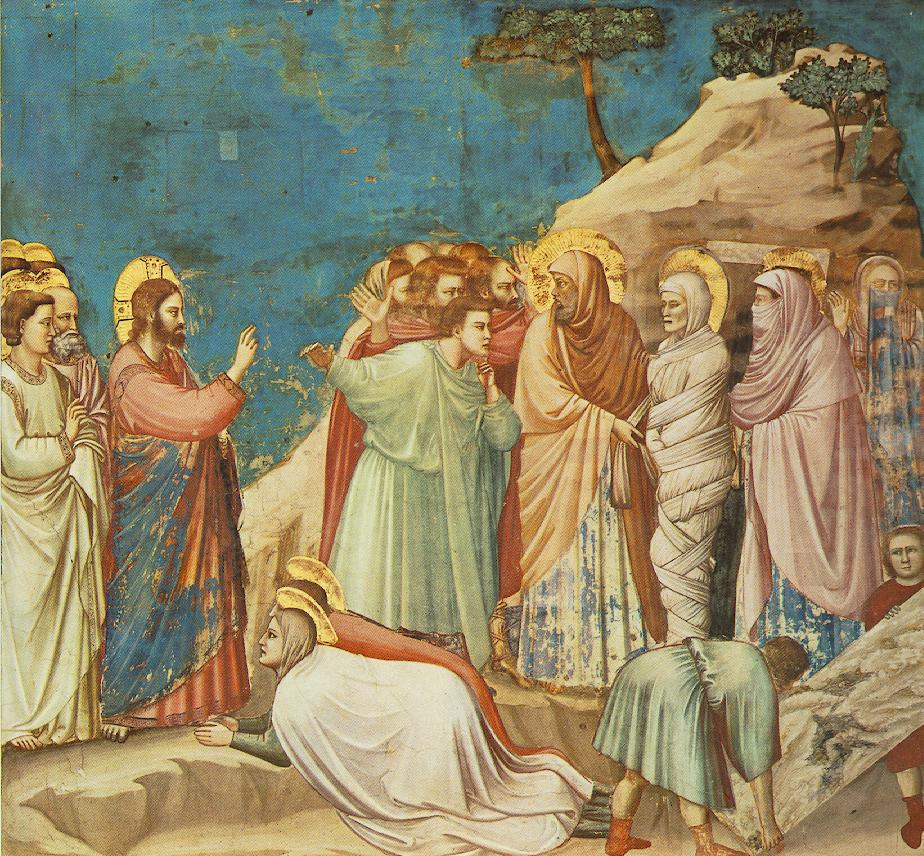
The weekend got away from me; I’m posting this a day late. (Sound familiar, though?)
I have a beautifully creepy song for you to listen to while you read this—or, better yet, to close your eyes and listen to. It’s based on a different biblical story, but it is about Jesus restoring a person to life: Tara VanFlower, Talitha Koum (on YouTube, so there will be an ad or two first).
In the image above, we see St. Lazarus, still looking pretty sickly, being led out from the tomb. Giotto seems, to my 21st-century eyes, anyway, to have really captured the bewilderment Lazarus’ family and friends would certainly have felt in that moment. I can almost hear the central figures whispering to each other: “Wait, so now what—do I unwrap him?” Martha and Mary seem so stunned that they not only don’t get up to greet their brother; they don’t even seem to have tracked exactly where Jesus actually is standing. Why was Jesus late? Couldn’t he have saved everyone the trouble, the emotional roller-coaster ride, and just shown up before Lazarus died? Typical; we don’t get an answer—just a Jesus who seems to want little more than to follow us deep into our suffering. We get a glimpse, though, into why he does that: He’s there to join the mourning for Lazarus, sure; but he’s also going to restore Lazarus to life. There’s some foreshadowing here, because we know where else Jesus will go to be in solidarity with human suffering. But the suffering won’t win.
There may not be an obvious theme running through all today’s readings, but there certainly is a connection between this Gospel story and the story from the Hebrew Scriptures. That passage is the familiar story of Ezekiel in the valley of the dry bones (“dem bones, dem bones, dem dry bones“). So we start with a disconcerting vision of life literally being breathed into the dead. And the Gospel is another familiar story, the raising of Lazarus.
Confusingly, though, in Romans, we hear that we are not the valley of dry bones returned to life, nor Lazarus brought out of the tomb. Rather, we are alive in the spirit while dead in the flesh, and we’re still in the valley or in the tomb waiting for life to be restored—or, we would be, if it weren’t for that Spirit giving us life. We seem to be the un-dead, dry bones walking around doing God’s work because it’s the Spirit that gives life, and our flesh just binds us to death anyway.
OK, alright, that’s not really what Paul is saying; he (probably) isn’t writing with Ezekiel’s vision on his mind.
Despite the tendency in the Pauline corpus (pun intended?) to denigrate the body (or the “flesh”), the fact is we need our bodies. Our bodies are how we are in the world. Our bodies tie us to place and time, for good and for ill. The fact that we are lofty minds or spirits inside these bodies we don’t always control is at the root of comedy: think, toilet humor. If we’re thinking of the Incarnation, “holy shit” takes on a whole new meaning. Of course, there was a line of thought that Jesus somehow did not experience such bodily functions. Beneath his dignity or something. Maybe Christians would do well to join our Muslim and Jewish siblings in saying prayers like the Asher Yatsar:
Blessed are You, our God, source of the universe, who formed humans with wisdom and created within our body many openings and many hollows. It is revealed to you throne that if one of them were ruptured, or if one of them were blocked, it would be impossible to exist and stand in your presence. Blessed are You, God, who heals all flesh and performs wonders. (source)
Bodies may be a liability, a source of humor, a source of pain, or something to be embarrassed aobut, sure; but Paul tends to go further. Our bodies are “dead” because they are bound up with our tendency to sin. Paul is, of course, onto something there. Both as individuals and as a species, we learned to do things we as moral agents label sin, before we were moral agents. There are sinful behaviors in our DNA (so to speak) because those behaviors maybe helped our (pre-human or human) ancestors survive millions of years ago.
The Psalmist’s attitude is helpful here. He is in that liminal moment between crying out to God and getting a response, but he is confident enough to hope in God. Not the wishful thinking kind of hope we often mean by the word, but rather the faithful, trusting kind of hope that listens for the watchmen to signal the morning. Maybe even the kind of hope that wakes the watchmen up and pulls the sun back into the sky.
But why? The main reason we’re given in this brief little poem is that God forgives, has mercy:
If you, Lord, were to note what is done amiss, *
O Lord, who could stand?
For there is forgiveness with you; *
therefore you shall be feared.
What if we could really believe that God doesn’t note what is done amiss? Not that God doesn’t notice things; but rather that God doesn’t make note of our mistakes and our sins the way we seem to want God to (at least in Lent). What if God understands that we are “but dust” (to quote a different Psalm—103:14), or that we are but great apes?
I we’re going to do the Lord’s work, we need to be in our bodies, and be OK with being in our bodies. Ugh. Poor Lazarus. He’d just gotten out, and Jesus pulled him back in(to his body, that is). The Church celebrates this, though.
In the Orthodox Church, St. Lazarus’ day is observed the day before Palm Sunday. Catholic playwright—a former professor of mine—the Rev. Harry Cronin wrote a play about the resurrection. As he pointed out to our class, the moment of Jesus’ resurrection is generally not depicted on stage. How could it be? The angels—or that one weird guy in Mark—at the tomb are far more dramatic, and they offer dialogue. Jesus’ moment with Mary Magdalene in the garden is sweet and compelling. Harry’s plays, meant to be produced in churches, were very simple to stage, with almost no set. They engage the audience in imagining those details. In this play, Jesus is lying on something akin to a slab, in a part of the performance space that can reasonably be mentally designated as a tomb. At one point in the action, a seemingly drunken Lazarus comes through, recounting how he was dead once but Jesus came and called him out of his tomb. As he approaches Jesus’ tomb, he returns the favor, yelling for Jesus to come forth. He doesn’t stick around, but Jesus’ eyes pop open, then, slowly, he sits up. It’s a beautiful dramatization of the mutual giving between Jesus and Lazarus—initiated by Jesus and powered by God, but Lazarus comes through and brings their relationship full circle.
That is, of course, a creative, imaginitive meditation on the story of the Resurrection. It’s not in the Bible, not even hinted at. We read the play in class, but I feel as if I saw it produced; it was that simple to imagine. And powerful enough to stick with me all these years.
Recalling the story of Jesus bringing Lazarus back to life is situated at this point in Lent as if to help us move our imagination forward to a place where we can hope for the morning watchmen through the Great Triduum, and maybe even find the hope—rooted in the God who we, with the Psalmist, wait for—that dares to call the dead out from the grave.
Normally, I’d probably give it a little longer, but this is the right time to post on this blog my Lenten poem that was recently published in Earth & Altar. I’ll make it a separate post, and link to it here.
 The Sound
Leave a comment