
Palm Sunday (Sunday of the Passion), Year A—March 29, 2026
The Liturgy of the Palms
Matthew 21:1-11; Psalm 118:1-2, 19-29
The Liturgy of the Word
Isaiah 50:4-9a; Philippians 2:5-11; Matthew 26:14- 27:66 or Matthew 27:11-54; Psalm 31:9-16
We call it Jesus’ “Triumphal Entry into Jerusalem,” but to read the description in the Gospels, that’s hardly an apt description.
In the “Gospel of the Palms,” we see Jesus appropriating a messianic image that comes from Zechariah (9:9-10):
Rejoice greatly, O daughter Zion!
Shout aloud, O daughter Jerusalem!
See, your king comes to you;
triumphant and victorious is he,
humble and riding on a donkey,
on a colt, the foal of a donkey.
He will cut off the chariot from Ephraim
and the war horse from Jerusalem;
and the battle bow shall be cut off,
and he shall command peace to the nations;
his dominion shall be from sea to sea
and from the River to the ends of the earth.
That allusion could have a double meaning. It could have been Jesus making a claim to be the Messiah. But in the context of Passover in Jerusalem, it takes on another meaning. It’s a commonplace now to point out that around the time of Passover, Pilate, the Roman governor whose residence was on the Mediterranean shore, would have made something of a triumphal entry into Jerusalem as a show of “Pax Romana”—”peace” imposed from the top down by an empire that visciously put down insurrection.
In that context, Jesus’ actions become political theater. Whereas Pilate would have arrived with soldiers, on a horse-drawn chariot, Jesus came in on a donkey, accompanied by his disciples and other followers—ordinary people on the underside of a colonized land. Bystanders were caught up in the scene, and, pulling another script from their tradition, shouted “Hosanna to the Son of David” (showing that they understood the messianic allusion) and laid palm branches and their cloaks on the ground before him—nothing special, just the branches off the trees around them and whatever clothing they were wearing they could remove and were willing to allow to be trampled by a donkey.
This wasn’t literally a triumphal entry. Yet Christians have called it that, and have mimicked it in liturgies, for centuries.
We have a couple of options for understanding that today.
We can follow the precedent that reads the story through the lenses of the Christian empire, with its own sense of triumph: Pilate, representing Caesar, was illegitimate; Jesus is the true king. Push Caesar off the throne, and put Jesus on it, and let Jesus collect the tribute of colonized lands and peoples.
Or we can recognize that Jesus was delegitimizing the way of Pilate (and by extension, Caesar), intentionally mocking the Roman display of power, wealth, and pomp.
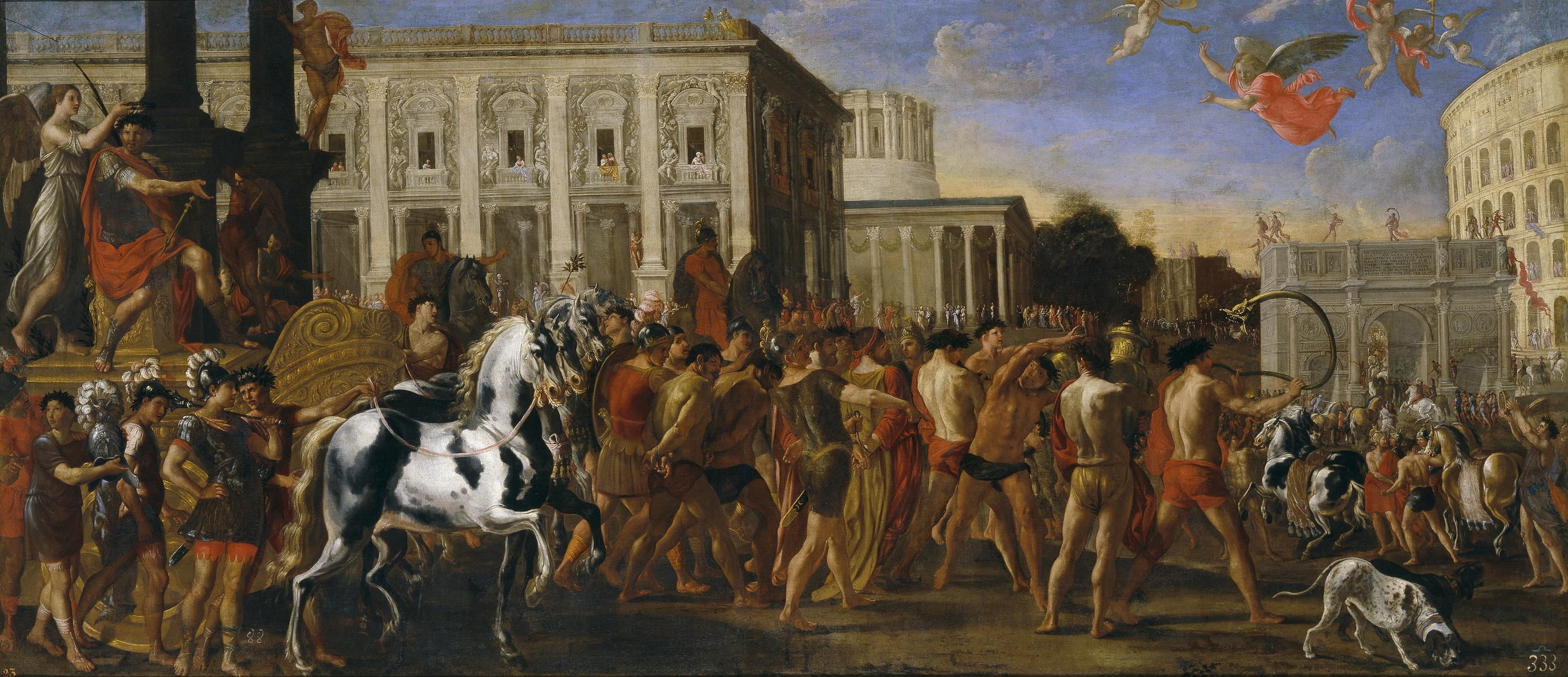
The image at the top of this post portrays the triumphal entry of Constantine into Rome. Not only does the image, regardless of who it portrays, give us a fantastic contrast to the Gospel image; it also shows how the first Christian emperor…didn’t imitate Christ.
Growing up in church, I remember Palm Sunday being a celebratory experience. The church I grew up in didn’t have a specific liturgy, and didn’t use a lectionary. We celebrated Palm Sunday, and left it at that; Good Friday and Easter would occupy their own spaces—although I also remember Good Friday encroaching on Easter quite a bit, since not everyone would go to Good Friday services.
In the Episcopal and other liturgical churches that use the Revised Common Lectionary, the problem of non-attendance on Good Friday has been handled by packing Holy Week into Palm Sunday, re-naming it “Sunday of the Passion.”
Maybe that’s more appropriate, especially if Jesus’ triumphal entry was less a proclamation of his kingship (or even messiahship) and more an act that could at least be read as fomenting insurrection. After arriving on a donkey, he would go into the Temple and disrupt the goings-on there—remember, this is the week leading up to Passover. Christians call it Jesus’ “cleansing of the Temple;” I’ve heard Jews call it Jesus’ “desecration of the Temple,” and they certainly have a point. We don’t know for sure where precisely in the Temple his actions took place, but it’s likely to have been in the outermost courts, where people who were unable to bring their own sacrificial victim could exchange their imperial coin (which could not be ceremonially clean for Temple use) for Temple coin they could use to purchase something to offer for sacrifice. That’s the explanation we generally learn, anyway. Christians who wish to fully justify Jesus’ actions will say that those moneychangers were cheating people, giving an unfair exchange rate. As far as I can tell, we have no way to know that; it’s an assumption that borders on a racist trope I needn’t even repeat here.
But there’s some background.
In 4 BCE, a deathly ill Herod the Great had a statue of an eagle placed over the entrance to the Temple in Jerusalem. The eagle was a symbol of Roman military power, so this was a statement and reminder of Rome’s dominion over Judea. According to Josephus, some indignant Rabbis and their students convinced a large enough group of people to pull the statue down, as it went against the Law to place any kind of image, human or animal, in the Temple. Herod had the instigators burned alive, and Josephus alludes to others—the people who had been convinced to join in the act, I assume—who were also executed by other means.
Josephus also recounts that around the same time (the same year, but after Heord’s death), a riot near Nazareth resulted in mass crucifixions. Josephus records that while thousands were killed in the uprising, two thousand rebels were kept for crucifixion. Crucifixion was how the Romans both punished and discouraged revolt, an act of state-sponsored terrorism if there ever was one. Jesus likely would have heard about this traumatic episode while growing up in its shadow, if he were too young to have witnessed any of it himself.
Jesus’ actions surely would have brought to mind these and other popular revolts, and the Roman response. Is it any wonder that the people (in the Gospel’s telling) called for Jesus’ crucifixion when Pilate gave them the choice?
I’ve often heard Christians remark on the “fickleness” of people who would celebrate Jesus and acclaim him as king or messiah one day, and call for his death later the same week. But, assuming any historical accuracy to the accounts, I don’t think the people would have been that invested in Jesus. The thing with the palms was crowd behavior, easy to join in for a bit of fun. But when Pilate is asking them if this guy, who had caused a disruption in the Temple during a very holy time, should be crucified—why would the crowd ask for his release? They had been witnessing their whole lives how cruelly Rome would lash out at whole cities over civil unrest. As John’s gospel has Caiaphas, the high priest, point out to his peers, it would be better to let one man die than to bring Roman wrath down on the whole population.
A few years later, the emperor Caligula made plans to have a statue of himself erected in the Temple. He wanted to be worshipped as a god. I imagine it would have been a gold statue, a beautiful statue—a lot of people were saying it was the best statue, bigger than you can even imagine. /here endeth the impression
But this is what emperors do, what despots and would-be-kings do, the kind of narcissitic display of purported wealth, power, and importance. Then they watch how others react. Do they admire the statue? Bow to it? Ignore it? Deface it? Try to remove it?
If Jesus is “king,” he cannot be this kind of king. He mocked that kind of show on Palm Sunday. Our liturgical actions should be seen as our siding with Jesus in his assessment of imperial power. He didn’t want it, but we keep trying to foist it on him, just like people reportedly tried to do in his own day. Thinking he might be able to initiate a popular uprising, the Roman machine performed their own parody.
Crucifixions were not used to punish “thieves,” as the Gospels call the men on either side of Jesus. But “bandits” was a term Romans used for political insurgents, in order to delegitimize their movements. Biblical scholar Joel Marcus (2006; if you have access to JSTOR, you can read it here) draws on diverse ancient texts to describe crucifixion as “parodic exaltation”—meaning the portrayal of Jesus being mocked, “crowned” with thorns, robed in purple, etc., speaks to the point. The Gospel writers and early Christians seem to have jiujitsued this imagery to appropriate the idea that Jesus’ cross was his throne; I choose to read the Lucan Jesus’ “Father, forgive them” as him pronouncing his judgment.
Christians took up the Cross as a sign of faith and used it to identify Jesus precisely because it was a dishonorable death. Paul, for example, claims to “glory in” the Cross of Jesus, which was a ridiculous, even perverse, thing to do.
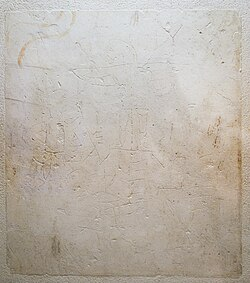
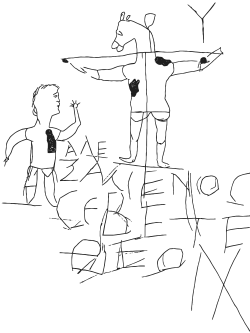
Above: “Alexamenos worships his god” is the inscription on this graffito (“the Alexamenos graffito”) in which a Christian named Alexamenos is mocked for worshipping a crucified man, depicted with the head of a donkey—possibly because of a rumor that Christians worshipped a donkey-like god, or simply to mock a crucified man. Crucifixion, among other things, was considered emasculating. That Jesus was crucified would have seemed prima fascie evidence that he could not have been divine.
If we give “glory, laud, and honor” to Jesus today, let it take the form of following his lead and eschewing empire and all its ungodly trappings.
A favorite scene of mine from Jesus Christ Superstar is a fantastic meditation for today:
 The Sound
Leave a comment