
Years A, B, and C
Since the readings are the same every year, I’m not going to address them directly in this post. Next year, or the year after, I will.
Maundy Thursday—April 2, 2026
Exodus 12:1-4, (5-10), 11-14
1 Corinthians 11:23-26
John 13:1-17, 31b-35
Psalm 116:1, 10-17
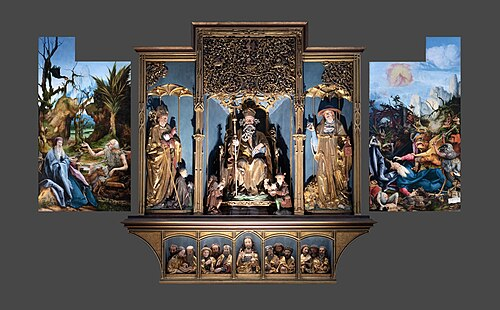
For the Triduum, I can’t think of a better image than Matthias Grünewald’s Isenheim Altarpiece. Isenheim painted on the reredos crafted by sculptor Nikolaus Hagenauer between 1512-1516 at the Monastery of St. Anthony in Issenheim near Colmar, which ran a hospital serving sufferers of St. Anthony’s fire, or ergotism, a horrific disease caused by consuming rye or other grain infested with the fungus claviceps purpurea, or ergot. Symptoms included severe itching and burning due to vasoconstriction, hallucinations, and convulsions, and could lead to gangrene and the loss of limbs. The monks at St. Anthony’s cared for the sick, and the altarpiece in the chapel also ministered to the spiritual needs of the sick in profound ways.
The altarpiece has three layers, the inner two revealed by opening the doors of the previous panels.
We begin with the innermost panel because it shows the Last Supper on the predella (the base of the altarpiece). It also features the figure of St. Anthony, patron of the monastery and hospital, among other saints and scenes from saints’ lives, including St. Augustine and St. Jerome, and the altarpiece’s patron kneeling at St. Anthony’s feet. St. Anthony is also accompanied by a pig, a symbol of the religious order.
This section of the altarpiece was popular with pilgrims, particularly those who suffered from the illness or were praying for the sick. They could venerate St. Anthony and ask for his prayers.
Combining the depiction of saints, the pilgrims and other worshippers gathering around it, and the image of the Last Supper, this part of the altarpiece speaks to me of the radical community Jesus formed, particularly in the institution of the Sacrament of his body and blood. By feeding us with the sacrament of his own body, he unites us all together to be his body in the world. We come together as in the upper room where Jesus gathered with his disciples, to spend time in intimate safety with each other, to be strengthened for all the things we, as Christ’s own body, are tasked with as we go out into the world: caring for the sick and poor; building our own mutual bonds of love, faith, and shared labor; and increasing our love to include, well, everyone. Even those who might crucify us.
Good Friday—April 3, 2026
Isaiah 52:13-53:12
Hebrews 10:16-25
or Hebrews 4:14-16; 5:7-9
John 18:1-19:42
Psalm 22
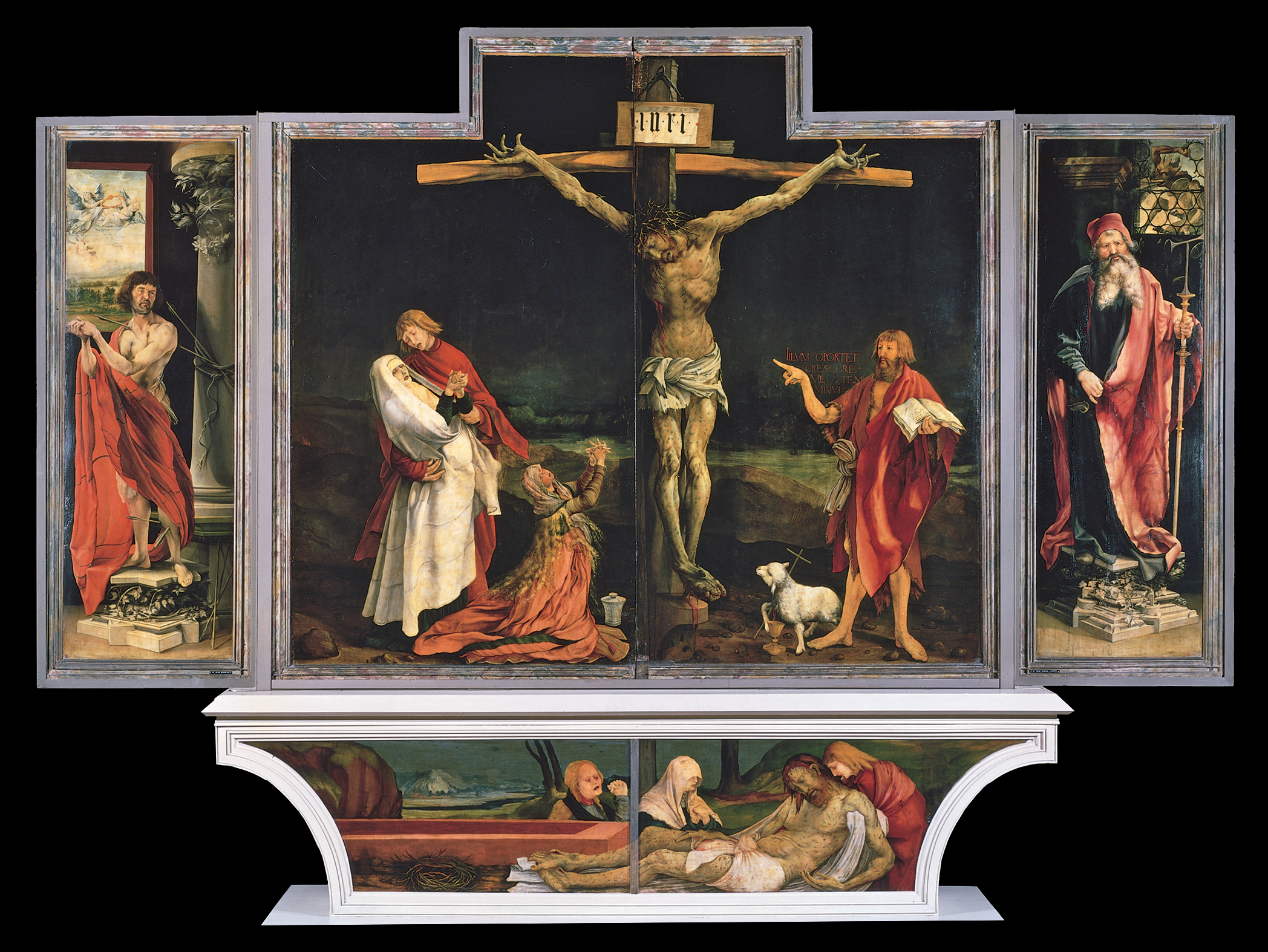
When fully closed the altarpiece shows the Crucifixion and, in the predella, the burial of Christ. The side panels show the suffering of St. Sebastian (left), and a depiction of the monastery’s patron, St. Anthony (right).
This crucifixion scene blends the familiar elements of a Crucifixion painting with details that would speak directly to sufferers of St. Anthony’s fire. As for the traditional lelements, we see (left to right) Jesus’ mother, Mary, in agony being supported by the Beloved Disciple—in the Gospel according to John, Jesus has made her his mother and he her son; St. Mary Magdalene, who was at this time still confused with another, post-biblical, Mary who was a life-long penitent; and St. John the Baptist, accompanied by an Agnus Dei (the lamb holding a cross), as he points to Christ reminding us that Jesus is the Lamb of God.
What is different is the portrayal of Jesus’ flesh full of sores and thorns. This is a way to show him suffering the same symptoms as those in the hospital at the monastery. He even has a slight, sickly green color to his flesh. His head hangs not only in submission (the traditional reading of that gesture in art), but in utter weakness; his hands are where we most easily read his extreme pain.
The reason for depicting Christ in pain on the Cross had been, for a long time, a way of affirming the Incarnation against docetism, a belief the Church deemed heretical. Docetists believed Christ only appeared to have a body. Showing him suffering and dying visually and viscerally denies that claim. Over time, it also became a means of control: showing ordinary people what sinners they were, that God should take flesh and die this awful death because of their sins.
But another reason for depicting the crucifixion and emphasizing the suffering of Christ has also been, and continues to be, a source of comfort—which is why crucifixes are traditionally veiled in Lent, when sources of such comfort are deliberately laid aside for a time. When praying with a crucifix, or an icon or painting of the Crucifixion, we can see God the Son relating to our suffering—by his own free choice, at that—and we can sympathize with his suffering, while asking him to sympathize with ours in this moment.
The sufferers at the St. Anthony’s hospital were able to relate to this Jesus and recognize that he understood their pain, caring enough to share in it.
Holy Saturday—April 4, 2026
Job 14:1-14
or Lamentations 3:1-9, 19-24
1 Peter 4:1-8
Matthew 27:57-66
or John 19:38-42
Psalm 31:1-4, 15-16
We continue on the same panel, as it shows the entombment on the predella.
Holy Saturday is the day God is dead. It is the day Christ descends into the place of the dead. The traditional theme of his harrowing of hell, drawn from a couple verses in 1 Peter, gives us hope that he will be bringing all the dead with him when he leaves that place.
Incidentally, if we map Holy Week onto the week of the Creation in the Genesis 1 telling, then Good Friday falls on the day humans were created; Holy Saturday falls on the Sabbath; and Easter…is the Eighth Day, the day of new creation, as Christians have long seen it. That is why the number eight, and the octogon to represent it visually, is meaningful in Christian tradition. You may notice, in particular, that fonts often incorporate the octagon: in the font’s shape itself, in the steps leading up to the font, or in the shape of the room the font is in (for those churches with separate baptistries).
Do what you will with those juxtapositions. Maundy Thursday falls on the days other animals were made; I don’t think anyone has read anything into that yet, but I could be wrong.
But the Church has definitely seen a connection between the Resurrection of Christ and the continuation of God’s creative work in making our cosmos—the cosmos, I will remind, which was made through Christ and for Christ, for him to inhabit.
Easter Eve—April 4, 2026
During the Vigil:
Genesis 1:1-2:4a [The Story of Creation]
Genesis 7:1-5, 11-18, 8:6-18, 9:8-13 [The Flood]
Genesis 22:1-18 [Abraham’s sacrifice of Isaac]
Exodus 14:10-31; 15:20-21 [Israel’s deliverance at the Red Sea]
Isaiah 55:1-11 [Salvation offered freely to all]
Baruch 3:9-15, 3:32-4:4 or Proverbs 8:1-8, 19-21; 9:4b-6 [Learn wisdom and live]
Ezekiel 36:24-28 [A new heart and a new spirit]
Ezekiel 37:1-14 [The valley of dry bones]
Zephaniah 3:14-20 [The gathering of God’s people]
At the Eucharist:
Romans 6:3-11
Psalm 114
Matthew 28:1-10
The Easter Vigil is my favorite service of the entire year.
With its roots in deep antiquity, it was restored during the liturgical reforms around Vatican II, reforms that rippled out into other churches such as the Episcopal Church (whose version of the RCL this blog adheres to).
We begin with darkness, then light a new fire, representing the light of Christ. That light is transferred to the Paschal candle, then shared with everyone in the congregation via individual candles. The room grows a little brighter. Then come all those readings listed above, interspersed with chanted Psalms. It’s as if by gathering and sharing our memories about what Jesus has meant to Christians from the very beginning, we are, by the Psalms, singing him up from the grave.
Finally, the declaration is made that he is risen, and the Great Alleluia is sung.
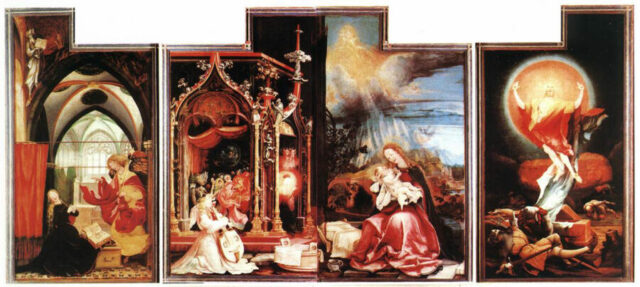
The inner panel of the Isenheim Altarpiece only includes a side panel depicting the Resurrection, but it is joined by other joyful scenes: the Annunciation and the Nativity—the latter implied in Mary holding the baby Jesus.
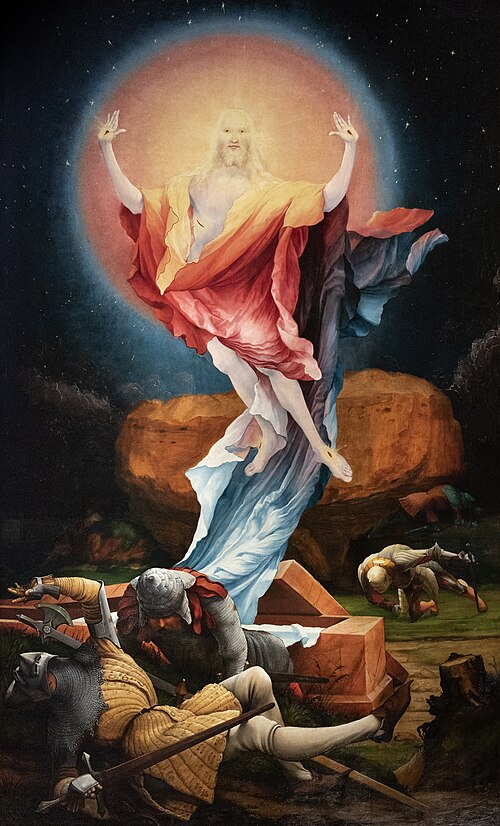
But on the right-hand panel, we see one of the strangest depictions of Resurrection, that also seems to pull in the Ascension.
I’ve never seen the altarpiece in person; relying on images, it appears that the predella used with this set of panels is the same as for the Crucifixion: the burial. Perhaps Grünewald intended to allude to all of Christ’s life (well, the essential bits) together? Or just to keep the burial and Resurrection together? I’m also not sure how the predella panels even open to eventually show the Last Supper scene. (To my mind, that would be a better default.)
As in the predella of the Crucifixion panel, the tomb we see here is no more authentic to Jesus’ day than the European appearances of Jesus and his contemporaries on this altarpiece. But historical literalism clearly wasn’t the point (or at the very least, the Baptist would not have been shown present at the Crucifixion). As detailed above re: the Crucifixion scene, the point of this altarpiece, as with much European religious painting, was for viewers to relate to the scene, to see themselves in it, or to be able to imaginatively insert themselves in it. We see the same impulse today, happily, when non-European artists depict Christ, his mother, and other saints as members of their own communities.
But if Jesus looked white in the Crucifixion panel, he’s literally white, and essentially transparent, here. We in the twenty-first century may be excused if our first impulse is to laugh at this image, where Jesus seems to be in a very bad production of a very tacky musical, flying up out of the grave into the air, maybe about to sing. In 2009, when I took a class co-taught by the late Doug Adams, the late Jane Dillenberger, and others, Jane told us about the response to this image of a dear friend of hers…Paul Tillich. She told us he hated this particular Resurrection painting, not least because the risen Christ should not have such “knobbly knees.” (Whether those were Tillich’s words, or Jane’s approximation of them, I don’t know.)
But if we remember the Crucifixion scene on the previous panel, this does show a remarkable contrast. The Crucifixion scene was dark and heavy; Christ’s body, drooping in every aspect except his protesting hands (a visual representation of the cry of derilection?) to the point the arms of the cross bend downward. But in the Resurrection panel, the trajectory is upward, displaying energy and lightness. The falling gravecloths connect, but do not anchor, Jesus to his recently-abandoned tomb. The only motion downward is the Roman soldiers, who in the Gospels are placed there on duty to guard the tomb, but also visually represent the machinery that crucified Jesus, now utterly undone.
As light clearly eminates from Jesus’ head and core, we see that his wounds are still fresh, but—if you look closely—they also radiate light. Jesus seems to be about to disappear into the light if you only look at his head, but the rest of him is certainly tangible. A common trope in Christian art of this era symbolizes innocence with nakedness, which explains why we see so much of that glowing skin—whose stark white color likely also symbolized purity and innocence to viewers at the time. Most importantly, though, Jesus still bore the wounds of his Crucifixion, but not of St. Anthony’s fire. This may have reminded the most seriously ill that they would be healed in death, if not in life, and their death would not be the end of their story.
Happy Easter!
Remember, it’s 50 days long. Keep those Easter carols coming!


Leave a Reply