
The Second Sunday of Easter, Year A—April 11, 2026
The Second Sunday of Easter is sometimes called “Lowsunday” or “Low Sunday,” referring to attendance in church. Not only the twice-a-year attendees, but even the most faithful congregants seem to be tapped out from the prior week or six. Even more unfortunate is the fact we drag out the same tired theme of “Doubting Thomas,” who, silly man, refused to believe Jesus was risen just because he hadn’t seen the risen Christ with his own eyes.
Among the many things there are to love about the Bible, for me, one is the fact that its stories lend themselves to many layers of meaning Like good images, symbols, and metaphors, they invite exploration and reward contemplation with insights that speak to the needs we bring with us. What we pay attention to will depend at least in part on our own experience, but what we find will usually expand our field of vision.
One thing I bring to today’s Gospel story is my own lifelong anxiety around being excluded. Among the earliest dreams I remember is a nightmare where my playmates suddenly all get up and go indoors together, and as I run to follow them, something I can’t see is chasing me. So I read Thomas’ declaration—”Unless I see the mark of the nails in his hands, and put my finger in the mark of the nails and my hand in his side, I will not believe”—as a protest. Jesus had appeared to all the disciples that one time Thomas was the only one not present.
Really, Jesus? I hear St. Thomas say in my own voice. You choose the time I’m missing to appear to the rest, show them your scars, speak peace to them, and breathe the Holy Spirit into them?
Whether Thomas really “doubted” Jesus’ resurrection or not, I can’t help but see his refusal to believe as a protest against not being included. It’s enough that none of the disciples, apparently, thought to say, “Wait—Thomas isn’t here! Someone call him!” But Jesus? He should have known better.
And yet, I don’t think Thomas is (just) expressing hurt at being left out. I see him stomp his foot and demand to be included.
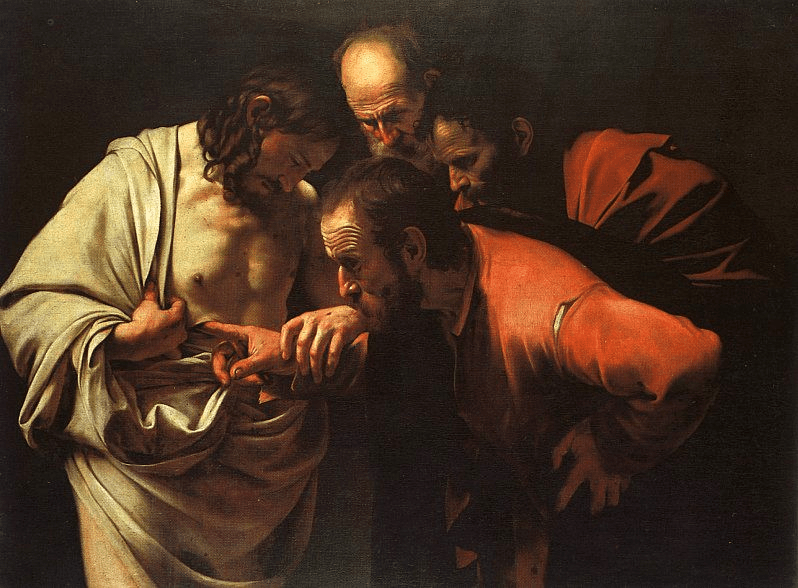
The image accompanying this post, Caravaggio’s famous Incredulity of St. Thomas, is likely the only image of this Bible passage most of us can visualize. Caravaggio’s skillful use of chiaroscuro grabs our attention and draws us into the scene, but the composition guides our eyes: not around the image to finally rest on the most dramatic part, Thomas’ finger probing the wound in Christ’s side. We’re drawn to that point from Thomas’ face, the incredulous expression that lends itself to the title of the painting. But it’s also not our final stop. Jesus’ intent gaze attracts our attention, and we follow his gaze to his hand on Thomas’ hand, gently guiding and supporting the saint’s inquiry into his flesh.
This is a profoundly intimate moment. Two other disciples huddle with Thomas, bearing witness and holding space for him. The blacked-out background closes in on it and transmutes it into an eternal moment, enlarging its scope precisely by narrowing it. And yet Caravaggio does not permit us to reduce this to a sentimental illustration of a story. Thomas looks disturbed by what he is seeing (and feeling), and the other disciples, for whom this is a rerun, are equally rapt. While bloodless, the scene leans toward the gory. It is shocking and disturbing at the same time it is comforting.
The other readings echo each other. As is the custom in Easter, the first lesson is from Acts instead of from the Hebrew Bible. Here we listen to Peter preach. His rhetorical force seems to come from his reading of the Psalm (the same one we have in the lectionary today). Assuming the Psalm was written by David, Peter argues that it was prophecy about Jesus, since, despite expressing confidence that God would not abandon him to the grave, David did wind up in one. He hasn’t come back, but Jesus, his descendent, also went to the grave but did come back:
“But God raised him up, having freed him from death, because it was impossible for him to be held in its power.”
The Epistle points us to the Gospel, including us in Thomas’ story:
“Although you have not seen him, you love him; and even though you do not see him now, you believe in him and rejoice with an indescribable and glorious joy, for you are receiving the outcome of your faith, the salvation of your souls.”
Here, Peter speaks to Christians who have suffered in some way for their faith. He reminds them that Christ will again be revealed, and at that point, their past suffering would conduce to greater joy.
We see when Jesus revealed himself to his disciples after Easter, he made sure they saw his scars. Those scars were proof of his suffering and death, and so also proved who he was and that he was risen. These were scars: wounds that were healed. As Caravaggio shows us, they are no longer bloody. They are healed, and ours will be too.
There’s a lot here, but what I’m taking away—or rather, hoping my readers will take away, or at least consider—is that we Christians, disciples of Jesus, have the right to demand inclusion. Wherever Jesus is, in the community he is forming, in the wounds he is healing, everyone must be accepted.
The disciples can be forgiven for not thinking to point out Thomas wasn’t there the first time Jesus appeared to them in John’s telling of the story. But we’ve had a long time to sit with this, and we should know better. So let’s look around. Who is missing? Who is excluded, even by accident?
All this time, Thomas has been called a doubter. But what if his demand is an act of faith—of trust that Jesus loves him too and will want to receive his pleading, devotional touch?
 The Sound
Leave a comment