
The Sixth Sunday of Easter—May 10, 2026
Note: I may revise this post later in the week. I had nearly finished it when my computer restarted for software updates and while the site keeps saying, “auto-saving,” it apparently did no such thing.
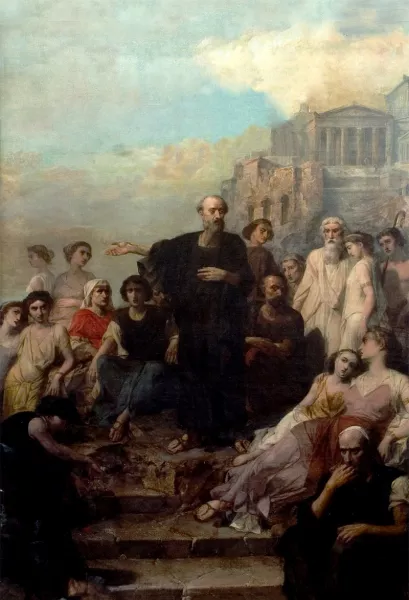
Among the various images portraying Paul’s speech to the Athenians, this painting by Rothermel (who I’m not familiar with) stood out to me. Other images were a bit more triumphal—which may be appropriate; I recall reading Bart Ehrman reminiscing on his trip to the site, thinking that in the end, Paul sorta won. But in the story as we have it in Acts, Paul’s listeners weren’t really that impressed. Neither are the people in Rothermel’s painting. There is some hint, though, at Paul’s eventual triumph, if Rothermel is using a trope from earlier European tradition: those broken steps beneath Paul’s feet might be there to indicate the old order (in this case, Greco-Roman paganism) passing away.1
Biblical authors, both in the Hebrew Scriptures and in the New Testament, create a bit of a straw man in their polemical attacks on pagan idolatry. Like apologists today, they weren’t attempting to convert outsiders, but rather to shore up their own ingroup identity by emphasizing others as foolish or just plain wrong.
In reality, ancient peoples were fully aware that their statues were not actual gods; they were ritual objects that mediated divine presence. So it’s little wonder Paul’s audience—if Paul really said what the author of Acts reports—would write him off. Even so, Paul (the character in Acts, at least) does something we don’t often see in those polemics: he reads the pagan cult charitably. It’s a good rhetorical move, but it’s also worth recognizing what Paul is doing here. First, he chooses to assume the worship of this “unknown god” is a genuine act of piety rather than merely hedging bets against whatever some slighted deity might do. Then he invites his listeners to learn about the God of Jesus Christ from within their own tradition. Paul apparently has studied something of his audience’s culture. He can quote from their literary canon, for example. He’s a good rhetorician in a culture where Rhetorics was a respected field of study.
A whole lot could be said about the dangers of Christians collapsing other systems of belief into mere precursors to Christianity. But there are theologians in various parts of the world who do claim their people’s religious traditions as a sort of “old testament” that legitimately prepared them for the Gospel.2
In the Gospel reading, Jesus promises to send the Holy Spirit—”whom the world cannot receive” (emphasis added) because the world doesn’t know the Spirit. The disciples, however, do know the Spirit. Their ingroup is characterized by obedience motivated by love. If I were a biblical scholar, I might be more hesitant to blur the distinction between the Johanine and Lucan traditions, but at least in Luke-Acts, the Holy Spirit is given to the disciples so that they can preach the Gospel and widen that circle of love so much that the very concept of an outgroup is undermined.
- I only read a little bit about Rothermel, and it seems he is known for painting portraits but also scenes from US history. The ones I saw seemed to fit with the romanticized and mythologized version of history that fills our public discourse. ↩︎
- George “Tink” Tinker and Steven Charleston are examples from within Native American theology; I’ve read similar ideas in Asian theologians as well. ↩︎


Leave a Reply