
The Third Sunday of Easter—April 19, 2026
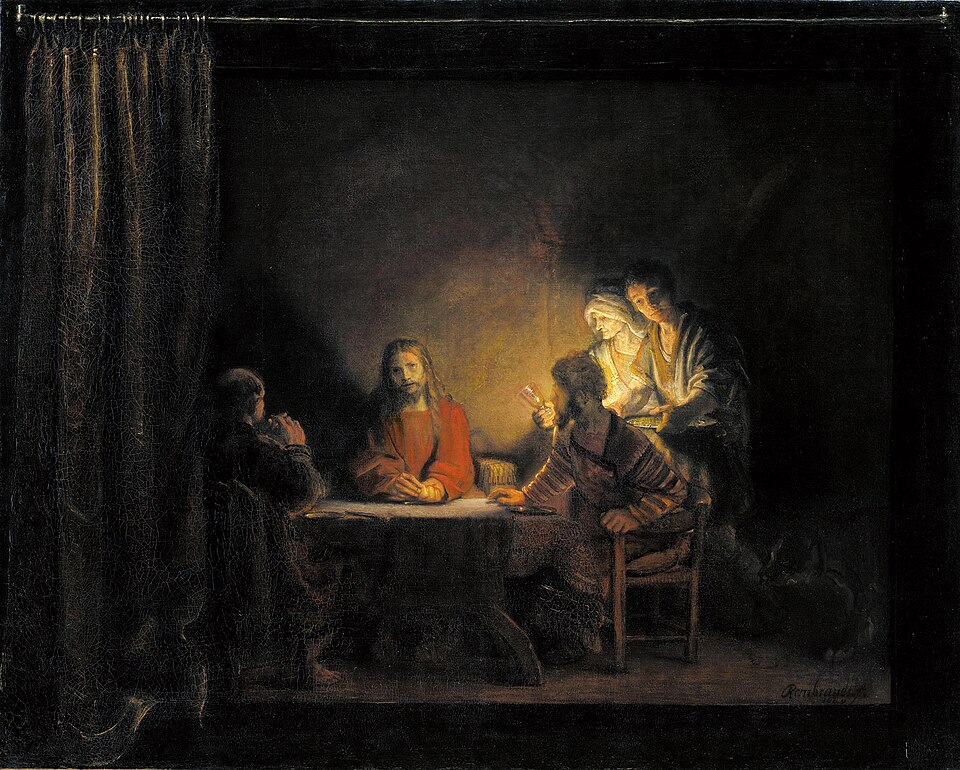
In his 1991 book of essays, AfterCulture: Detroit and the Humiliation of History, Jerry Herron writes about a paradox that was true several decades before and after his book came out: Detroit, in national media, was portrayed both as an empty space and as a city “overfilled with human misery.” Outsiders exaggerated pheasant and fox citings; meanwhile, they were unable to see the city as a city. Herron’s analysis probed the ways we see through our expectations. What visitors to Detroit often expected to see in a city either wasn’t there, or was obscured by so much that those viewers had no conceptual categories for within their understanding of cities. Detroiters were doing urbanism differently, as that period in its history required of them.
Similarly, the disciples in today’s Gospel are constrained by their expectations. They’re not to blame for that—Jesus, whom they had hoped would be the promised Messiah, had been crucified. They were aware of reports that some of their fellows had seen him, but how could that register? Their conceptual category for that phenomenon was likely what ours would be: people so stricken with grief that their minds are playing some kind of trick on them.
And yet, there Jesus was. He had to work to help them learn to see the radically unfamiliar sight of a resurrected human being. To them, he seemed like an ordinary person, strangely ignorant of everything that had been happening in Jerusalem that weekend. They needed new ways to process their present reality and recognize their risen Lord.
So he talked them through the Scriptures, highlighting the most useful templates they could use to understand him through—those templates Christians often think of as “types” of Christ or even prophecies about him.1
That was fine, but it didn’t do the trick. What they needed was more experiential, something that would prompt their muscle memory, so to speak. Primed by Jesus’ patient teaching and their own generous hospitality, the insight arrived when Jesus took, blessed, broke, and shared bread at their table.
In the image above, a student of Rembrandt’s depicts these disciples’ moment of recognition by filling the space between them and Christ with light. Curiously, the light doesn’t center on Jesus. It shines on the ones who receive the revelation of the risen Christ just before he vanishes from their sight. The scene is intimate—as intimate as the sharing of a meal. The light that dawns among them contrasts with the darkness holding the scene together. And the artist adds a nice touch, alerting us to view this as a moment of revelation by literally unveiling it with the opened curtain framing the image.
Yet in the Gospel text, Jesus promptly disappears. It is reminiscent of nola me tangere—don’t cling to me—that he said to Mary Magdalene in a different Gospel’s telling. Having received the light of revelation, these disciples must now learn its purpose: to go out into the world and share the good news of Jesus’ resurrection.
Jesus’ teaching, over the course of the journey, allowed these disciples’ understanding of him to unfold. Similarly, in the course of its ongoing journey with Jesus, the Church’s understanding of him unfolds, and continues to unfold. We too are sent out into the world. In the reading from Acts, the same author of Luke’s Gospel seems to hyperbolize by claiming Peter’s speech converted 3,000 people in one day. (Who, exactly, baptized all those people in the same day?) Peter’s speech accuses his hearers of having crucified Christ, although we know he was a victim of Empire’s campaign of terror. Yet his point is not to cast blame, but rather to preach the Resurrection, the good news.
Another author, writing in Peter’s name, reminds us that one of the outcomes of our faith in Jesus is our “genuine, mutual love.” Without that love in community, our work in sharing the Gospel will ring hollow. Christ has drawn us into community of folks who likely would not have much else in common. Pseudo-Peter frames this in terms of ransom through the Incarnation and the Paschal mystery (Jesus’ death and Resurrection).
All of this—redemption, loving community, sharing good news, baptizing new Christians—can be understood as conversion, what the late Donald Gelpi, SJ called “transvaluation.” Transvaluation, he explains in his book, Peirce and Theology: Essays on the Authentication of Doctrine, is when something you have understood in one frame of reference is seen in a new frame of reference. Recognizing the risen Christ in the breaking of the bread is a superlative example of transvaluation. Maybe learning to see a city full of people in 1990s Detroit would be another example. How might we be called, today, to shift our frame of reference so that we see our cities, our world, the human misery around us, our neighbors, our fellow Christians, or a shared meal in the light of revelation that shines from our risen Lord?
- I am of the firm opinion that there are no prophecies of Jesus in the Hebrew Scriptures; all the events and prophecies recounted there speak to the times in which they were written, redacted, and deemed Scripture by the community that had produced them. Instead, I think, the earliest Christians, who were Jews, turned to their Scriptures to try to understand an unprecedented experience they saw as God’s work in the world, and there they found language for what would become the Gospel, or as theologians last century were fond of calling it, the kerygma. ↩︎


Leave a Reply