
The Fourth Sunday of Easter—April 26, 2026
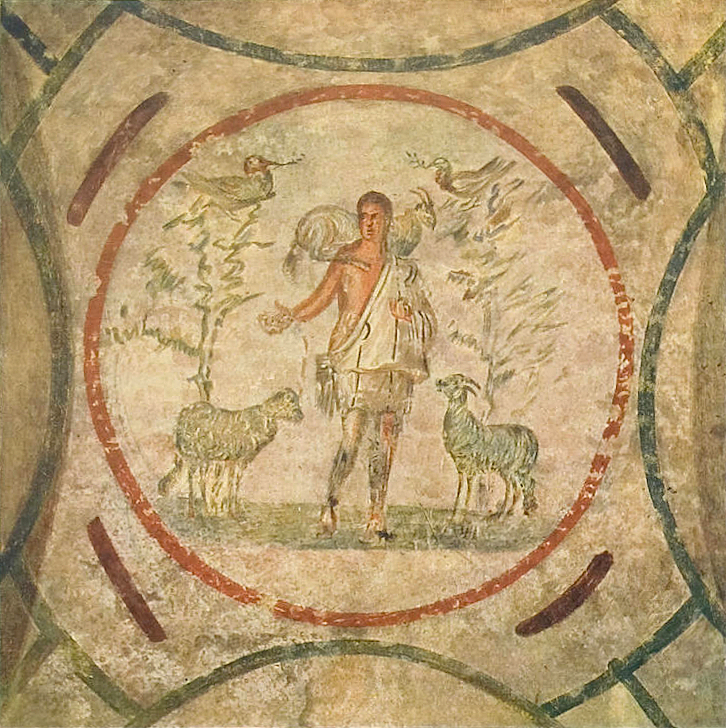
In today’s epistle, someone writing as St. Peter reminds Christians who are suffering for their faith that Christ also suffered unjustly, entrusting himself to God. In doing so, he set a model for us.
While early Christians were sometimes persecuted, it was far from a constant experience. Decades could pass between persecution campaigns, or these campaigns might be localized and not throughout the empire. Later Christians would find comfort in depictions of the crucifixion; by empathizing with Christ in his suffering, they could feel his empathy with theirs. However, the earliest Christians tended to portray Christ as a healer, or feeding the multitudes, or, as in the image above, as the Good Shepherd.
It makes sense that in a time when crucifixions were still actually happening that Christians might not be drawn to portrayals of Jesus’ death. But depicing Christ as Good Shepherd was both religiously and culturally significant.
In Roman myth, the god Mercury (Greek: Hermes), who may be best known as the messenger to the gods, was also worshipped as a patron of shepherds. As such, he was sometimes depicted carrying a ram or a lamb on his shoulders
Depicting Jesus in the same way could have served to help explain the Christian faith to others, or it could have been a way to encode an image of Christ that might pass under the radar during those times of persecution. The similarities are salient:1 Mercury/Hermes carried, and carried out, messages and commands from the Olympian gods; he mediated between mortals and gods, and between life and death. As the divine Word of God sent by God into the world to save us from death, the fact that Jesus could also be portrayed as a Good Shepherd like Mercury/Heremes certainly served Christian purposes at the time.
The lectionary pulls together a number of passages that image God, or Christ, as our shepherd. The one outlier is Acts; here, we continue to read the post-Resurrection story leading up to Pentecost. The depiction of an early Christian community living together so closely that they shared everything in common is likely an exaggeration (if not fabrication), but it speaks to Christian identity in the ideal, at least: unity, generosity, love, gratitude, and ordering one’s loves so that fellow human beings are valued more highly than mere possessions. We could think of this, perhaps, as a description of what life might be like in Christ’s sheepfold, but of course that is an intentional juxtaposition of the texts.
The Psalm reminds us that this imagery of the Good Shepherd isn’t simply borrowed from Roman mythology; it is embedded deep in the Jewish tradition from which Christianity emerged. It also gives us a good picture of the ways in which God, or Christ, is like a good shepherd: guiding us, protecting us, feeding us, providing water and pasture. When you are confident in that kind of care, you can sit down to eat despite enemies nearby; you can walk through the “valley of the shadow of death.”
The author of 1 Peter points out that even sheep we might see straying without a shepherd can enter this Good Shepherd’s care. Jesus tells us that he is the very door that opens to let sheep in, and closes to keep out thieves and other threats. He sees his role as shepherd as granting abundant life beyond mere safety.
He also invites us into a relationship of intimacy: His sheep know his voice, and follow him, because they trust him. Like the Psalmist, they have experienced his protection and provision.
Knowing Jesus’ voice seems to be a protection on its own. If we know, and follow, Jesus’ voice, we will not follow the voices of those who want to plunder the flock.
We’re living in a time where it seems clear that many Christians have followed other voices. We can be sure the Good Shepherd is aware of this, and is seeking to bring them back to safety. Is this something we can help with? If so, how? How can we ensure that we don’t mistake other voices for Christ’s?
I don’t take issue with the early Christians coopting depictions of Mercury/Hermes in order to say something about Christ, especially when they were under the threat of persecution. But I wonder if it’s easier to lose track of Jesus’ voice when we’ve been drawing him to look like gods that rule in our social order—such as money, privilege, and power (displayed so often as hyper-masculinity). These gods also masquerade as Christ, luring us with promises of security and provision. It’s easy to rationalize that. We need security, we need food and shelter. And as long as Christians have nursed a persecution complex, it’s perhaps no more surprising we would leap to an offer of power and influence than it is that fourth-century Christians (who had actually been persecuted) did when Rome extended the invitation.
We can’t help describing Christ in terms that are meaningful in our own culture. We need to recognize, though, that these are metaphors, depictions—as equally not Christ as they might point to him. I think remembering that is at least a good start to avoid mistaking someone else’s voice for his.
- I am only speculating on these points, as I’m not an expert in Roman or Greek mythology, and may be seeing similarities where ancients would not have seen them, so take this with a bit of salt. ↩︎


Leave a comment