
The Seventh Sunday of Easter, Year A—May 17, 2026
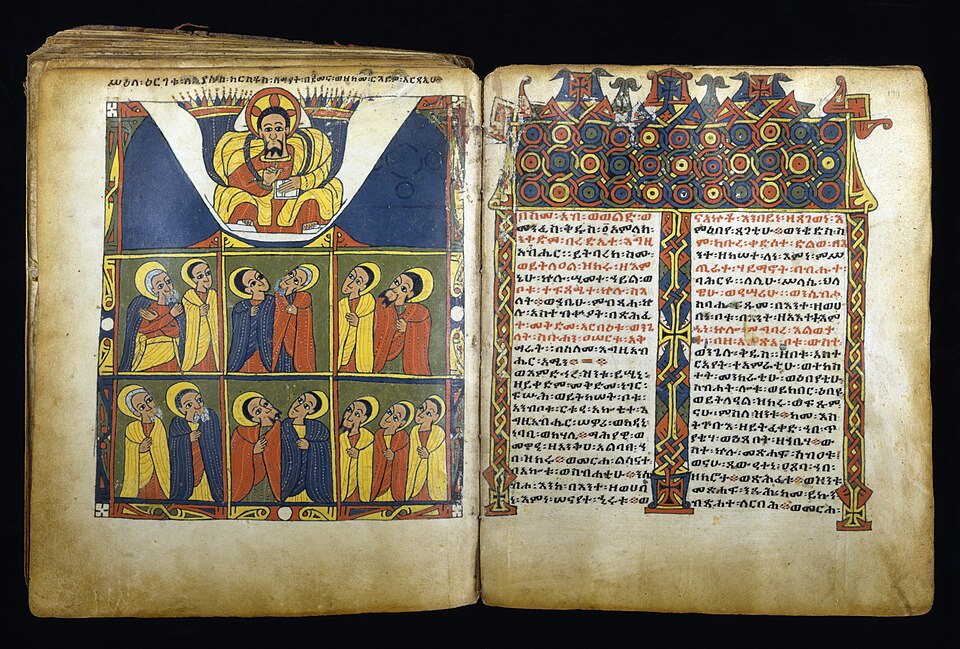
Acts 1:6-14
1 Peter 4:12-14; 5:6-11
John 17:1-11
Psalm 68:1-10, 33-36
My apologies for the lateness of this post; it was an unexpectedly busy weekend—I was barely at home, and when I was, I really had to sleep.
For Christians in the Modern era, the story of Jesus’ ascension is one of the most perplexing—for those who try to reconcile their religious faith with a scientific understanding of the cosmos. But to ask whether this event, as described in Acts, “really” happened is the wrong question. Like religion, like science, this account invites us into a much bigger story.
In the Incarnation, God became human: the Creator took up residence inside creation. Gathering up created matter into himself in what the Church traditionally has called the “hypostatic union,” Christ infused creation with his divinity—which is to say, saved it. The Ascension is at the very least the symbol of the closing of that loop: Christ’s divinity, now joined to creation, returns to the Godhead. God now has human DNA, so to speak.
All of this, of course, is metaphor and symbol. Divine realities don’t fit into our conceptual frameworks without remainder, and so they can’t be adequately expressed in language. All our language about God is, in some sense, wrong.
Luckily, humans have other ways of expressing ideas than the more prosaic, scientific language that seeks to explain ideas precisely. Prior to instrumental logic is the logic of the story. Stories are quite possibly the earliest way humans, being meaning-making animals, have tried to make sense of our world and our place in it. Myths fit well into that category. A major characteristic of story and myth is that they can be unpacked almost infinitely. They are not mere recountings of factual events; they are filled with a superfluity of meaning. Each time a story is told, it may be unpacked in a new and enlightening way that can be unique to the person reading or hearing the story in that specific moment. And stories in oral traditions—like human memories—change a little or a lot with each retelling.
The word “mystery” today usually connotes a puzzle or problem to be solved. As meaning-making animals, our brains do love a good puzzle. But this is only one definition of “mystery,” and it’s not the definition we use in church.
Etymologically, the word “mystery” traces back to the Greek word mustērion, which referred to what we call the “mystery religions,” which involved secret initiation rites. On her blog, Useless Etymology, Jess Zafarris1 notes that this meaning is related to the Greek word, myein, “to close” or “to shut.” Christians used the word early on in a way that seems similar to ideas in the Hebrew Scriptures (especially in the apocalyptic literature like Daniel) regarding secrets disclosed by divine agents.
In the New Testament, mustērion is used to refer to what we now call “sacraments.” While Latin has the word mysterium, which has also been used in theology, Tertullian famously translated mustērion using the word sacramentum, which referred to a military oath of initiation2—signaling a theological understanding of sacraments as a kind of seal on Christians’ commitment to their new life in Christ.
A seminary professor of mine claimed that the Christian use of the word mustērion or “mystery” refers to closing the mouth—i.e., having nothing to say in the presence of the divine. At the very least, this would reference the tradition in Greek mystery religions to keep one’s lips sealed (i.e., not talk about it outside the cult) but it does remind us that it’s worth thinking about our inability to find words for divine mystery. Alejandro García-Rivera, another seminary professor of mine, described divine mystery as a “sensible” mystery, not to be solved, but to be experienced. That sense of being rendered speechless in experiencing the divine is captured in the Latin word mysterium, famously used by Rudolf Otto, who wrote about our encounter with the numinous as the mysterium tremendum et fascinans. We experience the divine within two poles: a profound sense of our own creatureliness tinged by fear; and a strong attraction or desire. The divine is both overwhelming and hope-bearing; the experience of it is a sacred experience of the sublime.
Exploring the human experience of the sacred sublime calls for story, and Christians have the great story of God speaking the cosmos into being so that God could dwell in it; God becoming human to so completely join Godself with creation that creation is thereby saved from absurdity, meaninglessness, or even ultimate mortality; and God accepting creation into Godself. All of this is equally symbolized, I think, when St. Thomas puts his hand into the wound in Jesus’ side—that wound being a fecund poetic symbol for the locus of God’s act of creation.
Whether or not Jesus actually rose up off the ground and disappeared into the sky—stranger things have surely happened—the story invites us into a mysterium tremendum et fascinans in which God is genetically related, through evolution and incarnation, to every living thing on earth. None of which is literally possible; but it is deeply true.
NOTES:
- Seriously, check out her blog. She also co-hosts a delightful YouTube channel with Rob Watts (of the channel RobWords), called Words Unravelled. ↩︎
- The word also referred to setting something aside as sancrosanct, like money contested in a lawsuit, but it seems Tertullian had the military oath meaning in mind. ↩︎
 The Sound
Leave a comment