
Pentecost (Whitsunday), Year A—May 5, 2026
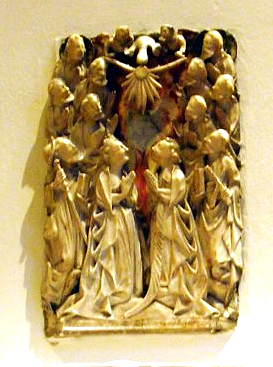
- Acts 2:1-21
- or Numbers 11:24-30
- 1 Corinthians 12:3b-13
- or Acts 2:1-21
- John 20:19-23
- or John 7:37-39
- Psalm 104:25-35, 37
The lectionary is a choose-your-own adventure today. By way of explaining the enormous list above: It’s the custom in Easter for the first reading to be from Acts; the usual pattern for Sunday readings is (1) Hebrew Scriptures; (2) Psalm; (3) Epistle; and (4) Gospel. So that pattern can be continued this 50th day of Easter, or you can opt for the pattern going forward.
[TL: DR—Boring churchgeekery, blah blah blah…] A further technicality: Beginning the day after Pentecost, we are in Ordinary Time. “Ordinary” here refers to counting. Every Mass includes elements that are the same every week; the variable parts are called “propers.” Each feast and season has its own assigned propers. The rest of the time, the propers are numbered. Traditionally, the time between the Feast of the Epiphany and Ash Wednesday is Ordinary Time, and Proper 1 begins after Epiphany. Then Lent and Easter have their own propers. After Pentecost, the propers pick up again where they left off. In the Episcopal Church, as the time after Epiphany has tended to drift more toward becoming an Epiphany season, we number those Sundays as Sundays “after the Epiphany” and don’t tend to include the proper number. So once we start counting Sundays “after Pentecost,” the proper numbers start at a seemingly random number. Since Easter moves each year, the number of weeks between Epiphany and Ash Wednesday vary, as do the weeks between Pentecost and Advent. So the seeming random number is simply where we pick up from where we were prior to Lent. In theory, anyway.
For the purposes of this blog, I’ll allow the full range of readings to inform what follows.
Pentecost celebrates the gift of the Holy Spirit, as described in the Acts of the Apostles. The word comes from the fact that it falls fifty days after Easter. But if we juxtapose the reading from Acts with the Gospel from John 20, we get a slight contradiction that points to the fact that the author of Luke-Acts is doing something interesting.
The author of John has Jesus refer obliquely to the Holy Spirit (in chapter 7) under the metaphor of springs of water to refresh the thirsty. But this was a prediction of future events: “…as yet there was no Spirit, because Jesus was not yet glorified.” So in chapter 20, after his resurrection, Jesus appears to the disciples, and
Jesus said to them again, “Peace be with you. As the Father has sent me, so I send you.” When he had said this, he breathed on them and said to them, “Receive the Holy Spirit. If you forgive the sins of any, they are forgiven them; if you retain the sins of any, they are retained.”
For John, the Spirit is given directly by Jesus—through breath. The same way God breathed into Adam. The Spirit has long been associated with breath, which should be no surprise: breath is life.
But Luke takes a different tack. Why would he have Jesus tell the disciples to wait for it…wait…wait… and the promised Spirit would come fifty days after the resurrection?
Pentecost was originally the Greek name used by Jews for the Feast of Weeks, Shavuot. Observed fifty days after Passover, it celebrates God’s gift of Torah to Jews—a gift that constitutes them as a people. Luke is opening the meaning of Jesus’ death and resurrection, and the gift of the Holy Spirit, by mapping them onto Passover and Pentecost.
Much has been made of the comparison between Pentecost and Babel: At Pentecost, the Spirit enabled people who spoke different languages to nevertheless understand each other. Unfortunately, we’re too often distracted by the supernatural elements. Our knowledge from Paul that early Christians practiced glossalalia gets read back into this story as well. But Luke goes to great pains to make his point: The Spirit enabled Jesus’ followers to speak languages they did not know, yet they were plainly understood by native speakers of those languages. It was all about communication and connection.
Putting it all together, we have a liberative event (Passover / Resurrection) followed by a formative event (gift of Torah / gift of Spirit). But for Luke, the Spirit moves this a bit further. The arc of Luke-Acts shows Jesus’ message spreading from Jesus’ origins in Nazareth all the way to Rome and throughout the empire. So in this formative moment, the people being formed includes people who are only just arriving or who are yet to come. The Spirit removes the barriers that have been in place since Babel. Luke offers a seemingly-exhaustive list of the places people are coming from. Before the end of this chapter, Luke tells us 3,000 people became Christians that very day. The rest of the book of Acts continues to raze all boundaries of difference, bringing into the Church people of different nationalities, genders, socioeconomic statuses, languages, and religious backgrounds. All are welcome. And what’s more—the chapter closes with the claim that the Christians lived together and shared everything in common.
While we celebrate Pentecost, perhaps for the “birthday of the Church,” or maybe for the outpouring of charismatic gifts, we would do well to remember Luke’s point here. God the Father, through Christ, by the Holy Spirit is drawing everyone who will come to become one people: a Church whose members understand each other, make space for each other, support each other, and keep reaching out to include others. Unity-in-diversity, just like the Trinity (which we celebrate next Sunday).
The rest of the readings celebrate the Spirit at work in Jewish history, in the Church, and in all creation. In the reading from Numbers, we see the Spirit moving in unexpected ways. Moses had called seventy elders, who were granted a one-time ability to prophesy; but two men, Eldad and Medad, who were not among the seventy, began to prophesy as well. Joshua tried to stop them, but Moses responded,
“Would that all the Lord’s people were prophets, and that the Lord would put his spirit on them!”
Later, the prophet Joel would promise that Moses’ longing would be fulfilled, that God would pour out the Spirit on all people. Acts has Peter quoting Joel:
“In the last days it will be, God declares,
that I will pour out my Spirit upon all flesh,
and your sons and your daughters shall prophesy,
and your young men shall see visions,
and your old men shall dream dreams.
Even upon my slaves, both men and women,
in those days I will pour out my Spirit;
and they shall prophesy.”
Peter continues quoting Joel, but ends on this note that the rest of the book will continue to sing:
“Then everyone who calls on the name of the Lord shall be saved.”
The Psalm celebrates creation, and through it, God, its creator. The poet marvels at God’s power, but also at God’s playfulness:
“and there is that Leviathan,
which you have made for the sport of it.”
All God’s creatures rely on God for sustenance, and for life itself. The Psalmist credits the Spirit with granting all creatures the breath of life. That may be a tenuous connection with Pentecost, but it is one worth making. The poet exuberates in God’s marvelous creation, and blurts out the hope that God enjoys it, as well.
And finally, in the epistle, Paul explains how the Spirit undergirds the Church. Its confession of faith is only possible through the Spirit, who draws believers together into one body and distributes gifts to each so that the whole will have what it needs. Gifts of wisdom, knowledge, prophecy, miracles, healing, speaking in tongues—these are not party tricks or status symbols. Paul writes,
“To each is given the manifestation of the Spirit for the common good.”
All our gifts are manifestations of the one Spirit, which we all have received, and they are given to us for the sake of others. Together, we are one body with many gifts sufficient to serve the common good of the whole world. They are gifts, after all, of the one Spirit who gives life to every single creature on earth. Revel in your gift; God does.
And remember what it’s for.
By the way, while I was writing this, YouTube’s algorithm, apparently looking over my shoulder, offered this video: “Is the Book of Acts Historically Accurate? (6 Reasons I’m Cautious)” from CJ Cornthwaite, a scholar of early Christianity whose channel I follow. The video is a year old, but I do recommend it.
- The author is not too proud to admit that this is a photo she took at some point, and found it in her external drive. It’s edited down from a larger photo, so the detail’s pretty bad. ↩︎


Leave a Reply