
The First Sunday after Pentecost: Trinity Sunday
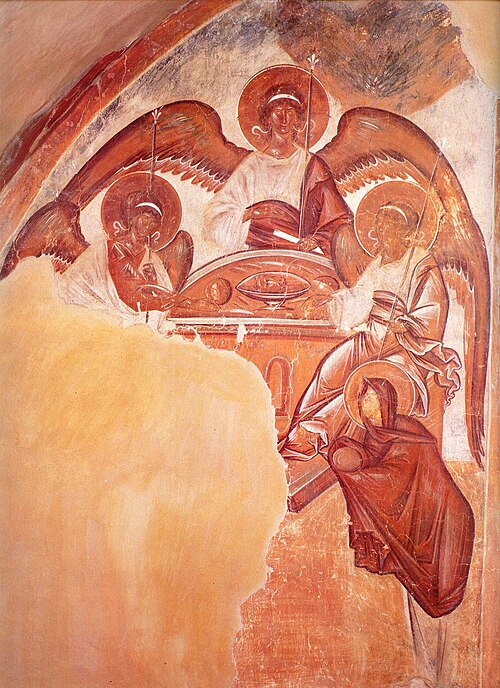
The image above is a popular iconographic depcition of the Holy Trinity, interpreting the three angelic visitors received by Abraham and Sarah as a representation of the Trinity. You can see many different versions of this image online: I googled it for you. Most people know the version by Andrei Rublev, painted in the early fifteenth century. (Rublev’s version removes Abraham—and Sarah—from the scene intentionally, and reorders the Persons at table to center God the Son.)
The reason artists chose the passage depicted here is because, traditionally, Christians were not supposed to depict the Father and Spirit in any way except symbolically: often, in the case of the Father, a hand reaching down from heaven; in the case of the Spirit, as a dove or as fire. There’s plenty of art, especially in more recent centuries, that breaks this rule, which I think are much less powerful. They tend to try to depict doctrinal data rather than drawing us into an encounter.
Theology similarly often makes the mistake (in my opinion) of veering too far into the analytic. I’ve often said that I think the native language of theology is poetry; part of what I mean by that is that poetry calls language back into a vehicle for encounter. Study the Trinity in seminary or graduate school, and, if you’re like me, you’ll feel like you’re in some kind of theology lab trying to dissect the Holy Trinity: Slice here, and you can see that the relationship between the Father and Son is one of begetting; over there, you can see the relationship between the Father and Spirit is one of procession. To be fair, there’s a lot less precision in that language—you may find yourself wondering, for example, what exactly we’ve learned by reading that sentence. What does “begetting” mean when it’s God we’re talking about? And how is “processing” distinct from begetting? In the West, theologians added the detail that the Spirit is the bond of love between the Father and Son, which at least closes the loop. It also explains that neuralgic filioque (“and the Son”) clause in the Western version of the Nicene Creed: the Spirit is said to proceed “from the Father and the Son.” The original wording omitted that phrase and simply stated that the Spirit proceeds from the Father.
You can actually see some of this theology in Rublev’s version of the Hospitality of Abraham and Sarah—although his Abraham-and-Sarah-less version is often called “The Holy Trinity” or the “Old Testament Trinity.”
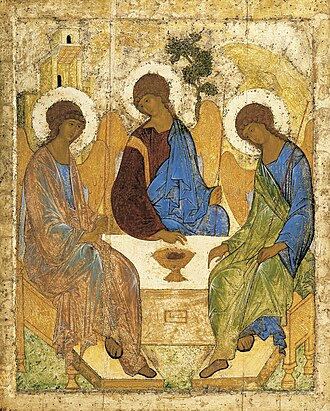
Artistic depictions of the Trinity can remind us not only that there are right ways and wrong ways and…questionable ways to visually communicate this important dogma. They also remind us that the doctrine of the Holy Trinity is a theological construct that attempts to point, as adequately as possible in human language, to the transcendent God as experienced in the Christian tradition.
The readings assigned for this feast really only hint at the doctrine of the Trinity.
The reading from Genesis is likely included because Christians read the Trinity into it. It reminds us of our understanding of the three Persons’ involvement in creation. The New Testament asserts in several places that the world was created through Christ; in Genesis 1, we also see the Holy Spirit active—at least, if you read וְרוּחַ (“ruach”) as “spirit” rather than “wind.”
Paul’s letter (2 Corinthians is generally thought to be one of the genuine Pauline epistles) includes a sign-off that has become incorporated into liturgies as an informal blessing:
The grace of the Lord Jesus Christ, the love of God, and the communion of the Holy Spirit be with all of you. (2 Corinthians 13:13, NRSV)
This is not in any way a formal declaration of the doctrine, but it does show that pretty early on, Christians had some mental category comprised of Jesus Christ, God, and the Holy Spirit.
The Gospel lection contains what many critical scholars consider to be a later interpolation of a trinitarian formula for baptism. While early, reliable manuscripts do contain it, they are late enough that they are still inconclusive when considered along textual evidence1 and extrabiblical texts.2
Ultimately, the doctrine of the Trinity is not in the Bible. This fact cements, for some Christians, the rejection of that doctrine. Probably the majority of Christians do hold to a belief in the Trinity—even many who claim to follow the ideal of sola Scriptura.3
The earliest Christians were left reeling from their experience of Jesus. Over time, as Christians thought through that experience and tried to work out amongst themselves how to best live and worship in light of it, the majority of Christians within the Roman Empire concluded that Jesus was God.4 Having inherited a monotheistic commitment from Judaism, Christians held this christology in tension even as they were also coming to understand the Holy Spirit to be not only a Person, but also God.
As anyone who has studied philosophy will recognize, various ideas about how to harmonize these seemingly-incompatible beliefs were worked out with logic, tested through counterfactuals, and—in a method less common among philosophers—tried in practice. Some Christians pointed to the fact that in the liturgy, Jesus was prayed to as to God. Other Christians argued that both Jesus and the Spirit did things only God could do.
There are other ways to interpret all the same data, and had the councils happened and the creeds been formulated in another time and place, our doctrines would almost certainly be slightly different. It’s so important to remember that all our doctrines and dogmas, despite their claims to precision, are symbols that point to the divine.
My graduate school, the Graduate Theological Union, is an inter-religious consortium of seminaries and institutes, and the seminary where I currently teach, the Ecumenical Theological Seminary, is, well, ecumenical (i.e., inclusive of all Christian traditions; we also frequently have non-Christian students as well). So it shouldn’t be any surprise that my undogmatic self hesitates to use a doctrine, even one so central to my own faith as the Trinity, to exclude anyone who claims the name Christian from the Christian family. YMMV, of course.
But the symbol of the Trinity does tell us something important about the Christian conception of God: that God is love.
God is Love. Somehow, this idea that love is constitutive of God’s very being rings true for Christians. Logically, a single God existing entirely alone could love Godself, then choose to create a world in order to love it and invite it to love God in response. But for trinitarian Christians, God is love shared between Persons in Godself, eternally without need for creation. While I’ve heard people say they find it meaningful to think of God as needing creation, I think it’s more powerful to recognize that God in fact has no need of us. We are entirely unnecessary, and that is liberating. And it speaks to the fecundity of divine love: we exist because God loves, and has loved us into being. Pure, unadulterated love.
The doctrine of the Trinity also captures an ancient understanding of beauty as unity-in-diversity. The Trinity is both unity and diversity, three Persons in one Being.5 Beautiful. And the good news is that Holy Beauty calls us into the same beauty: to become an ever-increasing diversity (or, in Darwin’s phrasing, “endless forms most beautiful”6) of beings drawn into unity in God.
Ultimately, the doctrine of the Trinity is based in Christian experience of God in history. It is one attempt among countless attempts humans have made to describe transcendence, and the one that many Christians have found to best resonate with their experience of God in Christ.
Postscript: A couple miscellaneous pet peeves of mine:
First, “trinity” is a word that was coined to describe the Christian understanding of God. There is only one Trinity. Other things people often call trinities would be better called triads, threesomes, trios, or groups of three.
Second, if God is Trinity, then “God” refers to the Trinity: Father, Son, and Holy Spirit. In other words, to say “God and Jesus” sounds odd to my ears (though I know it’s a common phrasing) because Jesus is God. But even I can be annoyed with my preference for precision there.
And I also want to say a word about inclusive language and the Trinity. Many Christians will use formulae that avoid gender-specific words to speak of God the Trinity. Most common is “Creator, Redeemer, and Sustainer,” but that is often criticized or rejected because of its appearnce of Modalism (i.e., Monarchianism or Sabellianism) which was deemed a “heresy” by the Church Fathers and/or the powers-that-were-at-the-time. A number of clergy in my diocese have adopted our current bishop’s formulation, “Creator, Christ, and Holy Spirit.”
The issue with “modalism” is that it tends to assign roles to the three Persons of the Trinity. As we have seen, Christians understand all three Persons to have been involved in creation; indeed, the ancient tradition affirms that whatever any Person of the Trinity does, all the Persons are involved in. However, the tradition has always understood the First Person of the Trinity (the Father, traditionally) to be in some sense a source of the whole—probably because Jesus referred to his “Father” and called himself the only-begotten, and early Christians understood the Spirit to proceed from the Father. So my own formulation, which I have no real occasion to use, would be “Eternal Source, Incarnate Word, and Holy Spirit” (or “Holy Breath,” to follow a late professor of mine, Donald L. Gelpi, SJ).
- (the fact that in Acts, people are said to be baptized in Jesus’ name, without an invocation of the Trinity) ↩︎
- (e.g., Eusebius’ late 3rd/early 4th c. quotations of that passage, which omit the trinitarian clause) ↩︎
- “Scripture alone”—a Reformation-era idea that was essentially adopted to eliminate the influence of (Catholic) tradition in theology. For Catholics, doctrine is based in Scripture and in its interpretation by the Church through councils and synods, theological work, and one might argue, liturgical practice. Reformers wanted to strip away the accretions of tradition, which of course isn’t entirely possible; the Trinity may be a prime example of that. ↩︎
- This is, of course, a staggering oversimplification. ↩︎
- Being, though, is a slightly problematic concept to use in relation to God. Some theologians—notably Paul Tillich and John Macquarrie—have described God as “Being Itself” or “the Ground of all being,” and remind us that to say “God exists” is almost a nonsensical statement, as if God were one more thing alongside other things that could exist or not exist. Nevertheless, we have to think and communicate through language which simply breaks when we attempt to apply it to the transcendent divine. ↩︎
- “There is grandeur in this view of life, with its several powers, having been originally breathed into a few forms or into one; and that, whilst this planet has gone cycling on according to the fixed law of gravity, from so simple a beginning endless forms most beautiful and most wonderful have been, and are being, evolved.”—from the conclusion to The Origin of Species, 1859. ↩︎


Leave a Reply