
The Fourth Sunday after Pentecost, Year A (Track 1)—June 21, 2026
Genesis 21:8-21
Psalm 86:1-10, 16-17
Romans 6:1b-11
Matthew 10:24-39
Take up your cross, the Savior said,
if you would my disciple be;
Take up your cross with willing heart,
and humbly follow after me.(Hymn 675, Hymnal 1982, words by Charles William Everest, alt.)
Did Jesus really say that?!?
The author of Matthew puts similar words in Jesus’ mouth: “…Whoever does not take up the cross and follow me is not worthy of me.” Yikes. Taking up your cross, at that time in history, could only mean one thing: You had been convicted by Rome and were on your way to die horribly. It’s likely something that made sense to followers of the Way after Jesus had died and risen, although it’s still a tough sell. Even if you know you’ll be raised from the dead, who wants to volunteer to be crucified?
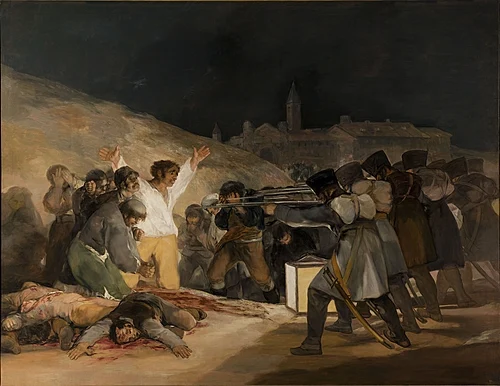
Goya’s painting, The Third of May 1808 celebrates a popular uprising against French occupation under Napoleon and his brother Joseph Bonaparte. The focal point, of course, is the condemned man whose radiance and gesture indicate fierce courage in the face of his fate. His arms mirror those of Christ on a crucifix, and his hands are painted so that the creases in his palms resemble stigmata. The connection is deliberate. Art historians have noted the formal similarities between Goya’s painting and an near-contemporary devotional etching, Miguel Gamborino’s The Assassination of Five Monks from Valencia (1813), which focuses on one of the monks, in brilliant white habit, kneeling, with arms extended in a similar pose. Goya is suggesting the condemned rebels of May 3, 1808 are heroes to be revered like saints.
But even these patriot rebels were not seeking martyrdom.
In any case, putting yourself at risk for the sake of a cause is not only a danger to your life; it can cost you relationships.
Matthew’s Jesus not only heads off to be executed; he also wields a sword. His words,
“Do not think that I have come to bring peace to the earth; I have not come to bring peace, but a sword”
clash directly with the Christ we celebrate at Christmas—the “Prince of Peace.” But it makes no sense to imagine severing relationships is a goal in itself for Jesus. Like the prospect of crucifixion—described in this passage so forcefully it sounds like a command to try to get yourself killed—finding yourself at odds with close family members and others is simply a consequence of the life Jesus is calling his followers to live. Any time you have to take sides, you’ll find yourself on the other side of a line that separates you from someone you love. Historically, family members have often found themselves on opposite sides of a war—the US Revolutionary War, e.g., or any nation’s Civil War.
But these familial rifts happen all the time for many reasons, each as tragic as any other. In the Genesis passage today, we see such a rift.
The promised child, Isaac, had been born to Sarah and Abraham. But Abraham already had a son—Ishmael—by Hagar, an Egyptian woman enslaved by Abraham and Sarah. In today’s reading, Sarah notices Ishmael playing with Isaac, and perceives this as a threat to her son’s future inheritance. Her feelings are understandable, even if she was the one who suggested to Abraham that he use Hagar to gain an heir. Now Sarah insists that Abraham send Hagar and her baby away. Just throw them out.
It’s not clear why this distressed Abraham. We hope he will have loved his son Ishmael. God speaks to him with a promise: Abraham, it’s OK to toss your kid and his mother out into the wilderness, because I will make a great nation of him.
Fast-forward: Hagar is out in the wildnerness with her child, and they have just run out of water. Her distress is visceral, and God responds, providing water…and also promising that God will make a great nation of her son.
The same promise, but how does it sound to the different people in the story?
What does it mean to Abraham that Ishmael will become a great nation?
What does it mean to Sarah that Ishmael will become a great nation?
What does it mean to Hagar that Ishmael will become a great nation?
I suspect Abraham would have felt some relief that he wasn’t sending mother and child to certain death. Maybe he also took comfort in the promise of posterity even beyond Isaac’s descendents.
Surely the promise would not assuage Sarah’s resentment, although Isaac’s inheritance from his father would not be split with a brother.
For Hagar, it means her son will not only survive, but thrive. Her recognition that she is seen by God must run even deeper, knowing that God is concerned not only with her present situation, but with her future, and her son’s future, and his children’s future.
Meanwhile, in Romans, Paul reminds us that being baptized into Christ means being baptized into his death. Being baptized into Christ’s death means also being raised with him.
I think we’re often tempted to imagine that being baptized into Jesus’ death in order to be raised with him means we get to skip to resurrection. His death, after all, was substitutionary, right? Him for us, right? (More on that next week…)
But Paul had no concept of Jesus’ death freeing us from any suffering. Quite the contrary—he generally expects that following Christ leads to suffering, at least for an apostle like himself. Being baptized into Jesus’ death more likely means we’re following him with a cross on our own shoulders; but like Jesus, we will be resurrected.
How does that promise sound?
What does the promise of resurrection mean to us when we’re comfortable, and needing to be resurrected feels like a hypothetical scenario?
What does the promise of resurrection mean to us when we suffer—especially when we are potentially or certainly facing death?
What does the promise of resurrection mean to us when it is offered to others who have been forced onto the other side of a line that’s keeping us safe? When we have forced them across that line?


Leave a Reply