
The Third Sunday after Pentecost, Year A, Proper C, Track 1—June 14, 2026
Genesis 18:1-15, (21:1-7)
Psalm 116:1, 10-17
Romans 5:1-8
Matthew 9:35-10:8(9-23)
Note: I apologize that this post is so late due to health issues combined with just being overly busy.
I’m a city-dweller, and I feel that in my blood. But I grew up in a semi-rural area, where we did refer to less obvious landmarks as well street names. It wasn’t quite rural enough that we were referencing trees, but I do sort of get how an oak tree could be a major landmark for nomadic people in a relative wilderness.
“The Oak Tree at Mamre” is the setting for today’s story from the Hebrew Scriptures. I’m intrigued by the inclusion of this named tree. Being neither a biblical scholar nor an historian, I can’t really speak to this in those terms—whether, for example, the fact it was a tree was significant, or if it was a matter of something visually significant in the landscape. We read that Abraham and his household were living in tents; there were almost certainly no buildings in the setting of this story.
Regardless of what the landmark was, the fact that it’s given a name in this story speaks to the particularity and importance of place, something we see a lot in Scripture, often in the form of someone building an altar or naming a place where they had encountered the divine. And Abraham encountered the divine at Mamre, more or less under an oak tree.
Hospitality being important to nomadic life in the wilderness, Abraham calls out to three men passing by and invites them to rest in the shade with him and have a bite to eat. Then he runs into the tent and mansplains to Sarah how to bake bread, picks out a calf for one of his servants to slaughter and cook, and finally he served the calf along with curds, milk, and Sarah’s bread. We get the image that Abraham is very personally engaged with the preparations, which seems strange; he had all these servants (and a wife) who could do that work while he attended to his guests. But I think it’s important to the storyteller that Abraham be the main actor in all of these details.
We’re told in the text that “the Lord” came to Abraham, just before we’re introduced to these three men. One of the men quickly emerges as the mouthpiece or spokesperson for the group. Referring to this individual or the group as a whole as “the Lord,” and having the spokesperson give voice to God’s words in the first-person singular—neither of these literary devices make the claim that this is Godself come to visit Abraham. Later tradition, of course, would concur, as the idea developed that God has no literal body. But whoever these strangers were, the text treats them as both representing and speaking with the authority of God.
Early Chrisitans, being predominately Gentiles, had no problem making images of Christ and others. The conflict between that and the commandment against making images would eventually be resolved (for the Eastern churches, anyway) in the 8th century.1 It’s been suggested that the icon painting tradition either grew out of or bears some kind of influence of Greco-Egyptian funerary paintings. You can see the similarities, although theological developments in Christian iconography altered the style to be less realistic.
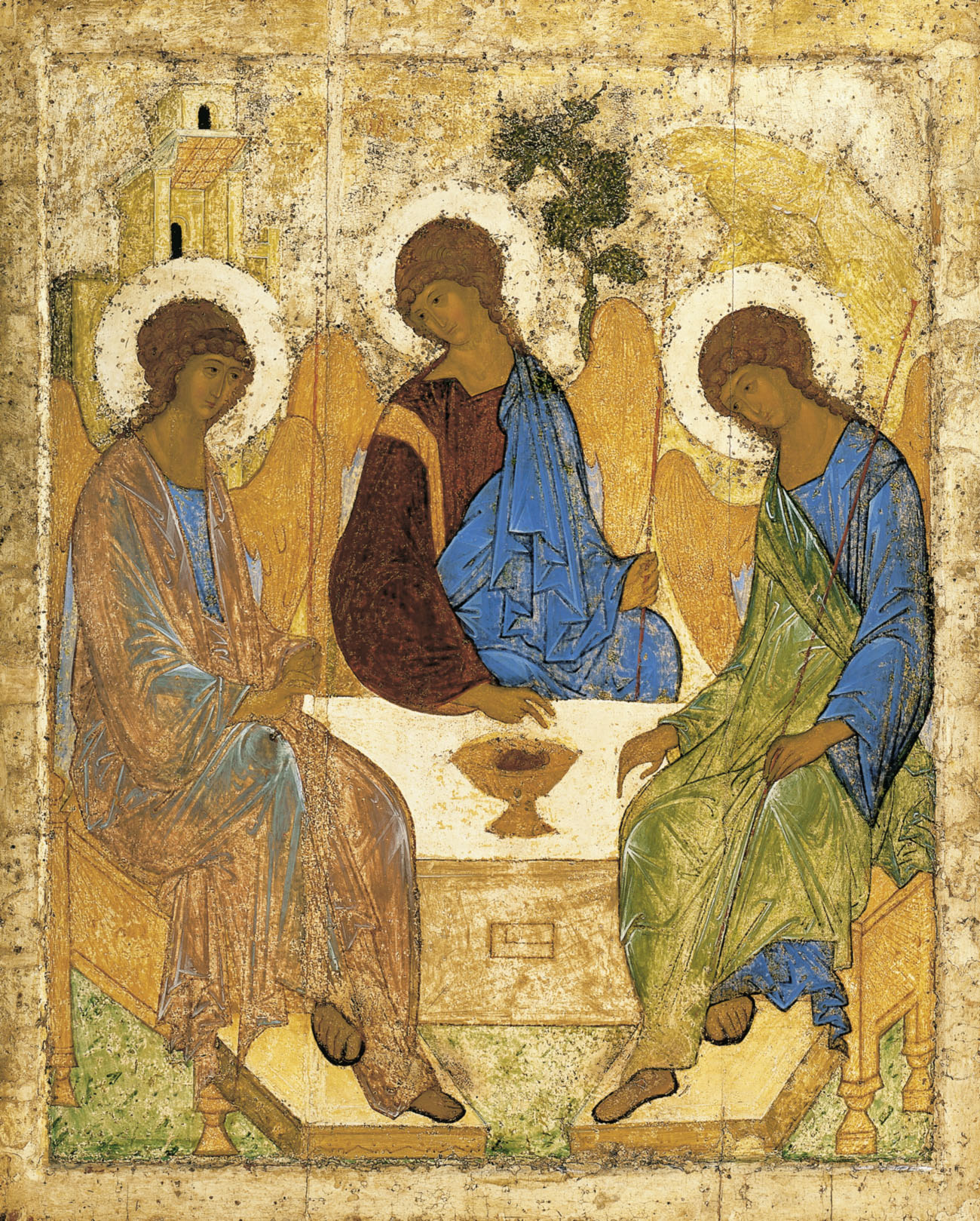
Icons famously have a reverse perspective: the perspective converges not in the background, as we’re used to in art, but rather on the viewer. So imagine you’re looking into the concave side of a reflective bowl. Your nose and other facial features would be pinched, and your hair would look big—as we commonly see in icons. Keeping this in mind is important to the icon pictured at the top of this post, the famous “Rublev Trinity,” more accurately, an icon of the type The Hospitality of Abraham [and Sarah]. Often in that icon type, you can see Abraham and Sarah. For example, look at this 16th-century Russian icon:
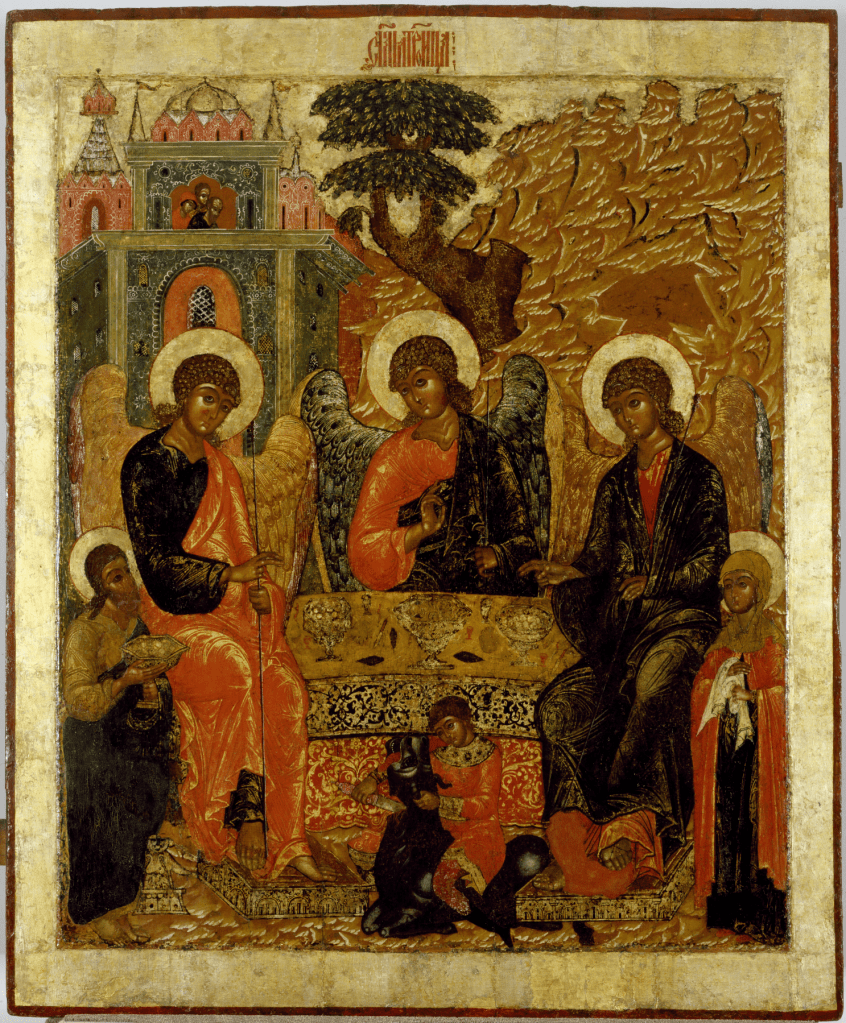
You’ll notice a few things. First, it’s visually similar to Rublev’s slightly earlier version. Second, there are more people in the image. The two haloed figures are Abraham and Sarah, and in typical iconographic fashion, they are smaller than their guests, the more important persons in the image. In the front, we’re not seeing a child playing with a dog; Abraham and Sarah do not have a child yet. Rather, this is a person considered even less important than Abraham and Sarah: it’s their servant, slaughtering the calf. (I don’t know who the two men and one woman looking down from the window in the building might be; they don’t typically appear in this type of image.) This version of the image also shows the angel on the left looking directly at the viewer, while the other two look up. Another difference is the figure on the right is also gesturing in blessing.
The two versions of the icon bear many similarities, though, including the background’s building (to represent Abraham’s tent), the oak tree, and a mountain. In Rublev’s icon, the elements in the background bend into the reverse perspective typical of icons.
The Christian appropriation of the commandment against images involved allowing images generally, because God had become human, making the incarnate Christ a visible image of God; however, because the Father and Spirit are not incarnate, Christian tradition (officially and in theory more than in practice) prohibits depicting them except symbolicaly. Usually, the Spirit will be depicted as a dove or as flames; the Father is normally portrayed as a hand reaching down from heaven (or the top of the frame).
But here, Abraham’s visitors, interpreted as angels, can be portrayed, and can also symbolize the Persons of the Trinity. While many Christians today understand the visitors to either literally be the three Persons of the Trinity or the pre-incarnate Christ flanked by angels, here they are angels symbolizing the triune God. As such, it needs to be read symbolically.
Rublev explores the tension between the “tri” and “unity” that give us the word “trinity.” The carefully circular composition draws the figures into a unity echoed in their similarity to each other and in the table, the space between them that also connects them. But there are also differences, notably the colors of their garments as well as the nuances of their gestures.
A few details tell us that we are looking at symbols, left to right, for the Father, Son, and Holy Spirit. First, the colors of the garments. Blue represents divinity, and all three figures wear blue. The central figure, however, wears a reddish-brown or brownish-red color representing the incarnation.
For the next detail, it helps to understand one of the major points of contention between the East and West: the filioque. Literally, that means “and the son,” and it refers to the phrase that at some point worked its way into the Nicene Creed in the west: the part that says the Holy Spirit “proceeds from the Father [and the Son].” In the East, the Spirit proceeds from the Father, full stop. In this image, we see the figures representing the Son and Spirit bowing their heads toward the Father, their source.
The three figures’ gazes are upon each other, not the viewer. With Abraham and Sarah and their servant missing, we get the feeling we’re glimpsing an intimate moment here. Perhaps we’re getting something of a glimpse into what theologians call the “imminent Trinity”—the Trinity as God is in Godself (as distinct from the “economic Trinity,” or the Trinity in relation with the world).
How on earth (literally; remember that oak tree) could we possibly be looking into the interior life of the Trinity? Of course, this is symbolic—and this is my reading; other interpreters may see things differently. But allow me to suggest a few possible clues.
First, the central figure represents Christ. Notably, he is blessing the food (the two-finger gesture indicates blessing), mirroring the Father’s gesture of blessing toward him, as if passing it through the food on the table to…us?
While it’s tempting to read the vessel on the table as a chalice, it’s actually a vessel holding food. I’ve heard it stated that the vessel holds figs, but it is also commonly interpreted as the slaughtered calf, symbolizing Jesus’ sacrificial death. I don’t personally accept substitutionary atonement theology, so I would downplay the sacrificial element, but there is still a strong Eucharistic symbol in Christ blessing food.
And most important, for me, anyway, is this:
In my own experience, I was contemplating a modern copy of this icon (actually, a reproduction of the modern copy that I had on a postcard), thinking about the symbolism and the theology going on in the image, when the reverse perspective seemed to open up and I felt an invitation to sit down. (A friend of mine later shared a similar experience with me regarding the same type of icon.)
While we cannot really see directly into God’s inner life, we have been invited there by Christ, who became human without losing his divinity. His ascension, which we celebrated a few weeks ago, represents the fact that he carries that humanity into the very Godhead, something that is quite likely impossible for our minds to wrap around. Luckily, our minds don’t have to wrap around it.
The mystery of the Trinity is, after all (in the words of Alex Garcia-Rivera) a mystery to be experienced rather than solved. I think that is why contemplating an icon like this is so valuable. And the icon itself is likely so revered because it does mediate this kind of experiential encounter with God. We can meet God in an icon as we also do in other sacred and profane places—like at church, or around any table where food is being shared, or under an oak tree at Mamre.
- The interested reader can consult John of Damacus’ (sometimes called John Damascene) Three Treatises On Divine Images. ↩︎


Leave a Reply