
The Sixth Sunday after Pentecost, Year A (Proper 9), Track 1—July 5, 2026
Note: This is published way behind schedule, in part due to a power outage from July 3-July7
Genesis 24:34-38, 42-49, 58-67
Psalm 45: 11-18
or Song of Solomon 2:8-13
Romans 7:15-25a
Matthew 11:16-19, 25-30
I was working as a verger at Grace Cathedral, San Francisco, when the Episcopal Church released the experimental Holy Women, Holy Men, intended to be the new Lesser Feasts & Fasts. I decided to make a binder with all the readings in it, so we could just put that book out for use in our daily Masses, basically as a lectionary. And I was deeply disturbed by how often women martyrs’ feast days were assigned the Psalm that appears in the lectionary for today (track A, anyway).
Hear, O daughter; consider and listen closely; *
forget your people and your father’s house.The king will have pleasure in your beauty; *
he is your master; therefore do him honor.[…]
In place of fathers, O king, you shall have sons; *
you shall make them princes over all the earth.I will make your name to be remembered
from one generation to another; *
therefore nations will praise you for ever and ever.
What is going on here? The king needs a consort in order to produce an heir (and a spare, no doubt). So he picks a woman he finds beautiful, and she is told, “He is your master…” She really can’t refuse. What a horrible image for the martyrdom of a woman, no matter how much you spiritualize “beauty”!
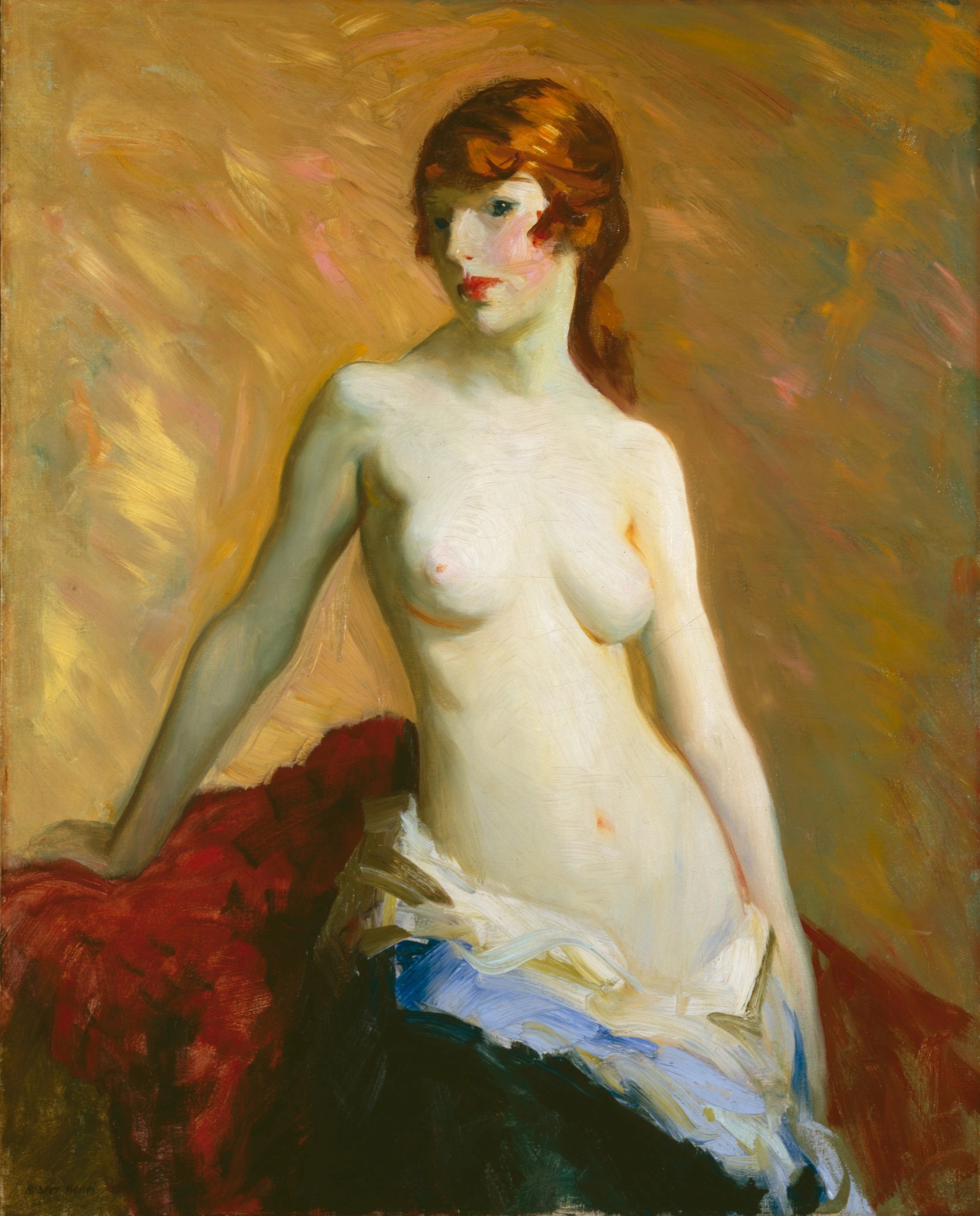
The painting above was more or less a study for the artist. Working with a live model (who apparently was unacquainted with sunlight), Henri worked out his own methods and style for portraying the human subject. That excercise leaves us with an ambiguous image. The model’s nakedness is displayed for view, which could go in any number of directions, depending on who is looking and in what context. To my eye, her direct gaze toward the viewer indicates her presence and agency, to whatever extent her context would have allowed. Did she enjoy posing as a model? Was she doing it for money? In any case, spending time with the image is likely to divert your attention from the mere facts about her physique toward the artist’s style and technique in communicating something of the moment to us.
In either of the options from the Hebrew Scriptures, we get significantly less icky depictions of wife-taking than the Psalm offered.
In the Song of Songs, the male gaze is definitely present, but it is something the female persona desires. “Look, there he stands behind our wall, gazing in at the windows, looking through the lattice.” Written as prose, it sounds a bit…creepy. But it’s part of an extended love poem that gives voice to both the man and the woman, who we see are caught up in mutual love and desire.
The Genesis story is a little different. Abraham decides his son, Isaac, needs a wife. That kid is supposed to provide Abraham with descendents as numerous as the sand on the seashore. Well, Ishmael is part of that too; but Ishmael is no longer under Abraham’s aegis. Abraham insists that his son’s wife should come from Abraham’s own broader kin, his ethnic group back home, rather than from the Canaanites on whose land he lives. Here we see the beginnings of a distinctive ethnic and religious self-identity forming in which Abraham’s progeny will be contrasted with the Canaanites. (Historically, though, the ancient Israelites were Canaanites.)
So Abraham’s servant goes to find a wife for Jacob. He stops at a spring of water, and decides that when a woman comes to draw water, he would ask for a drink. If she agreed, and offered to water his camel as well, this would be a sign from God that she was the woman intended to be Isaac’s bride. (Ladies, be careful when offering water to camels.)
Our passage today begins with the servant recapping these events to Laban, Rebecca’s brother, who had invited him to stay the night with his family. When the servant of Abraham finishes his story, Rebekkah is called in and asked if she is willing to go with this stranger and become his master’s son’s wife. She agrees, and climbs onto a camel, joined also by a few of her servants. When they arrive back where Abraham and Isaac are staying, it seems to be love at first sight, and Isaac takes her as his wife.
It’s such an idealized story—much like a fairy tale. The perfect woman appears, and without knowing it, says the thing that identifies her as chosen; but she also is given a choice. She’s up for the adventure and leaves her home and family to meet a stranger with whom she lives (more or less) happily ever after.
I don’t see any way to connect today’s readings, so I won’t try.
The passage from Romans has Paul crying out in frustration that his actions are at odds with his values. Whatever it is he wants to do, he doesn’t do; whatever he doesn’t want to do, he does. I’m sure we can relate to this. What Paul didn’t know was that our ideals are often at odds with a long evolutionary history that honed our instincts toward survival in particular settings. Before we were homo sapiens, we learned to do things we’re not proud of now, and those habits are part of what got us here. They’re in our DNA. That’s not to say we have no agency in our actions, of course. Paul’s interjection, “Wretched man that I am!” and his claim that “nothing good dwells within” him may have been somewhat rhetorical, or they may have been his true feelings. But he found liberation in Christ.
Christian tradition has long held that our salvation relies on the fact that “God became human so that humans might become divine.” Whatever that means for us as one species of great apes, it’s hard to say. The incarnation of God does not live in the realm of scientific theories and methods. We can speculate, but mostly, it takes faith—not “faith” as an act of believing something that doesn’t warrant belief, but rather faith as a deliberate act of trust in God.
Jesus lays it out in the Gospel: There is no proof that will satisfy everyone. John the Baptist was too rigid, but Jesus is too libertine; both easily dismissed on moral grounds. Jesus re-centers the conversation on two things: wisdom (known by action) and rest. He invites us who are weary to become his disciples. By doing so, we will find rest.
Even this is unsatisfying. His claim that no one can recognize who he really is unless God the Father reveals it to them is a just-so claim: If you don’t get it, it’s because you don’t get it. But he does invite us to give it a try: “Take my yoke upon you and learn from me.” If that appeals to you, why not try it, and see if his ways lead to wisdom and rest?


Leave a Reply