
The Seventh Sunday after Pentecost (Proper 10), Year A (Track 1)—July 12, 2026
Genesis 25:19-34
Psalm 119:105-112
Romans 8:1-11
Matthew 13:1-9,18-23
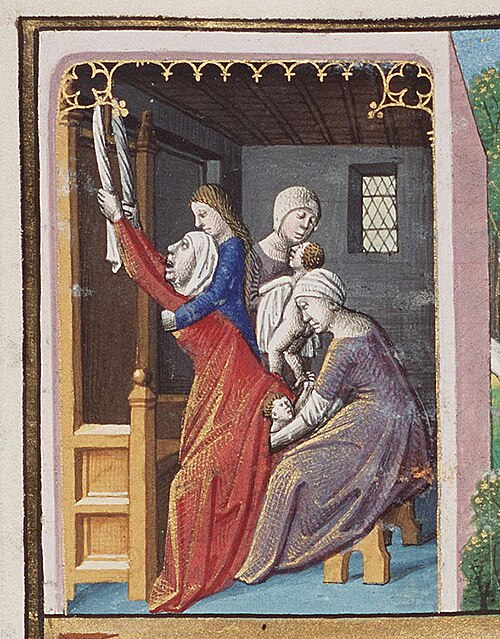
I have to confess; I find that phrase of Rebekkah’s to be rather quotable. I mean, it applies a lot. Right?
And while the illustration above might tell us more about medieval birthing practices, it also somewhat humorously shows Jacob still clinging to his brother’s heel even as Esau is being cleaned up by one of the midwives.
The illustration also renders Rebekkah’s question, “If it is to be this way, why do I live?” in a rather visceral fashion. The contrast between the bold red and blue draws our eyes directly to Rebekkah’s face, no matter how much we’d rather be amused by the depiction of the babies.
Significantly, Rebekkah’s inquiry is answered by God. Her struggle, her suffering, her very last nerve are all given meaning: “Two nations are in your womb…” The oracle is the setting for what follows, as the story of Esau trading his birthright for some bread and soup offers an explanation for why God’s favor might follow the younger son. (Esau, for his part, introduces us to Maslow’s hierarchy of needs.)
That story is useful to bolster identification with Jacob (for his descendants, who are telling the story) and also as a moralizing tale. Esau is read in multiple uncharitable ways. By “despising” his birthright, he is often seen as in some way rejecting God. God’s election of Jacob is made to result from Esau’s choice, not God’s freedom or grace. The fact of the matter, however, is that eventually, when the time comes, Jacob has to deceive his father into giving him the eldest son’s blessing. That works, and the blessing cannot be revoked, nor is there much left over for Esau. Such a strange notion of blessing.
In Jesus’ parable, a sower scatters seed—throws it everywhere, even in places where it is unlikely to produce anything. Unlike Isaac’s blessing, this sower’s seeds are in abundance; like God’s blessings, everybody gets some. What they do with it is another matter, but there is no scarcity. When the seed does take root, and the plant grows to literal fruition, the abundance is multiplied wildly. There will be even more seed to throw around.
Of course, the Genesis story isn’t trying to tell us about God’s grace or blessing as it might be available to us. It’s explaining origins of several people groups, tracing their shared lineage and suggesting reasons for those groups’ estrangements and hostilities, as well as possibilities. Remarkably, the hero of the story—Jacob—is not depicted as a saintly hero; he doesn’t win because of his valiant deeds, but rather through strategy and accident that the text enfolds into its vision of divine freedom and sovereignty.


Leave a Reply