
The Fifteenth Sunday after Pentecost—Proper 18, Year A, Track 1
September 9, 2026
Exodus 12:1-14
Psalm 149
Romans 13:8-14
Matthew 18:15-20
I can’t read this Sunday’s Psalm without hearing the chant we use for it in choir. It always feels a little cringy when we get to the part about wreaking judgment and binding kings in chains being “the glory” of God’s people. I feel like reconciliation ought to be the glory of God’s people—you know, destroying your enemy by making them your friend, that sort of thing.
Right now, I’m reading those lines in the context of verse 4, where God “adorns the poor with victory”:
4 For the Lord takes pleasure in his people *
and adorns the poor with victory.5 Let the faithful rejoice in triumph; *
let them be joyful on their beds.6 Let the praises of God be in their throat *
and a two-edged sword in their hand;7 To wreak vengeance on the nations *
and punishment on the peoples;8 To bind their kings in chains *
and their nobles with links of iron;9 To inflict on them the judgment decreed; *
this is glory for all his faithful people.
Hallelujah!
It reads a bit more like “eat the rich” here. Which still may not be a very Christian sentiment, but it’s certainly understandable.
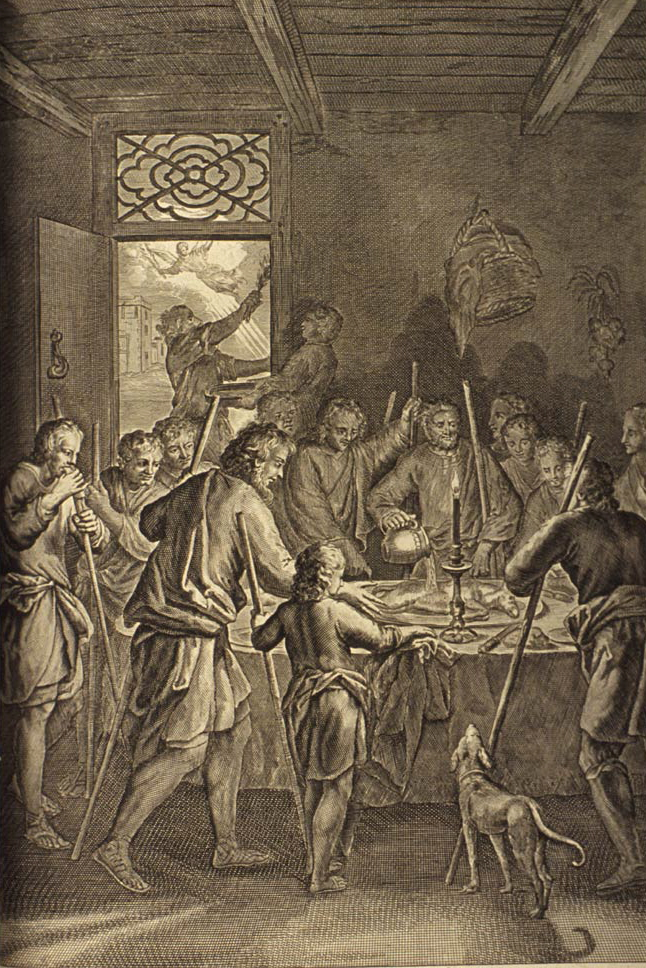
The reading from the Hebrew Scriptures is the institution of Passover. Every time I read it, it feels like there is a bit of a hush to it—words spoken in a hush both because they are subversive, and to invite the listener to lean in close because there are a lot of details to attend to. The preparations for this one night are precise, but simple in that they involve the process of providing a meal (something most of us do every day) and preparing for a journey (which we may do significantly less often). And there is a dramatic difference: not that a lamb is slain; that’s a prerequisite for eating it. But smearing the blood on the door frame? That sets a mood.
God is sharing God’s plan to break the Israelites free from their bondage in Egypt. It is such an important event that it reorganizes the calendar: “The Lord said to Moses and Aaron in the land of Egypt: This month shall mark for you the beginning of months.”
Yet despite the detailed instructions God gives, none of them direct the people to do anything that contributes to their liberation: that is God’s work. No, the instructions are how to memorialize the event. Nothing has happened yet, but God is giving instructions for what the people should do that night, and repeat each year as a memorial. The specific, detailed instructions direct each person’s attention to the significance of this night. Which is what religious ritual is about.
In Romans, Paul spills a lot of ink convincing us of how mired in sin we are. But today, instead of telling us that breaking one law means breaking the whole Law, he tells us we keep the whole Law by loving others. Paul is convinced that Jesus is returning soon, but in any case, he’s certainly not wrong in saying that “salvation is nearer to us now than when we became believers.”
Jesus is giving us some very specific guidance for living together in community: conflict resolution. The community’s actions in dealing with an offender in their midst quickly escalates: “Whatever you bind on earth will be bound in heaven, and whatever you loose on earth will be loosed in heaven.”
Déjà vu: we just heard Jesus say this to Peter, when he gave him the “keys to the Kingdom.” Did he mean Peter, specifically? Or does he mean the Apostles? The Church as such, as an institution? Christians generally? In any case, it gives weight to the community’s authority to act in whatever way is needed to restore peace to the community. And this authority is located in Jesus himself: he will be present whenever two or three believers gather, for example, the gathering of offender and offended (when the offended party reaches out to the offender) or the gathering of three (when they bring a witness).
It’s a seemingly random collection of readings; but part of the fun of using the lectionary is to force us to listen to whatever might come out of the juxtaposition of these texts this time around. (For Episcopalians, this set of readings won’t come around again for six years!)
I’m picking up on a few themes, personally.
God is preparing to liberate God’s people, and the point of doing so is to make of them a people, bound together both by the rituals and practices of their religion, and by God’s presence among them.
Also, eat the rich.
In all seriousness, the communities God is forming in Exodus and in the Gospels are in their early stages, and as such, are fragile. The exultation of the Psalm, celebrating vengeance against kings and nations, needs to be seen in that light.
I’ve found myself in online conversations lately about the tendency for people to reify their own identity as the “good guys,” and their enemies as the “bad guys,” and then to define actions as good or bad according to who commits them, rather than their actual ethical weight. It’s a particularly dangerous tendency for those of us who locate our origins in stories of being the underdog, stories of oppression—but we’ve been liberated or moved beyond that past, and now have power. We’re not the good guys. No one is. And God is always working toward the liberation of the oppressed.
Whether we’re the ones in need of liberation, or the ones someone else needs liberating from, we need to listen, and do what God says to do.


Leave a Reply