
The Fourteenth Sunday after Pentecost
Year A, Proper 17, Track 1—August 30, 2026
Exodus 3:1-15
Psalm 105:1-6, 23-26, 45c
Romans 12:9-21
Matthew 16:21-28
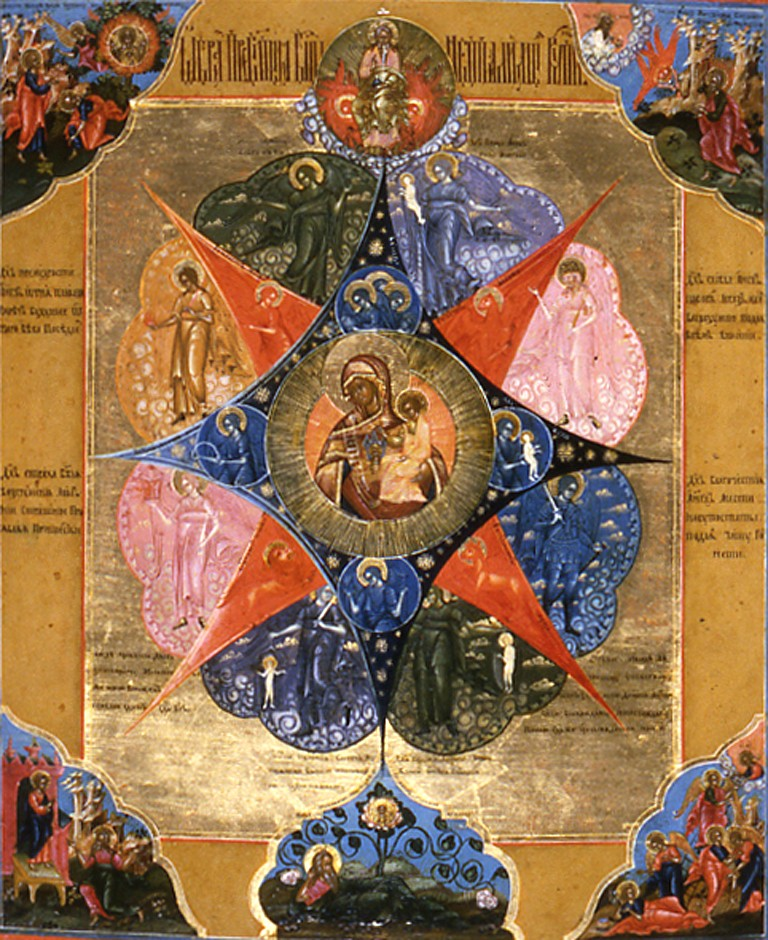
The Genesis story for this Sunday is the well-known story of Moses’ encounter with God on Horeb, “the mountain of God.” It’s such a well-known story, so I thought I’d use the opportunity to share a Christian tradition that sees a shared symbolism between the burning bush and Mary, the Theotokos.
The burning bush that Moses saw captured his attention because it was ablaze, but not consumed by the flame. An angel of the Lord spoke from the flame—i.e., the mediated words of God, delivered through a messenger (what the word “angel” means).
The connection with Mary is that as Jesus took form in her womb, she contained God within her, like Moses’ thornbush contained God, and, like the thornbush, Mary was not consumed.
How does one contain God? Tradition holds that the heavens and earth cannot contain God.
In Mary’s case, of course, it’s because her child was the incarnate God. In Genesis, the flame represented the angel of the Lord, an intermediary. Both represent ways in which people experience the divine in our ordinary world: because God enters it in some way or another.
The above icon is highly symbolic; the flame is represented by the triangular tongue-like shapes. The red flames shooting out from the center contain the symbols of the four Evangelists, and the dark blue flames depict angels. Angels also fill the outer cloud-like shape that seems to depict the thornbush, which in turn is emerging from the Jesse Tree below. (The Jesse Tree is a traditional depiction, usually of Jesus’ family tree emerging from the “root of Jesse,” the father of King David.)
The four corners show some specific scenes: the top two are different depictions of Moses and the burning bush; the lower two are other biblical images Christians have conscripted to represent Mary. On the left is a closed gate, seen by Ezekiel in a vision; it represents (to the Orthodox Church) Mary’s perpetual virginity. On the right, we see Jacob’s dream in which angels were ascending and descending on a ladder (probably a ziggurat, but Christian imagery has used an actual ladder). That ladder has been used to indicate Mary, through whom Christ came to earth from heaven. (I find that curious, as Jesus himself used the image of the ladder to speak of himself.)
The icon above draws me in, because it isn’t simply an icon of Mary and Jesus; it isn’t a simple image of Moses at the burning bush. It weaves both together with so much rich imagery, and it’s visually stunning as well.
You can read much more detail (and see another version of the type) at this site: Icons and Their Interpretation.
Another icon type depicts the scene of Moses on Mt. Horeb, but includes the symbol of Mary and Christ:
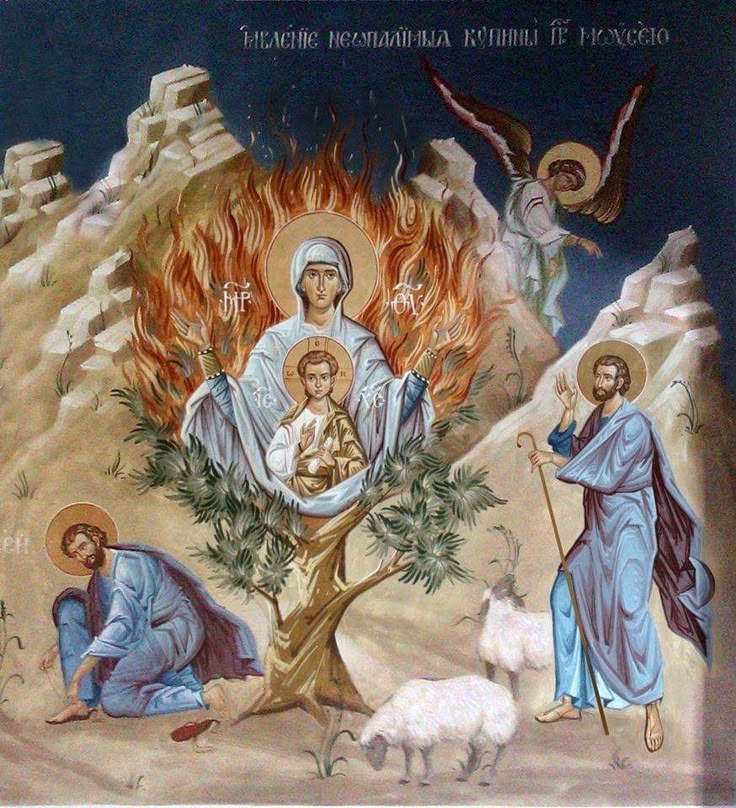
The narrative plays out in Moses noticing the bush while tending his sheep. He is then addressed by the angel of the Lord (seen above the mountain peak) and removes his shoes per the angel’s direction. The angel told him to take off his shoes because this ground, this desert mountain dirt that produces thornbushes and sparse vegetation, is holy. We see this action from the story taking place before the Theotokos and her Child, a reminder that in the Incarnation, Christ sanctified the whole of creation by entering it, from the inside out so to speak.
The thornbush “contains” God. It holds space for divine encounter. Likewise, Mary creates space for the great encounter of God inside of creation; she “contains” God. God, of course, far exceeds containment.
But the reading from Romans lays out a sort of lesson plan for us who, against all reason, are striving to do the impossible and also “contain” God. In no particular order, Paul commends the following habits to develop toward that goal:
Let love be genuine
Hate what is evil
Hold fast to what is good
Love one another with mutual affection
Outdo one another in showing honor
Do not lag in zeal
Be ardent in spirit
Serve the Lord
Rejoice in hope
Be patient in suffering
Persevere in prayer
Contribute to the needs of the saints
Extend hospitality to strangers
Bless those who persecute you; bless and do not curse them
Live in harmony with one another
Do not be haughty, but associate with the lowly
Do not claim to be wiser than you are
Do not repay anyone evil for evil, but take thought for what is noble in the sight of all
If it is possible, so far as it depends on you, live peaceably with all.
Never avenge yourselves, but leave room for the wrath of God
If your enemies are hungry, feed them
If they are thirsty, give them something to drink
Do not be overcome by evil, but overcome evil with good
It’s a lot. But if we could live like this, we would transparently reveal God to a world that needs God so much. So pick one, and work on it. We aren’t going to master this, but we can get just a little better at it than we are right now, and the world will be a better place.
In the Gospel, Jesus is trying to prepare his disciples for his coming death—not just to say, “This is about to happen,” but to teach them the pattern he is setting:
“If any want to become my followers, let them deny themselves and take up their cross and follow me. For those who want to save their life will lose it, and those who lose their life for my sake will find it.
Imagine that—God becoming human in order to fill the whole creation and make it holy, symbolized in a thornbush ablaze without being consumed, is going to just lay that life down, teaching his disciples that “the way of the Cross [is] the way of life” (as the Prayer Book words it, give or take).
If that’s the lesson Jesus is teaching us, if our task is to make this self-sacrificing God visible in our world, what does that require of us?
Holy Mary, Mother of God, pray for us now and in the hour of our death.


Leave a Reply