
The Second Sunday after Pentecost, Proper 5, Year A—June 7, 2026
Track 1*
Genesis 12:1-9
Psalm 33:1-12
Romans 4:13-25
Matthew 9:9-13, 18-26
*In the Episcopal Church, there are two “tracks” during Ordinary Time following Pentecost; each follows different readings from the Hebrew Scriptures and accompanying Psalms.
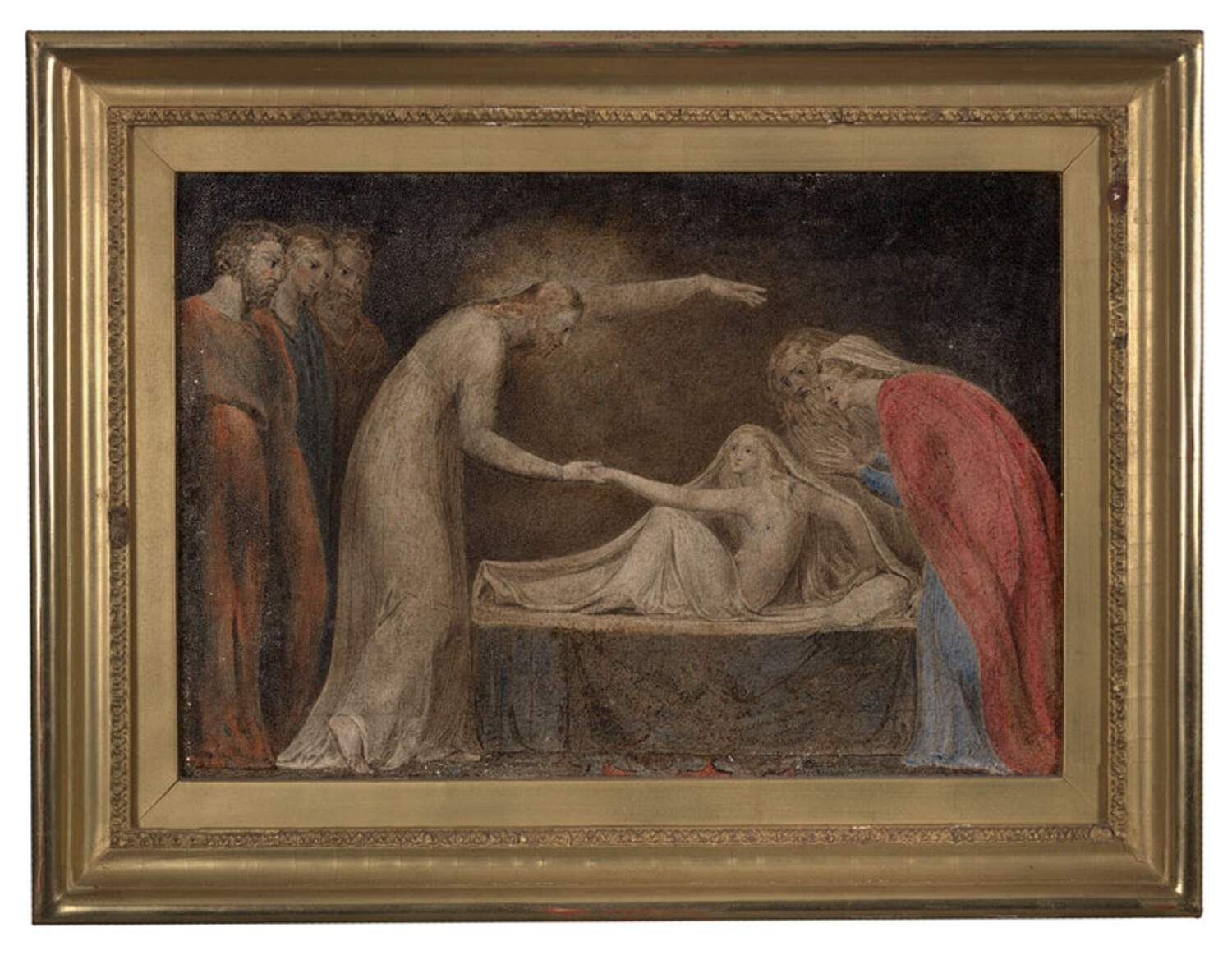
You’ve gotta hear this song by Tara Vanflower: Talitha Koum. It’s a little bit creepy, but isn’t a dead person returning to life a bit creepy? The above painting by William Blake is a bit creepy, but that’s Blake, right? Vanflower’s darkwave interpretation of the story is written from the perspective of the little girl, in an imaginative way that places the singer and/or the listener inside the girl’s experience. I can’t speak for Vanflower, but to me it is a powerful musical metaphor for the love of Christ piercing a particularly dark depressive episode.
I like the Blake painting because it shows Jesus taking the girl by the hand (as the Gospel passage indicates) and looking at her intently and tenderly. It also includes her parents, who exude joyful astonishment, as well as some disciples, whose subtler expressions still betray their amazement.
Matthew’s gospel, like Mark (in chapter 5) and Luke (in chapter 8), slips another story into the middle of this one—the well-loved story of the woman with a hemorrhage who touches Jesus’ hem and is cured. Preachers often note that both the young girl and the woman’s bleeding condition were both 12 years old, which makes the woman’s condition more devastatingly real to us. As he goes to undo death’s ending of a girl’s life after a mere twelve years, Jesus ends a woman’s life-stealing disease after a very long twelve years. How we experience time depends so much on what we are carrying through it. And because most of us have lived through some experience that dragged on through suffering, we can relate to a woman’s desperation as well as her choice to seek healing surruptitiously rather than assume Jesus would respond generously to her confronting him in a crowd. But he doesn’t just heal her, does he? He graces her with his attention—something we all need. Something a woman suffering with such a personal and draining health condition certainly needed. Something we also see Blake depicting in Jesus’ interaction wth the little daughter of the synagogue leader whom Mark and Luke call Jairus.
Thankfully, I’m not a preacher. While preachers usually focus on one of the passages in the lectionary—usually the Gospel—I have heard preachers tie them all together. I can’t imagine how anyone might do that with today’s lectionary readings (in either track). The reading from Matthew even gives us a bit of extra material at the beginning, where Jesus defends his friendship with “tax collectors and sinners.” This too has no clear connection to the other texts. This is fairly typical during Ordinary Time, though.
The Genesis and Romans readings, however, are directly related, and the Psalm can easily be woven in.
In Genesis, we overhear Abram’s call from God to pick up and go to…well, somewhere. It’s a call that does not only involve Abram, though. God calls him, but he must drag along a number of family members, including his nephew Lot (for whom Abram accepted responsibility when his brother, Lot’s father, died). He also must bring with him all his family’s possessions, including enslaved people he inherited from his brother. We too often just focus on Abram, as if he struck out alone, but his choice to follow God’s call required all of this small community of people to uproot themselves and go along with him. (I suspect many people today can relate, either as someone whose calling has affected their family and/or others, or as members of their families and/or others.)
Paul in Romans latches on to one element of this story: Abram’s faith. In his creative reading, Abram’s faith becomes a precedent for the inclusion of Gentiles who have faith among the descendents of Abraham. But he doesn’t seem interested in the promise God actually gave Abram, that his descendents would inherit a specific plot of land. For Paul, it is about being included among those who worship Abraham’s God, and inheriting God’s salvation.
As for the Psalm, it is a fairly standard psalm of praise. The interesting bit, to me, is toward the end:
10 The Lord brings the will of the nations to naught; *
he thwarts the designs of the peoples.11 But the Lord’s will stands fast for ever, *
and the designs of his heart from age to age.12 Happy is the nation whose God is the Lord! *
happy the people he has chosen to be his own!
The last verse gets misused by some Christians here in the US who want our nation to be officially considered a Christian nation. To me, these three verses can be read as a reminder that we need to place ourselves on God’s side, not seek to own or control God, or assume that God will be on our side.
You may have noticed one small detail about my claim that the Gospel doesn’t really tie in with the other readings: In our selection from Romans, Paul contrasts Abram’s and Sarai’s old age with Abram’s faith in a God who ” gives life to the dead and calls into existence the things that do not exist.” The Gospel illustrates the first part of this—giving life to the dead—and the Psalm addresses the latter:
8 Let all the earth fear the Lord; *
let all who dwell in the world stand in awe of him.9 For he spoke, and it came to pass; *
he commanded, and it stood fast.
Together, these readings stress the importance of faith in God a little more subtly than some passages might. More to the point, they show us what faith can look like. It can be as bold as Jairus running up to Jesus saying, “My daughter’s dead. Come reverse that.” It can be as timid as reaching for a garment’s hem. The woman’s act of faith, had it not cured her, could have easily been written off. No one likely knew what she was doing or trying to do, and she could tell herself that touching his garment was not sufficient after all. It was faith, but it was relatively safe. Faith can look like Abram not only risking his own fate but, problematically from today’s perspective, the fate of his whole household. It can look like learning who God is and how God acts, and aligning yourself with God’s will. It can be expressed verbally, pubicly, privately, existentially, through action, or in any number of ways.
You could even paint it!
 The Sound
Leave a comment