
The Eighth Sunday after Pentecost (Proper 11), Year A (Track 1)—July 19, 2026
Genesis 28:10-19a
Psalm 139: 1-11, 22-23
Romans 8:12-25
Matthew 13:24-30,36-43
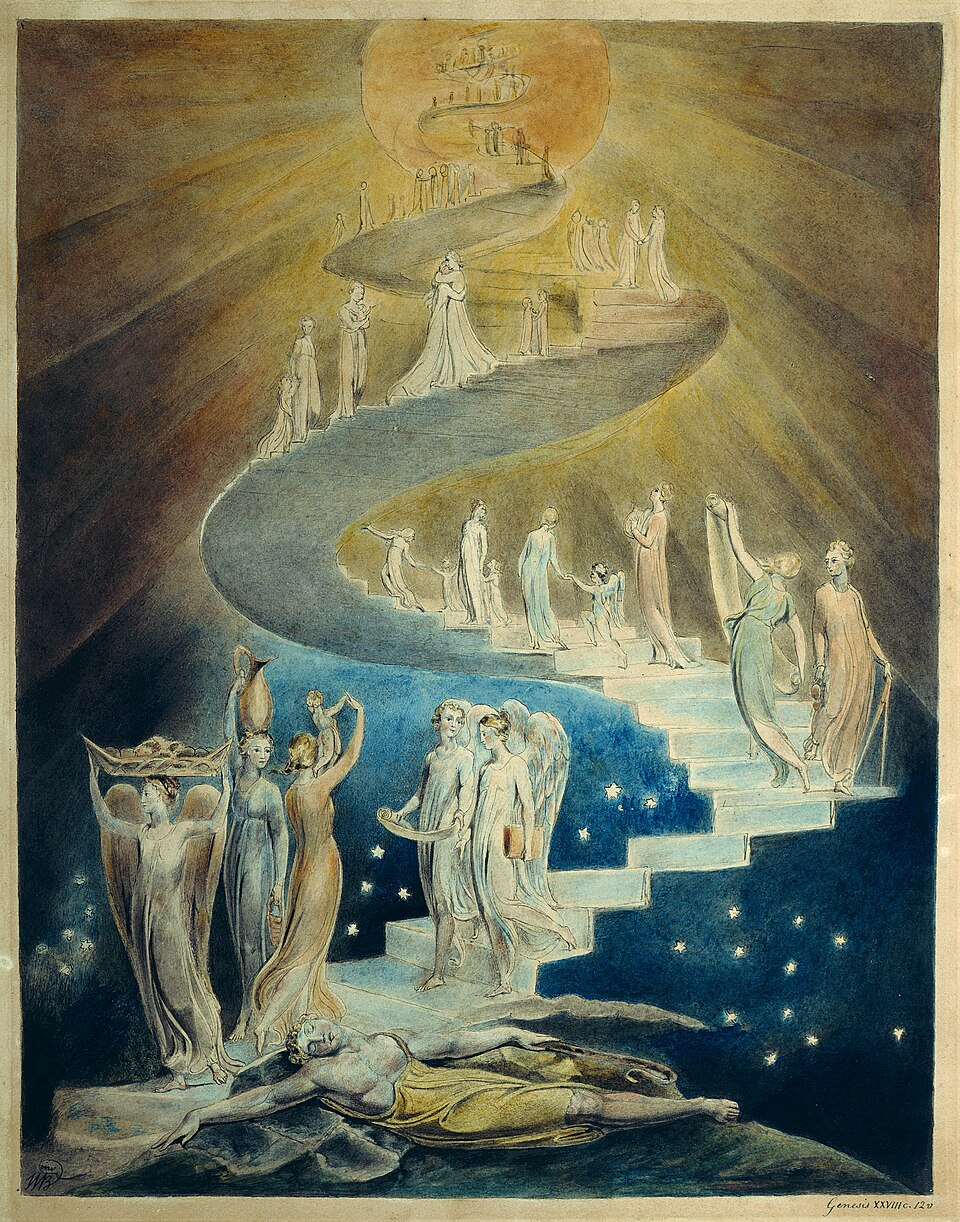
The lectionary today does not match the Genesis story to the Gospel we would expect. Perhaps I should have saved this work of art for a time when the two are aligned. Jesus uses the imagery of Jacob’s ladder to refer to himself; Blake here suggests this through Jacob’s posture. His arms are stretched out in cruciform, and his overlapping feet and head bowed to the side are symbols of submission in much of Western art’s handling of the Crucifixion.
Jacob’s ladder would have been a ziggurat, a form of sacred architecture in the ancient world that both symbolized and enacted the connection of heaven and earth. Mountains were considered sacred in the Bible and in many religious traditions of the time because they rise up toward heaven. The gods, after all, inhabited some space a couple miles above the earth. You climed a mountain, or a ziggurat (a human-made mountain) to get close to the gods, and sometimes, the gods would meet you there.
So Jacob wakes up from his dream with a sense of awe. “Wow—God is in this place, and I had no idea!” Of course not—he wasn’t on a mountain or at a temple of any kind. He was just in some place where he set up camp for the night. God met him there, anyway. And Jacob did something very human: He gave the place a name and set up an altar.
It’s said that place is storied space. This nowhere spot became a place when something happened there. Jacob recognized that by naming the place and marking it with something clearly made by human hands. Anyone who stumbled by would recognize that this was a holy place.
The Psalmist builds on Jacob’s experience of the radical unboundedness of God’s presence:
Where can I go then from your Spirit? *
where can I flee from your presence?If I climb up to heaven, you are there; *
if I make the grave my bed, you are there also.If I take the wings of the morning *
and dwell in the uttermost parts of the sea,Even there your hand will lead me *
and your right hand hold me fast.If I say, “Surely the darkness will cover me, *
and the light around me turn to night,”Darkness is not dark to you;
the night is as bright as the day; *
darkness and light to you are both alike.
The fact that God is everywhere, for the Psalmist, means that God also knows us inside-out. God can search our hearts—a realization that the Psalmist does not run away from (what would be the point? See above). Rather, the Psalmist discerns God’s tender love for them. If God can be everywhere, see everything, and know every thought of every human person, then God can interact very personally with us. God is not up in heaven only to be accessed through the mediation of mountains or temples; God is wherever you happen to be, and God is there to both know and guide you.
I’ve written about the invasive species in and around my back yard, and my front lawn is currently covered in Plantago lanceolata (narrow-leaved plantain), interspersed among the still-short grass. If the air quality improves before the next mowing, I’ll take my trimmer out and chop it down.
I can 100% relate to the belief that some enemy has come and sown these weeds.
In Matthew’s hands, this particular parable of Jesus’ is focused on the idea of judgment: the tares will be burned up, so don’t be a tare! The idea that the wheat and tares are allowed to grow together does seem to explain a lot: why, among religious folks, for example, there are so many truly horrible people. They’re plants.
But how does Matthew’s rationale for leaving the tares in place make sense? Surely the presence of truly horrible people among the pious actually harms the pious more than somehow removing the horrible people would, right?
I’m not going to draw a conclusion on this one. There are a number of ways you might read the story, and how you read it might depend on how you need to read it right now. Maybe there could be something harmful about losing a toxic member of the community. Or maybe it’s simple etiology intended to recognize the fact that the Church is ambiguous at best. Or maybe, just maybe, the field isn’t the Church, but rather each of our own hearts.
How might God be calling us to exercise patience with whatever is imperfect in ourselves or in our communities? When might we be called to lay aside that patience, and act?
Paul somewhat obliquely tells us that the whole creation is in a frustrated state, awaiting the eschaton, basically—similar to Jesus’ parable. The tares will be burned and the wheat processed into something wholesome. None of that sounds like a day at the spa, whether you’re wheat or tare. But Paul assures us that we are children of God, and as such, our story arc is tied to Jesus’. He suffered and then was glorified. We can expect the same.
The one we call “Abba” knows us as intimately as the Psalmist describes. That deep knowledge, God’s familiarity with everything there is to know about each of us, doesn’t lead us to the pile of tares to be burned. Paul says that we should “put to death” whatever is sinful in us; I would add, if we can. The Psalmist would, and did, put it this way:
Search me out, O God, and know my heart; *
try me and know my restless thoughts.Look well whether there be any wickedness in me *
and lead me in the way that is everlasting.


Leave a Reply