
The Ninth Sunday after Pentecost, Proper 12, Year A, Track 1—July 26, 2026
Genesis 29:15-28
Psalm 105:1-11, 45b
or Psalm 128
Romans 8:26-39
Matthew 13:31-33,44-52
Traditional marriage, eh? <sigh>
Today’s reading from Genesis is one I remember learning about as a child. I don’t remember much of how Sunday School teachers or others fielded any questions children had about Jacob and Laban’s strange dealings (in women). It was a story about Jacob’s determination to gain Rebecca, the woman he loved. He was working hard to gain the approval of his future father-in-law (not doing work for which the wages would be human beings). Love, hard work, respect for elders. That was the lesson for kids, anyway.
But the way we think of marriage today—a life-long commitment entered into voluntarily by two persons who love each other—that is a relatively new thing in human history. Our story today may or may not be historical, may or may not reflect the practices of the time it is represented to take place in. Whether or not there is historical accuracy in this story, the writers and compilers of the biblical text wanted to tell us something through it. This story, of course, forms part of ancient Israel’s myths of origin. All human communities have those. They blend fact with some degree of fiction, and history with some wishful thinking. They are organized around a particular people’s story about who they are, where they came from, and where they hope to go. Ancient Israel’s story is a lot more willing to lay out some ugly details of their past than we in the US are (officially, anyway) willing to do with ours.
Anyway, what we read about here contains an element of marriage that is so traditional, it’s still symbolized in contemporary wedding ceremonies in the West. “Who gives this woman to be married to this man?” the officiant might ask after her father has walked her up the aisle (unless the couple has opted out of that line). Sometimes when her father answers, he says, “Her mother and I do,” but the norm is for him simply to say “I do.” He then leads her to her husband-to-be, shakes his hand, and places her hand in her groom’s. The symbolism is not hard to understand, no matter how much we try to back out of it today. And in the reading from Genesis, we read the deal-making behind such a ritual. Jacob and Laban work out a deal whereby Laban will give his daughter to be wed to this man, Jacob: Jacob has to work for it.
Sure, working for Laban for seven years would involve Laban providing for him as a member of the household. This would also allow Laban’s family and Jacob to get to know each other. Presumably, Jacob could have called it off at some point and left. We’re told he barely noticed the labor because he loved Rachel so much. We could question what “love” might mean here, but let’s not.
And yes, there’s the part of the story where Jacob, who had previously deceived his father and brother, is now himself deceived. Again, that centers the men in the story.
But Leah, who has done nothing wrong (other than being born first) is given to Jacob instead of her younger sister Rachel. On the one hand, yay, she’s not left to be an old maid or watch her younger sister get married off first. But on the other hand, she probably knows her new husband thinks she’s someone else. Was she in on the deception?
One updated feature of our marriage rites today (apart from, you know, having them, instead of just calling it a marriage when the father lets the man “go in” to his daughter) is that the persons being married have to both be present to give their consent, and visibly so. Brides who choose to wear veils will have their veil pulled back (traditionally, by their father when he hands her over to the new man who will be in charge of her going forward) before committing to be married. (This is the point where the couple traditionally are asked if they will have each other in marriage, and respond, “I do,” or “I will.”)
Once Jacob can see Leah in the morning and realizes it’s the “wrong” sister, he complains to Laban and is told that he can work another seven years for the sister he really wanted. He agrees to those terms. Now Leah gets to not only watch, but support her husband as he labor to earn not just a different wife, but her sister. Two sisters end up married to one man. This is where one hopes the story is more fiction than truth.
But literally true or not, it is part of a bigger story that Jews, Christians, Muslims, and others look to for insight about the Divine.
Psalm 105:1-11, 45b is a song of praise, to be sure. Astute readers will notice a portion that is alluded to, even partially quoted, in Mary’s Magnificat (recorded in the Gospel according to Luke):
He has always been mindful of his covenant, *
the promise he made for a thousand generations:The covenant he made with Abraham, *
the oath that he swore to Isaac,Which he established as a statute for Jacob, *
an everlasting covenant for Israel,Saying, “To you will I give the land of Canaan *
to be your allotted inheritance.”
Compare:
He has come to the aid of his child Israel,
in remembrance of his mercy,according to the promise he made to our ancestors,
to Abraham and to his descendants forever.”(Luke 1:54-55, NRSVUE)
Comparing Mary’s song with its referent we can see that Mary’s hope for her Son at least contained some hope that he would secure the land of Canaan for his people, who were under Roman rule. While a common descent from one patriarch, Abraham, was likely more myth than history for the Israelites, Mary is able to simply allude to the familial relationship among, and common inheritance of, her people. Inheriting God’s promise to Abraham offered both a major part of her people’s identity and a sense of where they (hoped they) were going.
Paul extends this metaphor of familial relationship to Christians, regardless of their families of origin, ethnicity, or national identity. His audience were not to find their unity as members of a nation—as peoples conquered by the one Roman Empire. No, their identity is rooted in the family of God.
We know that all things work together for good for those who love God, who are called according to his purpose. For those whom he foreknew he also predestined to be conformed to the image of his Son, in order that he might be the firstborn within a large family. (Romans 8:29, NRSV)
Like children, we don’t even need words to come to God our loving parent with all our needs and concerns.
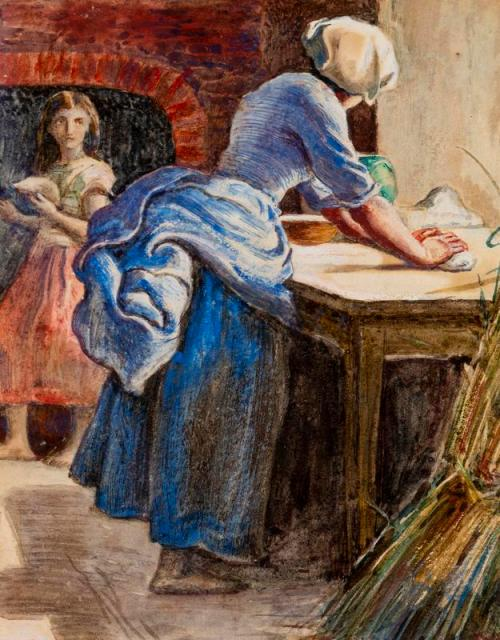
And now we come to the image at the top of this post. Millais’ painting was specifically made to be adapted for a woodblock print, one of a series of images to illustrate Jesus’ parables. Below, you can see the print made from his image. Click on it to read more about Millais’ process on the website of the Met, the museum where this print is housed:
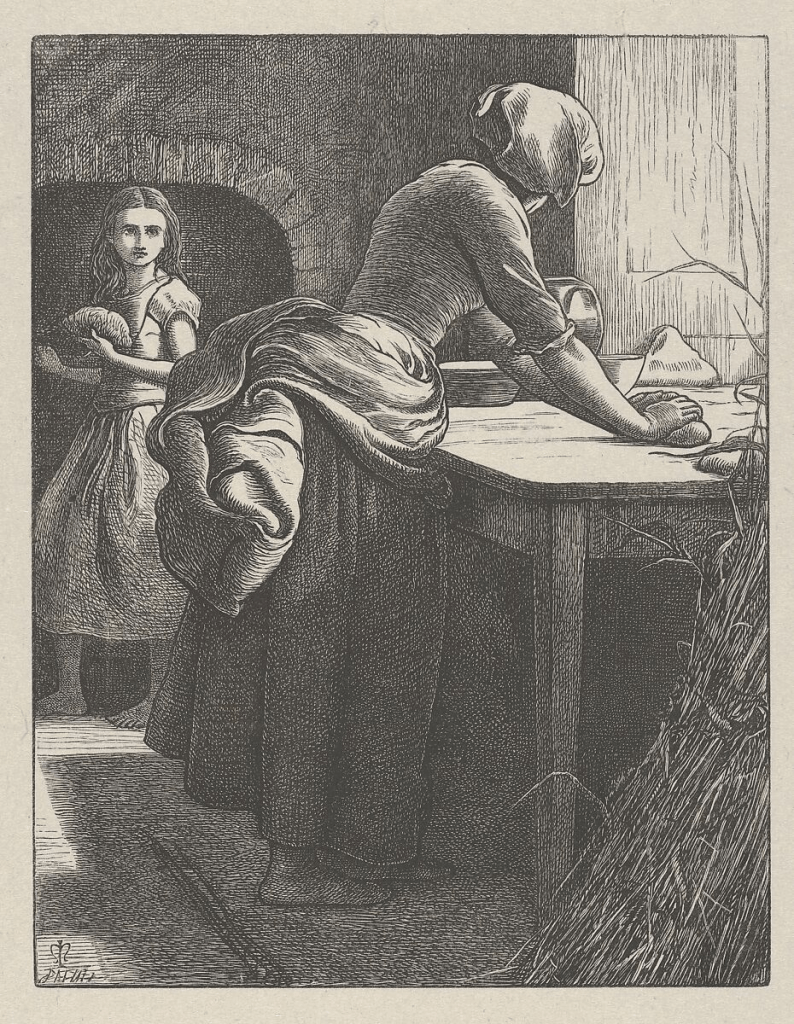
I love the parable of the yeast, and the others with it. They describe the “kingdom of heaven,” or God’s kin-dom, as some today call it, as contagious. Put a little yeast in dough and knead it, and it spreads through the whole dough. Yeast is alive; it grows. This isn’t the dry active yeast we get in packets today at the grocery store; it’s wild yeast, captured out of the air, introduced into dough, and retained over time. As long as part of the starter is reserved, that yeast keeps churning out loaf after loaf. And such is the kin-dom of God, this family Paul was talking about, that God is gathering around God’s Son. Millais adds a character to the story: the woman isn’t making this bread alone. A young girl is helping her, because there’s a lot of bread to make, and bake, and serve. We see hints of the whole process: wheat on the right-hand side becomes dough through the work of this woman’s hands, becomes loaves baked in the oven in the background, to be shared by a household. Adding the girl is a brilliant reminder that this woman’s work is not solitary. Even if the woman were the only one in the room, her labor and its product relate to other persons who will share and be nourished by the bread the woman bakes. And we can see, in the girl’s hands, that the yeast has made that dough rise, enlarging the loaves. (Now I want bread…)
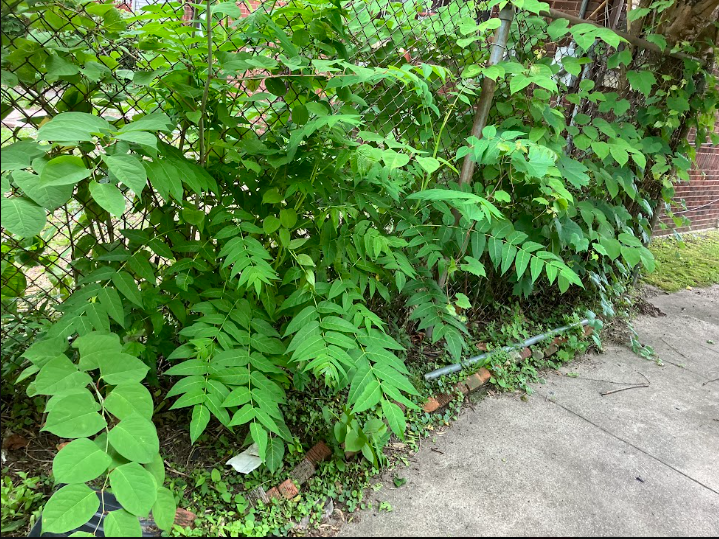
Likewise, God’s kin-dom is like, well, an invasive weed. If I were telling the story, I might compare it to the Japanese knotweed the landlords who own the lots either side of mine don’t care to remediate. The kin-dom of God hopefully won’t wreck anybody’s sewer line, but it will have profound effects on the world around it—some welcome, maybe; others, not so much.
Jesus ends this selection of parables by saying that “every scribe who has been trained for the kingdom of heaven is like the master of a household who brings out of his treasure what is new and what is old.” I’ve long been fascinated by that phrase. It speaks to how we might read Scripture and the tradition Scripture is always embedded in. A treasury containing both new and old might have other stuff in there—objects you don’t want to throw out, really, but you don’t need, or don’t even know how, to use. What is drawn out of the treasury is what is useful to the master of the household. The mental image I always get from this passage is the sacristy of a cathedral where I used to work. There were many valuable things, mostly old, but some new. Some precious metal vessels and some table linens and chalice palls were simply too fragile to use, but too valuable to discard. (Sometimes you couldn’t discard something, because it was donated and that brings a whole lot of responsibilities with it.)
Exploring this metaphor—a store of liturgical objects, some old, some new, some fancy, some plain, intended for a whole variety of uses—is fruitful for me. Just as I would select the vessels and linens for the specific service, so we might bring out of the storehouse of our faith and tradition what is called for and needed for our specific circumstances. What speaks to you right now from the story of Leah and Rachel, for example, is worth noticing, even if there are parts of the story that are, frankly, abhorrent. And if nothing in that story speaks to you, move it aside for now and reach for the object you do need. It might need a bit of polishing. But these scriptures, and our traditions, are treasures—treasures for us to use, to enjoy, and to care for.


Leave a Reply