
The Tenth Sunday after Pentecost—Proper 13, Year A, Track 1—August 2, 2026
Genesis 32:22-31
Psalm 17:1-7,16
Romans 9:1-5
Matthew 14:13-21
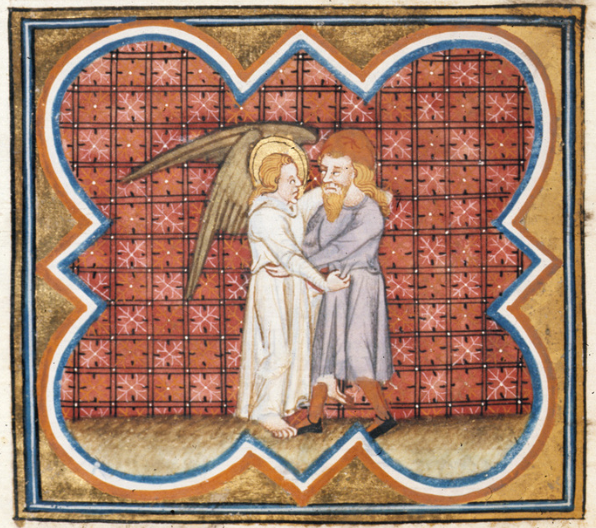
The story of Jacob wrestling with the angel is one of my favorites. It’s such a strange story. On the surface, it’s an etiology explaining how the patriarch Jacob came to also be called Israel. But there’s so much more to it than that.
This story is a brilliant example of why the modern practice of reading the Bible as if it were inerrant and univocal actually impoverishes the text. Imagine reading this story as a simple account of a thing that happened. Instead, like all good folklore or myth, this story brims with symbolic imagery. A useful metaphor, it discloses new meanings latent in other ideas or stories.
The contours of the story are both simple and striking. Jacob is traveling with an enormous entourage (starting with his two wives and their children). He sends them on ahead and stays by himself for some reason; asking the reason here is likely the wrong question. The story continues, as if a line like this were in any way normal:
Jacob was left alone; and a man wrestled with him until daybreak.
What man? How did this come about? I thought Jacob was alone—when did this guy show up, and how exactly did he engage Jacob in a wrestling match? Were they fighting over something, or just wrestling for sport? Not important.
The story doesn’t really tell us who the man is, except obliquely. We refer to the man as an “angel” because that is customary when speaking of a human being who seems to come out of nowhere to speak and act in God’s stead. The text itself implies that Jacob is wrestling with God: once alone again, Jacob marvels, “I have seen God face to face, and yet my life is preserved.” (That’s what caught my eye in the manuscript illumination above. It may not look like much of a struggle, but it shows us a moment—perhaps a fleeting one—in which Jacob and the angel stand face to face and look each other in the eye. I’ll be honest, though; it looks like they’re slow-dancing and Jacob is giving a certain kind of look to the angel who has stepped on his foot.)
I’m not sure it matters whether this is God or an angel. For Christians who want to be reading a literal account of something that actually happened that also doesn’t contradict their reading of other parts of Scripture, it does matter, and it has to be an angel. But in any case, I think either functions in the story. Jacob has had an intimate encounter with God, mediated by an angel or not. We might be tempted to read it as a dream, except that he walks away from the encounter with a limp.
There’s a fantastic essay on this by Rabbi Jonathan Sacks in which he interweaves this story with what comes next, and, from there, with Jacob’s past relationship with his brother, Esau. It’s a fascinating read, and I won’t summarize it here, but I encourage you to go have a look.
I love this story because of its potential to symbolize, and thus help interpret, other things. For example, while in my master’s program, I was taking a class that looked at some really problematic biblical texts. The professor, an Episcopalian, asked what it might mean to refer to this as “the Word of the Lord,” as we do when reading passages in church. (This was hypothetical; I’m pretty sure none of the horrific passages we were looking at are in the RCL.)
What came to mind for me is that our relationship with the Bible is like Jacob wrestling. These are the texts wrestle with—until they give us a blessing. They might even give us a new name (a renewed identity or a new understanding of ourselves). And often we walk away with a limp.
This is quite different from the way we read the Bible in the churches I grew up in. The Bible was there to answer our questions and tell us what we ought and ought not to do. It was a consistent account of things that literally happened, and also some predictions (I won’t say “prophecies”) about what was still ahead of us, again, literally. That’s not to say there won’t be any profound meanings to discover when reading the Bible that way; its genius is that it still has much to offer even when you mistake it for what it is not. Reading it the way I grew up reading it is still engaging with the text, however imperfectly. But I personally reached a point where I recognized that when I read the Bible, I was reading back into it what I had been taught that it said. So I put it away for a while and visited different churches as widely as I could, and after almost a decade, found my home in the Episcopal Church (with a few layovers in other churches along the way).
My own story aside… Jacob’s night-long wrestle with the angel might suggest a good spiritual practice. We all wrestle with many things at different times in our lives. Is there a possibility of demanding a blessing out of the struggle, even if it leaves us with a limp?
One of the points Rabbi Sacks makes in the article I linked to above is that Jacob’s wrestling with God allows him to essentially give back to Esau the blessing he had stolen from him so long ago. I want to try to read our Romans passage through that lens, since so much of Church history has involved Christians, as younger siblings or cousins, trying to steal our elder siblings’ birthright.
Paul seems to be struggling with the seeds of what would eventually become supersessionism—the idea that the Jewish people have lost God’s favor and that favor has moved to the Christian Church. Paul seems to be wondering if that might be the case, perhaps because his own logic has deposited him there. He has been arguing that Gentiles now share in God’s blessings first offered to Israel, but through Christ rather than through Torah. Since that gift is mediated differently (through Christ rather than Torah), does it constitute a new covenant for Gentiles? If so, what happens to the first covenant God made with Israel, confirming again and again through Abraham, Jacob, Moses, David, and various prophets? Can God break a covenant like that? Would God break a covenant? The Scriptures Paul knew consistently said no. But I think we can read this passage as a real struggle Paul is going through.
The Psalm is a rather confident declaration of the psalmist’s faithfulness to God’s commandments, and an equally confident assurance that such a life will lead to what Christians call the beatific vision, “seeing” God as if directly, as if face to face. “Beatific” is related to the word “beatitude,” which we know refers to blessing and happiness. So there is a tie-in with Jacob’s story, even thought the psalmist de-emphasizes the struggle we can infer from the fact they are crying out to God in the first place.
The Gospel is one version of Jesus’ feeding of a multitude. In this instance, it’s a multitude of five-thousand plus (since only the men were counted, which seems to me like it would be harder than just counting everybody—and if it were me, I’d just estimate a crowd that large).
Jesus was trying to get away by himself for a bit. So he got in a boat, which seems like it would be a great way to get to his destination undisturbed, but people figured out where he was going. From different towns, we’re told—probably some from the spot he had left, and others they picked up while walking, on foot, to wherever he was going by boat. As several thousand people crashed Jesus’ alone time, he responded by ministering to them. I started to write that he taught them and healed them, but this text does not mention him teaching—only healing. He was attending to their immediate needs. They had many needs. The hour grew late.
Jesus’ disciples, like good personal assistants, took that opportunity to suggest maybe the crowd should be dispersed. They would need to eat, and this was a secluded place. Where would the people find food nearby? They’d better go home.
Jesus, ever the impractical miracle-worker, said, “Nah, you can feed them, right?”
“Um, no. We have five loaves of bread and two fish”—presumably for the thirteen (or more) of them. (This version doesn’t mention the boy we all remember from one of the other versions.)
“Aaagh—gimme those,” he may have said as he took the bread and fish, and somehow got the crowd to sit down.
Then, in language familiar to anyone who regularly attends Mass, Jesus took the bread, blessed it, and gave it to his disciples, who distributed it to the people. And there was more than enough for everyone to eat their fill.
This is a Eucharistic story. It’s not just a story to wow us and prove somehow that Jesus is God, or that Jesus was a worthy sacrifice for our sins. It’s a story about God’s provision for all our needs. Tradition tells us that when we receive even a crumb of consecrated bread, we have fully communed with Christ and his Church. Even so, there’s more than enough, and it will satisfy us. It’s part of how Jesus takes care of us, makes us whole.
Jacob or Esau, Jew or Gentile—don’t worry, Paul, God has enough blessing to go around. Everybody gets their fill.


Leave a Reply