
The Eleventh Sunday after Pentecost—Proper 14, Year A, track 1
August 9, 2026
Genesis 37:1-4, 12-28
Psalm 105:1-6, 16-22, 45b
Romans 10:5-15
Matthew 14:22-33
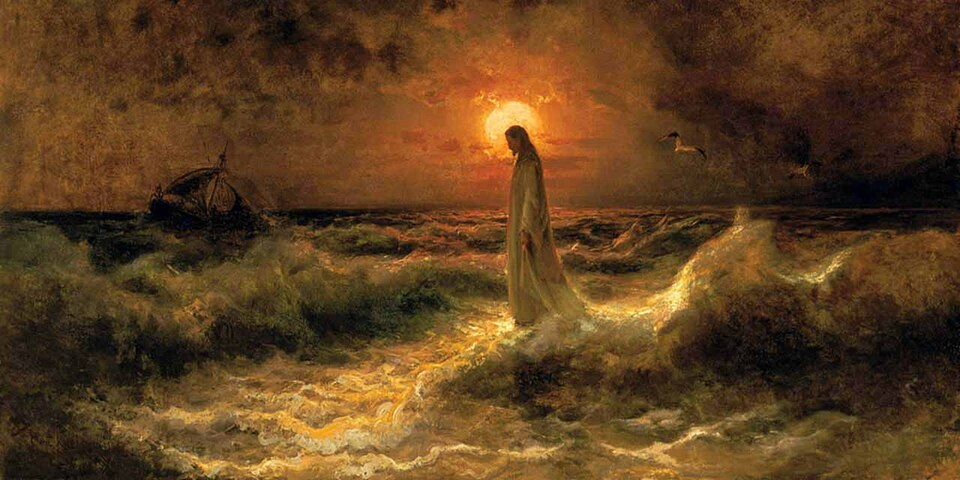
Julius von Klever was a prolific Russian artist (of Baltic descent, also known in Russia as Yuly Yulyevich Klever) who painted stunning, dramatic nature scenes and landscapes. This image, however, is considered to be of the curious genre known as “history painting.” The term isn’t a terribly helpful one, in my opinion, because it doesn’t really circumscribe a style, and the subject matter is generally of ancient myth and fable, and biblical stories.
I’m drawn to this unusual painting because it shows the scene as Christ or his disciples would see it, but from a perspective that centers the staid confidence Jesus interjects into the otherwise turbulent setting. Brown, gold, and red tones—warm colors we normally wouldn’t associate with a seascape—contribute to the unsettling feeling. We know there’s a storm. Is it night or early in the morning? Is that a moon, a sun, or a halo? (It’s not a halo, but it functions somewhat like one, reminding us of the holiness of the figure who dominates the scene.)
Today we read the story that inspired this painting, as it is told by the author of Matthew. Jesus had sent the disciples off in a boat so he could finally get that alone time he had been deprived of by the crowds last week. It’s a well-known story. While Jesus is alone on a mountain (in antiquity, a place you go to be closer to God) the disciples’ boat is being pushed around by wind and waves, and they struggle to direct it toward the shore. At some point, they look out and see what they think must be a ghost on the waters; otherwise, a person is walking on the water! Wait, someone is walking on the water—Jesus, who, apparently close enough to them now to be heard, reassures them and tells them not to be afraid.
We’ll remember the next part of the story as Peter getting excited and jumping out of the boat, but it’s a bit stranger than that. He says,
Lord, if it is you, command me to come to you on the water.
OK, but what if it isn’t Jesus? Anyone can command a person to leave the safety of their boat and try to walk on stormy water.
Jesus simply says, “Come,” and Peter does so. He loses his nerve, though, and starts to sink. But when he does, he cries to Jesus for help. Apparently his brief few steps on the water were enough to convince him this really was Jesus, and, while he may have doubted his own ability to walk on water, he trusted Jesus to be able to rescue him.
Jesus’ final comment, “You of little faith, why did you doubt?” feels a bit insulting here, or like a rather disappointing denouement. Peter just had a profound and, appropriately, turbulent experience, quickly vascilating between trust and fear, and in the process, likely strenghthening his faith by performing it.
This story illustrates that faith is not mere belief, but rather the kind of existential trust that would ask God to call us to do something we have no business doing, then respond to that call by stepping into whatever the text’s stormy waves might symbolize for us. What people often assume faith means—believing something unbelievable—would look like Peter saying to the other disciples, “I’m pretty sure that’s Jesus.” Faith as trust has Peter venturing toward Jesus first with his desire (“command me to come to you”) then with his feet. Faith as trust is when Peter, faltering, calls out to Jesus, who “immediately” reaches out and catches Peter. It seems to me Peter has plenty of faith. The text in its strict reading might not support this stretch, but what if we read “you of little faith” in light of the symbol of the mustard seed (which comes later on in Matthew, chapter 17). Peter has little faith, but it’s enough. It’s enough, because it’s trust placed in Jesus.
The bit of Romans assigned for today contains several pieces that are often used independently to make theological points.
We start with a contrast between the quote from Leviticus 18:5, in which God says,
You shall keep my statutes and my ordinances; by doing so one shall live: I am the Lord
and God’s words in Deuteronomy 30:
“Surely, this commandment that I am commanding you today is not too hard for you, nor is it too far away. It is not in heaven, that you should say, ‘Who will go up to heaven for us and get it for us so that we may hear it and observe it?’ Neither is it beyond the sea, that you should say, ‘Who will cross to the other side of the sea for us and get it for us so that we may hear it and observe it?’ No, the word is very near to you; it is in your mouth and in your heart for you to observe.
Paul has rendered the crossing of the sea as “Who will descend into the abyss?” and, in either case, we can easily connect this passage with the Gospel pericope for today, in which the disciples and Jesus cross the sea, and Jesus pulls Peter from the abyss (or at least prevents him from going there).
But Paul goes on to say those famous words,
…because if you confess with your lips that Jesus is Lord and believe in your heart that God raised him from the dead, you will be saved. For one believes with the heart and so is justified, and one confesses with the mouth and so is saved.
That’s a different understanding of faith than we saw in today’s Gospel. Much is made of the contrast between Paul’s understanding of faith in Christ and its foil (for Paul), works of the Law. But I think our Gospel today shows us how those two understandings actually intersect. Deuteronomy makes that connection explicitly: God’s word is right there on your lips and in your heart for you to observe. The faith you confess and hold dear in your heart is meant to undergird action—not as “works” that make you righteous, but as the natural living out of what you actually believe: what is so inscribed in your body that it functions as motor memory, as habit.
But this quote from Romans is often used more superficially. Confess with your mouth and believe in your heart, and that’s it. You’re saved. It’s something like the “cheap grace” Bonhoeffer kept banging on about in The Cost of Discipleship:
The essence of grace, we suppose, is that the account has been paid in advance; and, because it has been paid, everything can be had for nothing. Since the cost was infinite, the possibilities of using and spending it are infinite. What would grace be if it were not cheap?
However, Paul’s motivation comes out when he immediately writes, “For there is no distinction between Jew and Greek; the same Lord is Lord of all and is generous to all who call on him.” For Paul, God’s grace must be available to everyone, even those whose people did not receive God’s gift of Torah.
“Everyone who calls upon the name of the Lord shall be saved.” This line must be behind the thinking of the compilers of the lectionary when they paired this epistle with this Gospel!
The Psalm and the reading from Genesis go together, although the Psalm spoils the plot of the Genesis story a bit.
It’s another well-known story—although the NRSV more accurately (as I understand it; I don’t read Hebrew) renders the description of Joseph’s coat as long-sleeved rather than many-colored. But looking closely at the text, there are bits we tend to gloss over that are a little bit confusing.
Joseph’s brothers, annoyed with and jealous of their little brother, consider killing him and tossing him in a pit, until one of them, Reuben, suggests, “How about we don’t kill him, but just throw him in the pit?”
Here’s where it gets confusing:
Then they sat down to eat; and looking up they saw a caravan of Ishmaelites coming from Gilead, with their camels carrying gum, balm, and resin, on their way to carry it down to Egypt. Then Judah said to his brothers, “What profit is it if we kill our brother and conceal his blood? Come, let us sell him to the Ishmaelites, and not lay our hands on him, for he is our brother, our own flesh.” And his brothers agreed. When some Midianite traders passed by, they drew Joseph up, lifting him out of the pit, and sold him to the Ishmaelites for twenty pieces of silver. And they took Joseph to Egypt.
Why do the Midianite traders show up, and why does the story even mention them? As I understand it, this may be a trace of some other version of the story.
Midian was the half-brother of Isaac, a son of Abraham and his concubine Keturah. Midian went on to have five sons, who would be Jacob’s cousins. So…by the time Jacob’s children were around, how many Midianites would there be? It doesn’t seem so strange to call these third cousins “Midianites,” just as today we might refer to our third cousins by their family name (“the Campbells,” e.g.). But Midianites weren’t Ishmaelites. Ishmael, of course, was a different son of Abraham, a different half-brother of Isaac. So the Ishmaelites in the story are another set of third cousins.
At any rate, the Joseph’s brothers retrieve him from the pit in time to sell him to the third cousins on the Ishmaelite side of the family who are heading to Egypt to trade gum, balm, and resin. So Joseph is packed along with incense and lotion, basically. It would probably smell very nice if it weren’t for the camels.
Psalm 105 is safely on the other end of this story, and is able to praise God for having used Joseph’s brothers’ treachery toward their brother in order to provide for Jacob and his family later on during a famine. Joseph’s story will be one of descent not only into a pit, but into an enslaved state, then even lower into prison, before being lifted back out and placed in a position of authority. Joseph will have gained wisdom through his experiences (maybe a bit like Peter) and will use his position of power not to get revenge on his brothers, but to help them in their time of need and to heal their relationship.
I’m not going to make an easy association here between living out faith as trust in God and being able to forgive really awful things that have been done to you, maybe even by your family. The biblical stories may point to that as a possibility, but it cannot be an expectation or burden on anyone. More importantly, these stories point to a possibility of surviving whatever abyss we’re thrown into and coming out again—alive, but maybe more than that. Maybe stronger, like scar tissue is stronger. Maybe wiser, maybe in a better position. Maybe more sceptical and less prone to trust. Healing will be a process of putting one foot in front of the other—though not necessarily on stormy water.
Trusting Jesus means putting that one foot in front of the other, and letting him catch you if you start to falter.
Most of all, trusting Jesus means acting on his command, “Do not fear,” even if that action is only a baby step in his direction.
We’re constantly bombarded with reasons to be afraid—some real, some imagined, some completely fabricated in order to control us. Heading into an election season here in the US, the voices commanding us to be afraid—of immigrants, of socialists, of various kinds of existential doom—all while throwing us into some kind of pit to sell us to someone, to enslave us. None of that is the voice of Jesus; none of it should lure us into stormy waters, because none of it will rescue us if we fall.


Leave a comment