
The Twelfth Sunday after Pentecost, Proper 15, Year A, track 1—August 16, 2026
Genesis 45:1-15
Psalm 133
Romans 11:1-2a, 29-32
Matthew 15: (10-20), 21-28
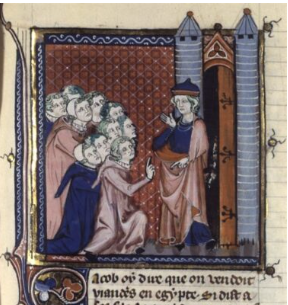
You will have had to do some reading on your own for all the details, but now the lectionary highlights reel brings us to the moment of truth, when Jacob’s brothers, who had sold him into slavery, find out what’s become of him.
Joseph’s brothers had come to beg. A little earlier, in chapter 42 of Genesis, we learn that there was a famine. But the land along the Nile River was notoriously fertile, and Jacob had heard there was rice in abundance there. So he sent his sons—at least, ten of them; having lost Joseph (he thought), he couldn’t bear to risk losing Benjamin, so kept him at home. Joseph and Benjamin had been the only children of his late wife, Rachel—the favorite of the two sisters he married a few weeks of lectionary readings ago.
So the ten brothers travel to Egypt (no small feat when you’re hungry!) and it just so happened that Joseph was a governor in charge of Egypt’s grain reserves. So they find themselves in his presence, but don’t realize it’s him.
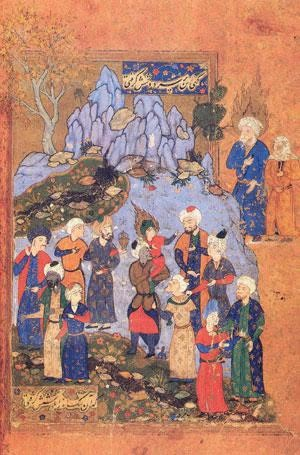
The illumination above renders the scene as if it were in medieval Europe, which was an entirely natural thing to do. See, for example, this later (16th c.) manuscript illumination by Persian artist Mir Ali:
But whether it was due to the passing of time, or Joseph’s royal Egyptian attire, or just the fact they couldn’t possibly have expected to see him in this position, his brothers do not recognize him until he reveals himself. Before he does that (in today’s passage), he really messes with their heads, accusing them of being spies, then sending them back to retrieve Benjamin (with Simeon bound and left in Egypt as collateral). They paid for some rice, but Joseph ordered that their money be returned in the sacks with the rice. When they found it later (on their way home, and at home in their father’s presence) they are pretty sure they’ll be accused of doing something wrong.
Jacob isn’t easy to persuade, but eventually the brothers are able to return to Egypt with Benjamin, and that is when today’s story takes place. Joseph reveals who he is. Before his brothers can really process it all, he assures them that, while they had done something horrific to him by selling him as a slave, God had used it for good, as a means of connecting their family with the supplies they needed to survive the famine.
Did you catch that? God provided for Jacob’s family, Genesis seems to say, by masterminding this whole drama where Joseph’s brothers sell him, he goes through everything he went through in Egypt (and if you didn’t read at home, you may want to—it’s quite a story), Jacob spends years believing he’s lost a beloved son.
Sometimes we experience healing or reconciliation in this way: it feels almost as if we are glad the injury happened, because what resulted from it has brought about a greater good. I think theologically, it’s very problematic to claim that God planned it that way all along. But looking back, it can feel that way to us. In reality, God is always seeking to bring about good using whatever is at hand. Sometimes, that’s an injury or treachery.
And it’s important to be careful here: Not every case of injury or treachery resolves this way. Suffering is bad, full stop. It is to be avoided if at all possible. And a person who is betrayed cannot be coerced to forgive, and cannot have terms of forgiveness or reconciliation defined for them.
A story like this creates space where we can think about, even wrestle with, the kinds of existential dillemas and crises we bring with us to the story, or that the story reveals by mirroring our situation back to us. That means, among other things, that there isn’t one “correct” way to interpret or read the story. It will mean different things not only to different people, but to the same person coming to it at different times. That’s just how good stories work.
The Psalm pairs nicely with the Genesis reading. “How good and pleasant it is when brothers live in unity!” After the story we just heard, we can see this both in the positive form (the family reunited) and in the negative (all the trouble their disunity caused).
Paul’s reasoning might be best read in this light: that God is not manipulating history in order to achieve God’s preferred outcomes; rather, God makes use of what does happen. Paul is bewildered that his fellow Jews don’t agree with his assessment that Jesus is the Christ. Sure, he can remember when he didn’t think so, but he’s also really good at beating himself up. When he claims here that the Jewish people are being disobedient, it’s entirely possible he’s projecting his opinion of himself, prior to his “Damascus Road experience.” Can God really only have mercy on people who deserve wrath for disobedience, Paul? Must God engineer a way for the righteous to fall in order to extend grace to them, Paul?
However he gets there (which, it turns out, is problematic all these centuries later), Paul at least arrives at the conclusion that God’s promises are irrevocable. God does not break covenant.
Paul isn’t espousing a supercessionist theology here, I don’t think. In fact, what he says here can be used to argue against that blasphemy. God does not break covenant.
According to Matthew, Jesus’ self-understanding was that he was sent to minister to his fellow Jews. When a woman of non-Jewish Canaanite lineage comes to him asking that he heal her daughter,
He answered, “I was sent only to the lost sheep of the house of Israel.” But she came and knelt before him, saying, “Lord, help me.”
Dang it, lady. He has to ramp this up so she understands:
He answered, “It is not fair to take the children’s food and throw it to the dogs.”
Didn’t work.
She said, “Yes, Lord, yet even the dogs eat the crumbs that fall from their masters’ table.”
She picks up his insult and turns it on him. Her daughter is ill. She is a mother. She is not going to give up.
Then Jesus answered her, “Woman, great is your faith! Let it be done for you as you wish.” And her daughter was healed instantly.
But…was that really so hard, Jesus? Why does she have to complete some kind of feat to show she really means what she is asking? Sure, she didn’t have to journey from Canaan to Egypt back to Canaan and back to Egypt again carting bags of grain and various combinations of brothers. But still.
Sometimes, divine provision seems obvious. Other times, it looks like this: really hard work for no good reason. I don’t know why. But I have experienced both.
Let’s review:
Genesis—God provides the basic need of food to Jacob’s household by [checks notes] having Joseph’s brothers sell him into slavery many years before, and letting fate knock Joseph around a lot until he winds up in a position where he’s holding the bags of rice when his brothers show up to beg.
Psalm—God offers blessing when people live in unity. (OK, that one’s not so bad. But living in in unity also is hard to do, if we’re honest.)
Romans—God’s gifts and calling cannot be revoked; but in order to extend them to everyone, God has to make sure everyone is equally guilty, so that they can be forgiven. Or something.
Matthew—There isn’t enough blessing to go around. Oh, wait, there is! It’s just crumbs on the floor for you, though.
So where am I going with this?
Well, I first want to point out that our sacred texts are highly problematic. They are our founding documents, so to speak; our communities of faith gather around them, like ancient humans around the fire, telling stories while cooking the day’s catch, and bonding as a community.
So these stories and texts are worth wrestling with. We can be honest when we find them distasteful. We can demand, like Jacob did (in the lectionary earlier this summer), that they give us a blessing or we won’t let them go. We might get hurt in the process. We might, in fact, have to give up, at least for now.
We might get it wrong.
But—and this is best done in community, where possible—we can find new meanings that arise from the text to greet, maybe answer, our own pressing concerns.
But what we are holding when we hold a Bible isn’t the answer section to life; it’s not even a book with the rules of whatever game we’re playing. It gives us scenarios, like zen koans, perhaps, or maybe templates to look at our world differently than we might have thought to, given the blinders fixed on us by the social order we live in.
It’s worth wrestling, arguing, demanding the crumbs.


Leave a Reply