
The Thirteenth Sunday after Pentecost—Proper 16, Year A, Track 1—August 23, 2026
Exodus 1:8-2:10
Psalm 124
Romans 12:1-8
Matthew 16:13-20
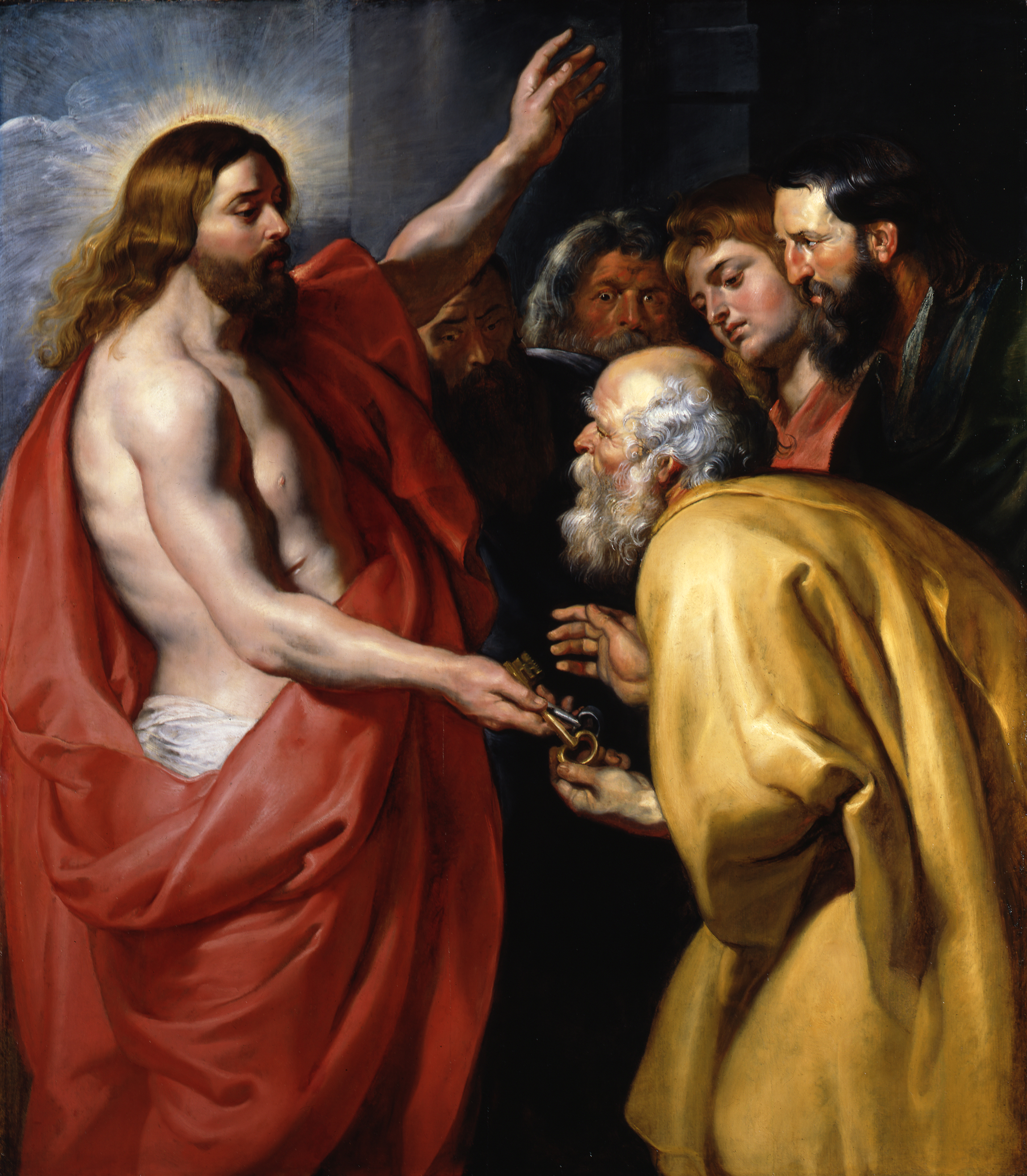
The image above is a curious one. It centers the moment in today’s Gospel where Jesus sais to Simon,
Blessed are you, Simon, son of Jonah! For flesh and blood has not revealed this to you, but my Father in heaven. And I tell you, you are Peter, and on this rock I will build my church, and the gates of Hades will not prevail against it. I will give you the keys of the kingdom of heaven, and whatever you bind on earth will be bound in heaven, and whatever you loose on earth will be loosed in heaven.
Traditionally, Catholics read this as something like an origin story for the papacy. Peter, retrospectively counted as the first pope, is here given the keys to the kingdom, along with the authority to effect heaven itself by actions taken on earth. Protestants understand Jesus to be referring to Peter’s confession, “You are the Messiah, the Son of the Living God,” as the rock on which Jesus builds his church; and the keys to the kingdom of heaven are given to the church as a whole. I’m Anglican, so I get to sort of shrug noncommittally. (Is that a word?—OK, I googled it; it seems to be.)
Then Jesus “sternly” tells the disciples to keep it all a secret—the “Messianic secret,” as scholars call it. This post won’t go into that; but I think it’s an interesting juxtaposition to Ruben’s painting here.
What do you notice first when you look at it?
I’m going to guess it’s Jesus’ stance, his glowing hair and flesh, and—yes, that flesh. A couple odd things about it. Why is that red…robe?… hanging off him like that?
Rubens has taken extreme liberties with the biblical source text.
First, the literal keys. Those are for our benefit. St. Peter is usually portrayed holding keys so that we can identify him in iconographic imagery such as stained glass or statuary. But here, in this fairly realistic-looking image, the keys alert us to the symbolic nature of the image.
Second, this is a post-Resurrection Jesus. You can see the scar in his side; but even before that, the way he is dressed is typical of depictions of his resurrected state. The red garment represents blood. It billows as if airy but also appears quite tactile: it’s physical cloth on a flesh-and-blood body. And the way it’s practically falling off? That serves two functions. First, it emphasizes Jesus’ flesh as a visual argument that he is indeed raised from the dead. Second, it represents innocence.
As four other apostles look on (the young one is likely St. John, the Beloved Disciple), Peter receives the keys with reasonable fear and trembling.
But this is not a post-Resurrection story. None of the Gospels place it after the Resurrection. It’s a middle-of-the-story passage. Mark even puts it practically at the center of his gospel, and organizes the rest around it. It’s both the biggest (Messianic) secret and the key to understanding everything else about Jesus.
But Peter has been given divine revelation in his confession that Jesus is “the Messiah, the son of the Living God.” Maybe Rubens was giving us something of that vision.
I normally don’t mention the collects, but this week I think it’s not a bad idea:
Grant, O merciful God, that your Church, being gathered together in unity by your Holy Spirit, may show forth your power among all peoples, to the glory of your Name; through Jesus Christ our Lord, etc.1
The readings for this week are a little disjointed, but one way to unify them is to focus on this idea of a group of people being “bound in unity.”
The Exodus story only fits into this scheme if we recall what it’s pointing toward. Scholars generally agree that there is no evidence that the biblical story of the Exodus is historical. In any case, it functions as an origin story for the ancient Israelites’ sense of identity and peoplehood, centering that identity on the liberating power of God.
This, of course, is a Christian reading, and only one particular Christian reading. I defer to the biblical scholars on any more details regarding the narrative, the text, and the text’s histories.
This section of the story holds a lot of interesting details—for example, the names of the midwives, the papyrus basket sealed with bitumen and pitch. The telling of how Miriam witnessed her little brother being drawn up out of the Nile, and having the clever idea to ask whether Pharaoh’s daughter would like to hire a Hebrew wet-nurse (her, and the baby’s, mother). These details draw us in to the story, but also create a trajectory for it: God’s provision, care, and salvation.
It is easy to imagine Psalm 124 alluding to either the rescue of the Israelites through the Red Sea or the Jordan River, but the psalm is vague enough that it can apply to any instance of overwhelming danger. The juxtaposition between the story of Moses being drawn up out of the Nile, adopted by Pharaoh’s daughter, and supplied with nourishment from his own mother and the first verse of the Psalm: “If the Lord had not been on our side…” foregrounds the ongoing story of divine provision and salvation that we will find throughout the Exodus story and beyond, into the very DNA, so to speak, of a people brought together in Canaan and united under the worship of one particular God.
The epistle and Gospel lections are certainly among the “greatest hits” of the Bible.
Paul draws on a metaphor used by Plato (that likely didn’t originate with him either): the body politic as an individual human body. He leans more heavily into this imagery in another letter (1 Corinthians), but here he uses the human body to point to diverse functions that work together for a greater whole. (I wonder what he would do with this metaphor if he knew even what little we understand of the brain and nervous system today!)
I’ve written before about the idea of conformity to God rather than the spirit of the age. It is important we not confuse the “world” here with the pet peeves of more vocal corners of the church. Paul is not saying to reject DEI, or to be uptight about whatever is currently the most salient political fodder. He’s enjoining us to draw our mindset from God, orienting ourselves toward God’s service in and through the church, the body of Christ.
The roles he lists are just examples, but they range from cheerfulness and compassion to generosity and leadership, to prophecy and faith. We find our vocation—the ordering principle of our lives—in the charisms God has given us within Christ’s body. And it is rare that this happens to be what we do for a living, what someone will pay us to do based on the values of the market.
In the Gospel reading, Jesus is curious about what his disciples are hearing about him in the streets. Once they’ve told him all the things they’ve heard—mostly identification with dead prophets—Jesus asks his disciples that well-known question, “But who do you say that I am?”
This question can be a cipher for us as we reflect on the words we’ve just read from Paul. Certainly, our answer to this question can indicate whether we’re “conformed to thi world” or “transformed by the renewing of [our] minds.” If we are to be members of Jesus’ body, it matters who we think he is.
There’s a common trope that seminary is a place where your faith goes to die, because people who study the Bible, theology, Church history, etc., at the graduate level are introduced to new ideas that for them and their tradition, may seem unprecedented. There’s a fantastic essay by Jeremiah Wright, Jr., “Doing Theology for Ordinary Folk,”2 in which the Rev. Dr. Wright relates the story of a new seminary graduate who had studied under the late James Cone, returning to his home church and preaching with all the knowledge he had gained through his studies. After the service, congregants were happy to greet him and thank him for his sermon, but, Wright notes, “an octogenarian—one of the “Mothers” of the church” called him out:
“Son! You’ve got a bubbling fountain of knowledge, insight, and wisdom […] but if you want me to drink from your fountain, next time, put it in a cup I can recognize!”3
I try, in my classes, to help students avoid this kind of situation by asking them to relate topics we study and articles we read in theology classes with their own spiritual life and their ministry. What difference does this make?
The seminary answer about who Jesus is can be rather convoluted; it took the Orthodox Catholic strand of the Church a few hundred years to spell it out (anathematizing countless other Christians along the way). But all Christians are faced with the same question. Who do you say Jesus is? No, despite what everyone else says, despite the word on the street, despite what your seminary professor says, despite what brilliant pastors like James Cone and Jeremiah Wright say… Jesus asks, “But who do you say that I am?”
The answer is personal, but not private. It will inform our very way of being in the world. It will inform how we join ourselves with other Christians in Christ’s body. It will inform how we renew our minds, to what we will conform, and how we will live out our various callings.
 The Sound
Leave a comment